
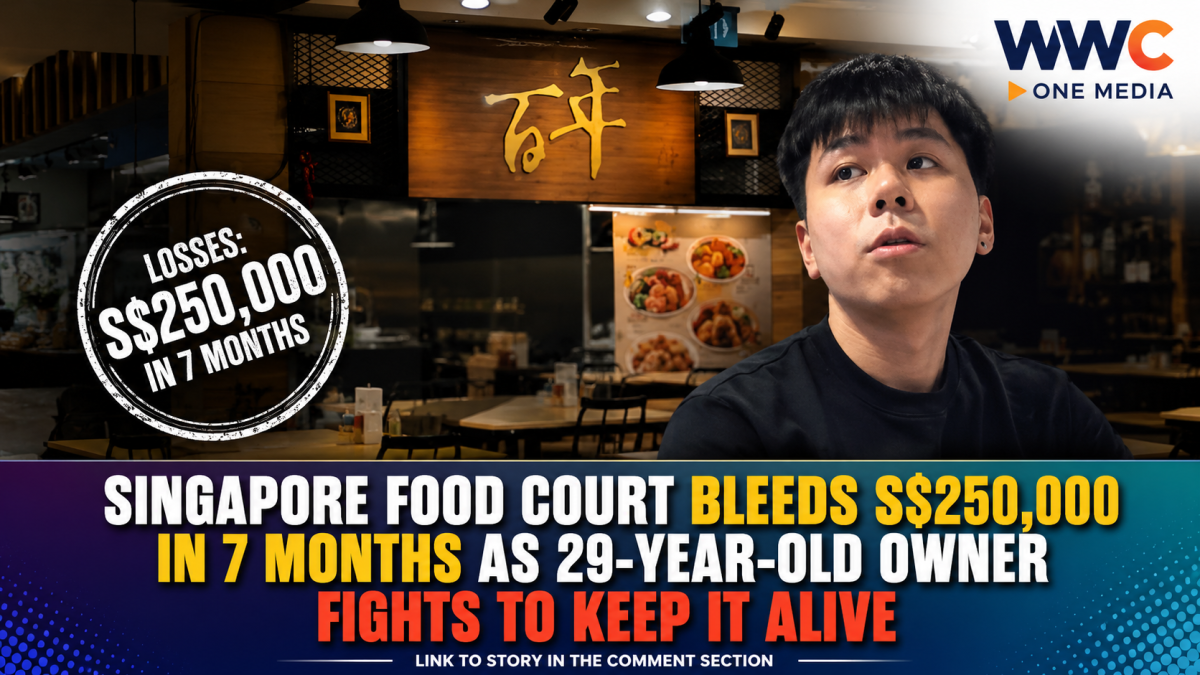
SINGAPORE — A family-run food court in Chai Chee has lost about S$250,000 in just seven months, with its young second-generation owner saying persistently weak weekday foot traffic has made it increasingly difficult to attract tenants and keep the business afloat.
At the centre of the struggle is Bai Nian Food Court, located at ESR BizPark @ Chai Chee.
Its 29-year-old owner, Tommy Pang, recently opened up about the business crisis in an Instagram video, saying the family had lost around S$250,000 simply trying to keep the food court operating.
And the numbers behind the problem are striking.
The food court can accommodate around 400 to 500 diners, but during weekday lunch, occupancy can fall to just 10% to 20%.
On one recent weekday, Pang said he saw only four or five tables occupied around lunchtime.
That lack of foot traffic has created a vicious cycle: fewer customers make the location less attractive to stall operators, while empty stalls make it harder to draw customers.
‘The building is dead’
Pang did not mince words when describing the problem.
According to 8days.sg, he said: “The problem is, there are just no people anymore. The building is dead.”
The family has operated the food court since 2017, but Pang said business deteriorated during the Covid-19 period and never fully recovered.
Companies moved out of the business park and working-from-home arrangements became more common, reducing the number of office workers eating in the area.
The result is particularly noticeable on weekdays.
Interestingly, weekends tell a very different story.
The food court can reach around 80% occupancy during weekend lunch, partly because the development houses children’s enrichment centres. Parents bringing their children for classes provide a much-needed source of customers.
But a strong weekend crowd is not enough to offset five weak weekdays.
The tenants started disappearing
The footfall problem has also created another headache: finding tenants.
A food court operator normally depends on individual stallholders to occupy its units and pay rent.
But prospective operators visiting Bai Nian Food Court reportedly see the quiet weekday environment and become reluctant to commit.
Pang said one Western food operator recently left and forfeited its entire deposit.
The family had hoped to find an Indian food operator to take over the vacant unit, but was unable to secure one.
And that leaves the family with a difficult choice.
An empty stall still represents an operating problem.
So instead of leaving units vacant, the Pang family increasingly started running the stalls themselves.
One family now runs seven of eight stalls
The food court has eight stalls, including a drinks stall.
According to 8days.sg, only one external tenant remains, while the Pang family operates the other seven units through its various F&B concepts.
Those businesses include brands such as Bai Nian, Shi Nian and Hae! Mee, alongside newer concepts launched to fill vacant spaces.
The strategy keeps the food court looking operational, but it comes with another cost.
Opening a new stall requires money, manpower, menu development, training and marketing.
Pang estimated that even a relatively basic new stall can cost around S$15,000 to set up.
So the family is effectively taking on more business risk to prevent the food court from becoming even emptier.
Why not simply close?
That may seem like the obvious solution after losing S$250,000.
But for Pang, the food court is about more than the balance sheet.
The family took over the food court nine years ago, when Bai Nian’s yong tau foo business was still relatively small.
Opening a food court carrying the Bai Nian name helped give the brand greater visibility.
Pang also described the location as deeply sentimental to his family, saying it was a place where his family used to spend time every day.
There is another consideration: the workers.
The food court currently employs 17 people, and Pang said closing it would leave him with nowhere to place them because his other businesses do not have enough capacity to absorb the staff.
So despite the losses, the family is not ready to walk away.
The family is trying one more push
Rather than simply waiting for customers to return, Pang and his team have started actively promoting the food court online.
They have created a dedicated Instagram presence and launched promotions aimed at encouraging customers from outside the business park to make the trip.
One current promotion gives customers a free hot drink with the purchase of a main dish from participating family-run food brands at the food court.
The promotion runs until Sept. 30, with drinks such as kopi, tea and yuan yang available; iced versions cost an additional 50 cents.
The family is also seeking help from its landlord.
Pang said he met with ESR on Sept. 1 to discuss the situation and has asked whether the rental could be reduced. AsiaOne reported that the landlord was open to helping.
The family has already faced other F&B setbacks
The Bai Nian Food Court crisis is not happening in isolation.
Pang has faced other challenges across his family’s F&B businesses.
Earlier this year, Dudu Cantonese Cuisine, another business associated with Pang, was forced to leave its Eunos location after the landlord decided not to renew the coffeeshop’s master lease. Pang was given just over a month to find a new location for the business and its staff.
His family has also previously spoken publicly about substantial losses from its Shi Nian pork leg rice expansion, making the latest S$250,000 food-court loss another major setback for the young entrepreneur. 8days.sg reported in 2025 that Shi Nian had lost about S$500,000 over six months following an aggressive expansion.
But Pang says he is not giving up yet
Despite the numbers, Pang has chosen to make the struggle public.
Rather than simply announcing that the business is failing, he is documenting what went wrong and what the family is trying to do about it.
His approach is essentially a gamble: turn transparency into marketing and hope customers respond.
And there are signs that the strategy may be generating some attention.
Pang told 8days.sg that some customers have told him they visited his businesses after seeing his social-media videos.
But whether attention can translate into enough weekday customers remains the bigger question.
The family renewed its food-court lease in October 2025, with the agreement running until 2030. Pang said the situation was still manageable at the time, when three external tenants were operating there.
It was only during the following four to five months that the situation deteriorated significantly as more tenants left.
For now, the 29-year-old owner is betting on new food concepts, promotions, social media and possible rental relief.
The food court has survived nine years under the family’s management. But after losing S$250,000 in seven months, its next few months could determine whether Bai Nian Food Court gets a second chance—or becomes another casualty of Singapore’s increasingly difficult F&B landscape.
WWC ONE MEDIA J.M.D




Leave a Reply