
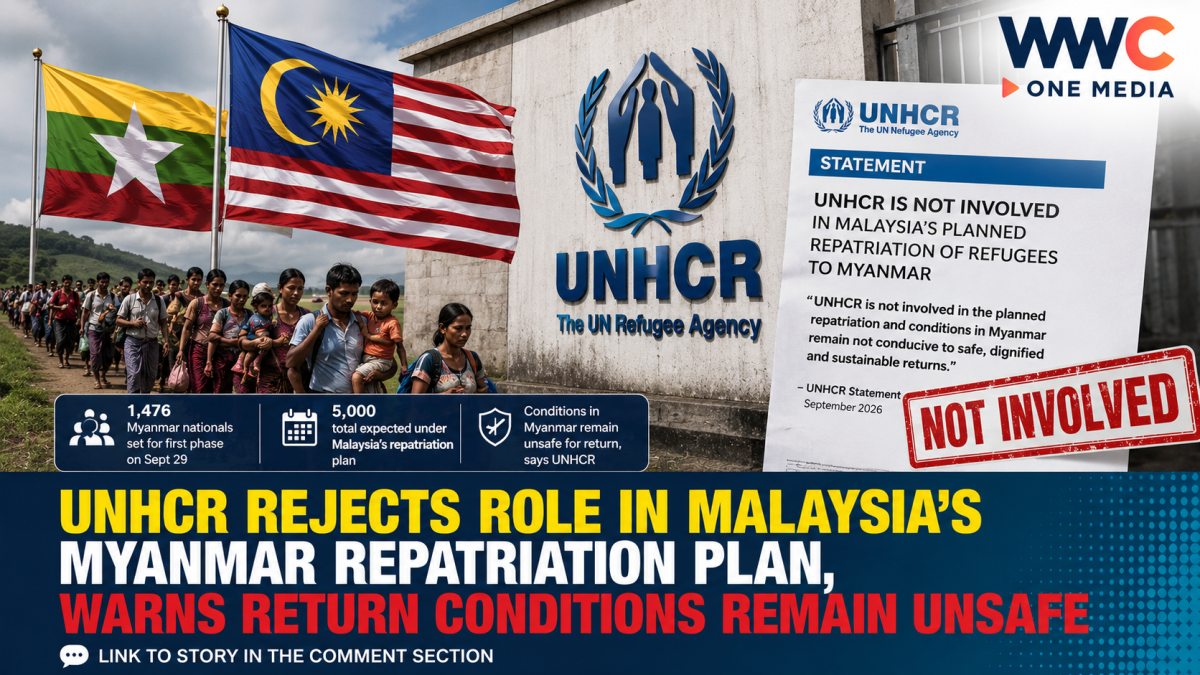
KUALA LUMPUR — A planned Malaysian repatriation of Myanmar nationals is facing renewed scrutiny after the United Nations refugee agency said it is not involved in the operation and warned that conditions in Myanmar remain too dangerous for a safe, dignified and sustainable return.
Malaysia has scheduled the first phase of its voluntary repatriation programme for September 29, involving 1,476 Myanmar nationals. The group is part of a broader plan involving about 5,000 people who Malaysian authorities say are eligible and willing to return to Myanmar.
The first group is expected to be transported aboard two Myanmar Navy warships and a hospital ship, according to Malaysia’s Home Ministry. Authorities have described the programme as voluntary and say the returns are being coordinated with Myanmar.
UNHCR: Myanmar is still not safe for return
UNHCR told Reuters that it has no role in the planned repatriation and stressed that ongoing armed conflict and violence across Myanmar prevent conditions for a safe, dignified and sustainable voluntary return.
The agency also emphasized the principle of non-refoulement, saying people should not be sent to a country where their rights or freedoms may be at risk. It called for protection needs to be carefully assessed before anyone is returned and said it remains ready to work with authorities on protection safeguards.
The Malaysian Home Ministry, meanwhile, has maintained that the programme is voluntary and previously said individuals would not be returned if they faced persecution or threats to their lives.
Who exactly is being sent back?
One important distinction is being overlooked in some reports: Malaysia’s official figure refers to 1,476 Myanmar nationals, not necessarily 1,476 people who have all been formally recognized as refugees.
Malaysia said 10,388 Myanmar nationals were being held in immigration detention centres as of August 15, but cautioned that the figure includes detained migrants who are not necessarily refugees. Authorities are conducting identity, citizenship, immigration-status, refugee-claim and security-background checks.
At the same time, Malaysia says 4,008 people, primarily Rohingya, are being processed under its new Refugee Registration Document (DPP) system rather than the repatriation track.
Malaysia’s refugee policy is also changing
The controversy comes as Malaysia moves away from relying exclusively on UNHCR’s refugee-registration system.
The Malaysian government introduced the Dokumen Pendaftaran Pelarian (DPP) programme in 2026, allowing authorities to collect biometric and personal information and determine who qualifies for temporary stay under government conditions. The government has also asked UNHCR to suspend new refugee registrations while Malaysia develops its own system.
UNHCR’s own figures show the scale of the issue: as of the end of February 2026, Malaysia had approximately 215,600 registered refugees and asylum-seekers, including 193,824 from Myanmar. Of the Myanmar population, 126,144 were Rohingya.
Malaysia is not a party to the 1951 Refugee Convention or its 1967 Protocol, a position the government has repeatedly cited while developing its own national refugee-management framework.
Why the September 29 return is drawing concern
Human rights organizations argue that returning people to Myanmar now could expose them to serious danger.
Fortify Rights warned that returnees could face armed conflict, persecution, torture, forced recruitment and other human-rights violations. The organization also questioned whether sufficient refugee-protection assessments are being carried out before people are placed on the repatriation list.
Amnesty International Malaysia has likewise called for the planned returns to be halted, arguing that conditions in Myanmar, particularly in Rakhine State, remain fundamentally unsafe for Rohingya refugees.
The concern is particularly significant for Rohingya people, who have faced decades of discrimination and persecution in Myanmar. More than 740,000 Rohingya fled to Bangladesh following the 2017 military crackdown, while many others sought refuge elsewhere in the region.
Myanmar itself says security remains a factor
The situation is complicated by Myanmar’s own statements regarding repatriation.
In August, Myanmar’s authorities said they had verified nearly 309,000 displaced Rohingya in Bangladesh as former residents of Rakhine State, but also indicated that repatriation would proceed only when security conditions in Rakhine become more stable.
That creates a major question surrounding Malaysia’s September plan: if security remains a concern in parts of Myanmar, what safeguards will be in place for those returning from Malaysia?
For now, Malaysia says the process is voluntary and coordinated with Myanmar, while UNHCR and rights groups are urging careful protection assessments before anyone is returned.
The September 29 operation could therefore become an important test of Malaysia’s evolving refugee policy — and of whether a return described as “voluntary” can also meet the standards of safety, informed consent and dignity demanded by international refugee-protection principles.
WWC ONE MEDIA G.A




Leave a Reply