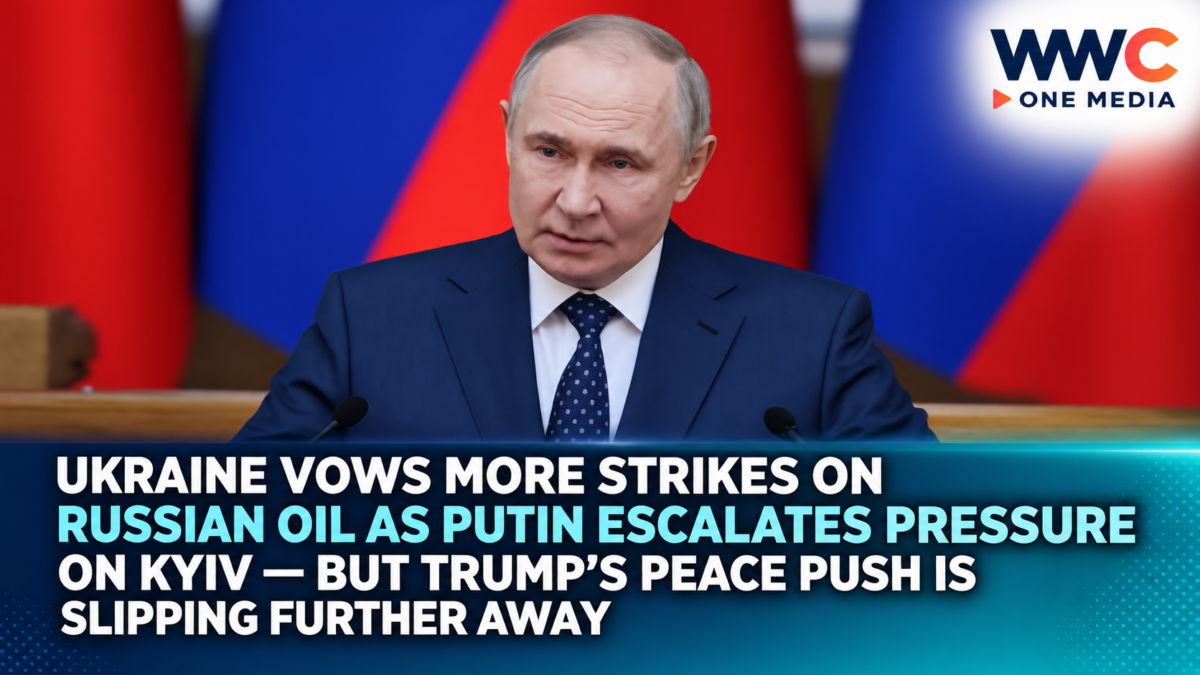
KYIV — Ukraine is preparing to intensify strikes on Russian oil refineries as Moscow steps up attacks on Kyiv and other cities, pushing the war into a more dangerous phase just as U.S. President Donald Trump tries again to revive negotiations between Vladimir Putin and Volodymyr Zelenskyy.
Ukrainian President Volodymyr Zelenskyy says intelligence obtained by Kyiv indicates Russian President Vladimir Putin has authorized a broader winter air campaign aimed at infrastructure, transportation networks and urban targets.
Zelenskyy told Reuters that Ukrainian intelligence had seen documents describing what he called a new Russian “doctrine” covering attacks on infrastructure, logistics, roads, schools and hospitals, which he said were designed partly to pressure civilians to leave major cities including Kyiv.
Those claims have not been independently verified.
Russia denies deliberately attacking civilians and says its strikes are directed at military installations, defense-industry facilities and infrastructure supporting Ukraine’s war effort.
But Moscow has also made clear that the attacks are about to intensify.
Russia’s Defense Ministry said on October 4 that forces would step up strikes on Kyiv and other parts of Ukraine after Zelenskyy promised further attacks against Russian oil infrastructure.
That leaves both countries threatening deeper strikes behind each other’s front lines even as Washington tries to reopen diplomatic channels.
Ukraine says it will hit Russia where it hurts: oil
Zelenskyy says Kyiv’s response will focus heavily on Russia’s oil industry.
Ukraine has already spent months targeting refineries, fuel depots, export terminals and other energy infrastructure because petroleum revenues remain critical to Russia’s economy and its ability to finance the war.
Zelenskyy said Ukraine intends to double down on refinery strikes, while insisting it will not respond by deliberately targeting civilians.
That creates a direct conflict with Washington.
Trump has urged Ukraine to scale back attacks on Russian oil facilities because the strikes are contributing to global fuel-market disruptions at a time when energy supplies are already under enormous pressure from the wider Middle East crisis.
But for Kyiv, Russian energy infrastructure is one of the few strategic targets it can reach deep inside enemy territory.
And the attacks appear to be hurting.
Russian oil output and revenue are under pressure
Russia’s oil sector is showing signs of mounting strain despite high global crude prices.
Reuters reported on October 5 that Russian oil and gas revenues have fallen 17% so far in 2026, totaling about 5.47 trillion rubles, or roughly $64 billion.
Russian production fell to around 8.72 million barrels per day in August, its lowest level in 17 years, from about 9.24 million barrels per day in January.
Repeated Ukrainian drone strikes against refineries and export infrastructure have contributed to production and loading disruptions.
That gives Kyiv an obvious strategic incentive.
Every damaged refinery can restrict domestic fuel availability, complicate military logistics and reduce government revenue.
Russia still remains one of the world’s biggest oil producers.
But Ukraine is attempting to turn the energy industry into a second battlefield.
Kyiv itself is under growing pressure
Russia, meanwhile, appears increasingly focused on making life in Ukraine’s major cities harder.
Kyiv has faced repeated missile and drone attacks against transport, energy and communications infrastructure.
Russia recently struck the Northern Bridge across the Dnipro River, one of the key transport links connecting the eastern and western sides of the capital.
The bridge had reportedly been targeted repeatedly over several consecutive days.
Russian attacks have also hit power infrastructure, railways, ports and other facilities essential to keeping Ukraine’s economy and military supplied.
That matters because the war is no longer being fought only over trenches in eastern Ukraine.
Both sides are increasingly attempting to weaken the other’s ability to function hundreds of kilometers behind the battlefield.
Russia says the escalation is retaliation
Moscow gives a different explanation for its expanded strike campaign.
Russia says Ukraine’s attacks on Russian refineries, energy infrastructure and territory have forced it to respond more aggressively.
The Russian Defense Ministry said it would intensify attacks on what it described as military facilities, defense-industrial sites and associated infrastructure in Kyiv and elsewhere.
Russia has also repeatedly said its operations are aimed at degrading Ukraine’s ability to wage war, not intentionally driving civilians from cities.
That does not resolve the dispute over the impact of the strikes.
Civilian areas, homes and infrastructure have repeatedly been damaged during the conflict, and both Moscow and Kyiv continue accusing the other of unlawful attacks.
Zelenskyy says Ukraine has regained ground in Donbas
Despite Russia’s air campaign, Zelenskyy says Ukraine is making some progress on the battlefield.
Ukraine says its latest counteroffensive, codenamed Vivaldi, has recaptured around 140 square kilometers of territory in the Donbas region.
Russia claims the entire Donbas as one of its principal war aims and has previously insisted that controlling the region must form part of any final peace agreement.
That makes even relatively modest territorial changes politically important.
For Putin, losing ground weakens the argument that Russia can simply wait until Ukraine is forced to accept Moscow’s conditions.
For Zelenskyy, battlefield gains help support the case that continuing military assistance can still change the war’s trajectory.
But 140 square kilometers remains a small portion of the territory under Russian control.
The wider front remains heavily contested.
Germany is sending another €1 billion in military aid
Ukraine’s European allies are also attempting to reinforce Kyiv as the fighting intensifies.
German Chancellor Friedrich Merz visited Kyiv on October 4 and announced another €1 billion in military assistance, along with €350 million to repair Ukraine’s damaged energy infrastructure.
Germany and Ukraine also signed a series of defense-industrial agreements covering systems such as air defense, radar equipment and drone interceptors.
The timing was symbolic.
Russian attacks continued while Merz was in Kyiv.
The German leader said Berlin would not be intimidated and framed support for Ukraine as part of Europe’s own security.
That is increasingly the European argument:
if Russia succeeds in Ukraine, the implications will extend far beyond Ukraine’s borders.
Ukraine desperately needs more air defense
The immediate military problem for Kyiv is increasingly aerial.
Russia is using large numbers of relatively inexpensive drones together with missiles to attack Ukrainian cities and infrastructure.
Ukraine can intercept many of those weapons—but interceptors themselves are expensive and limited.
Kyiv is therefore accelerating production of locally developed interceptor drones and new missiles designed to destroy incoming Russian systems at lower cost.
Germany’s latest package includes additional support for air defense and drone production.
The economics matter.
Using an expensive Western missile every time Russia launches a cheap drone is not sustainable indefinitely.
Ukraine increasingly needs lower-cost ways to defend its skies.
Trump is trying to restart peace negotiations
The military escalation comes as Trump attempts to reopen talks among Washington, Moscow and Kyiv.
The U.S. administration has previously held discussions separately with both Russia and Ukraine and has floated the possibility of renewed trilateral negotiations.
Zelenskyy has said Ukraine is willing to participate.
But he also says he has seen no indication that Putin genuinely wants a ceasefire or meaningful peace negotiations.
That is the fundamental contradiction surrounding Trump’s effort.
Washington wants negotiations.
Kyiv says it will negotiate.
Russia says it supports a diplomatic settlement—but only one reflecting what Moscow describes as the realities on the battlefield and its core security demands.
Meanwhile, the bombing continues.
Previous peace efforts have repeatedly stalled
This is not Trump’s first attempt to bring the two sides together.
U.S.-brokered negotiations earlier in 2026 produced some humanitarian agreements and prisoner exchanges, but fundamental disagreements remained over territory and security guarantees.
Russia continues to demand major territorial concessions and limits on Ukraine’s future military alignment.
Ukraine rejects any settlement that effectively rewards Russia for occupying Ukrainian territory without credible security guarantees.
That gap has repeatedly prevented diplomatic progress.
Trump has argued publicly that an agreement is possible.
But each new wave of strikes makes compromise harder politically for both sides.
An oil deal has now entered the diplomatic conversation
The peace process may also be becoming entangled with commercial interests.
The New York Times reported, according to Reuters, that U.S.-Russia discussions related to Ukraine have included a potential multibillion-dollar oil deal involving Lukoil assets.
The proposal would reportedly involve Russian and international energy assets and would require approval from both Washington and Moscow.
The Kremlin acknowledged that energy cooperation had been discussed with U.S. negotiators but declined to comment specifically on the reported deal.
There is no indication that the proposed transaction has been finalized.
But its emergence highlights the increasingly complicated nature of the diplomacy.
Ukraine negotiations are now intersecting with sanctions, oil markets, commercial interests and wider U.S.-Russia economic relations.
Ukraine’s economic problem may be as dangerous as the battlefield
Ukraine is also entering a severe fiscal squeeze.
Reuters reported that the country faces an estimated $56 billion budget gap, equivalent to roughly a quarter of its economy.
Military expenditure reached about $44 billion during the first nine months of 2026, while Kyiv is proposing record defense spending of roughly $110 billion for 2027.
Russia’s attacks have simultaneously damaged the industries Kyiv needs to generate revenue.
Steel plants have halted production.
Ports and railways have been hit.
Agricultural exports have suffered.
Investment is weak.
And Ukraine remains heavily dependent on outside financing.
That creates a brutal equation.
The longer the war continues, the more money Ukraine needs.
But the same war is destroying the economic base from which Ukraine could raise that money itself.
Russian strikes are deliberately hitting economic pressure points, Kyiv says
Kryvyi Rih—Zelenskyy’s hometown and a major steel and mining center—has suffered repeated strikes.
ArcelorMittal’s major steel operation there suspended production amid the attacks.
Other industrial and transport sites have also been damaged.
That illustrates why Ukraine believes Moscow’s strategy is increasingly economic as well as military.
Destroying a bridge affects transportation.
Destroying a power station hits homes and factories.
Damaging a railway affects troops and exports.
Closing a steel mill reduces tax revenue.
In modern war, infrastructure can be both civilian and strategically important at the same time.
That makes the legal and political arguments over targeting particularly contentious.
Russia is paying an economic price too
Ukraine’s attacks are also imposing costs on Moscow.
Russia’s energy revenues are falling.
Oil production has declined.
Export infrastructure is being disrupted.
And Russia’s federal budget is under increasing pressure.
Reuters reported Russia now expects a fiscal deficit of roughly 3% of GDP, almost double its earlier projection.
Those figures challenge the idea that Russia can wage war indefinitely without serious economic consequences.
But they do not mean Moscow is close to financial collapse.
Russia still earns substantial energy revenue, retains large industrial capacity and has reshaped trade toward markets outside the West.
Both countries therefore appear capable of continuing the war—at increasingly severe cost.
The refinery war could spill into global inflation
Ukraine’s decision to expand refinery strikes also has consequences far beyond Russia.
Russian refined fuels remain important to global energy markets.
When refinery production falls, diesel and other petroleum-product supplies become tighter.
Trump has explicitly raised this concern because fuel prices are already elevated due to the separate conflict involving Iran and disruption around the Strait of Hormuz.
That places Washington in an awkward position.
The U.S. supports Ukraine.
But Ukrainian attacks that successfully hurt Russia can also push international energy prices higher.
Those higher prices can feed inflation in the United States and Europe.
A strategically successful Ukrainian strike can therefore create an economic problem for Ukraine’s own allies.
Zelenskyy appears unwilling to stop
For Kyiv, however, the logic remains straightforward.
Russia uses oil revenue to finance the war.
Ukraine therefore sees the energy sector as a legitimate strategic target.
Zelenskyy says Ukraine will continue striking those facilities while avoiding intentional attacks on civilians.
That suggests Trump’s request is unlikely to end the campaign unless Washington offers Ukraine another way to exert comparable pressure on Moscow.
And as long as Russia continues attacking Ukrainian energy and urban infrastructure, political pressure inside Ukraine to retaliate will only increase.
The coming winter could become another battlefield
This may be the most serious concern.
Winter has repeatedly been used as a strategic pressure point during the war.
Electricity outages become more dangerous when temperatures fall.
Damage to heating infrastructure becomes more consequential.
Transportation disruptions become harder to repair.
Energy shortages place greater pressure on civilians.
Zelenskyy’s warning about Russia’s alleged new doctrine is therefore specifically tied to what Kyiv believes Moscow plans to do before and during winter.
Even if some of Ukraine’s intelligence assessment proves inaccurate, the observable trend is already clear:
Russian attacks on Ukrainian infrastructure are intensifying.
And Ukraine is preparing a stronger response against Russian energy assets.
Diplomacy is moving in the opposite direction of the battlefield
That is the central contradiction facing Trump.
The U.S. president wants negotiations to accelerate.
But Russia and Ukraine are both expanding the tools they use to pressure one another.
Russia is threatening stronger strikes on Kyiv.
Ukraine is promising more attacks on Russia’s oil industry.
Germany is sending another billion euros in military aid.
Ukraine is developing longer-range weapons.
And both countries appear determined to improve their battlefield positions before seriously compromising at a negotiating table.
That does not make peace impossible.
It makes the timing increasingly difficult.
Putin and Zelenskyy are both trying to strengthen their bargaining position
Wars often intensify before negotiations.
Each side wants to enter talks from the strongest possible position.
For Putin, sustained pressure on Ukrainian cities and infrastructure may be intended to prove that Moscow can continue inflicting enormous costs.
For Zelenskyy, refinery strikes and counteroffensives show that Ukraine can still hurt Russia economically and militarily.
That means some of today’s escalation could be connected to tomorrow’s bargaining positions.
But escalation also carries another possibility.
One side could miscalculate.
A strike could cause much higher casualties than expected.
A major infrastructure attack could trigger retaliation beyond previous limits.
Or political pressure could make negotiations impossible altogether.
Trump’s window for a breakthrough may be closing
The Trump administration continues to argue that a negotiated end to Europe’s bloodiest conflict since World War II is possible.
There have been periods when both sides engaged diplomatically.
Prisoners have been exchanged.
Temporary pauses have occurred.
Officials have discussed ceasefires and humanitarian measures.
But the fundamental political settlement remains out of reach.
Russia still wants Ukrainian territory and strategic concessions.
Ukraine still demands sovereignty and security guarantees.
Neither side trusts the other.
And after more than four years of war, every additional attack deepens that distrust.
That is why the latest exchange between Moscow and Kyiv matters beyond the battlefield.
Ukraine says it will intensify attacks on Russia’s oil industry.
Russia says it will intensify attacks on Ukraine.
Trump wants the two leaders back at the negotiating table.
But with both Putin and Zelenskyy trying to increase pressure before winter, the war may be moving further away from compromise just when Washington wants peace talks to move faster.