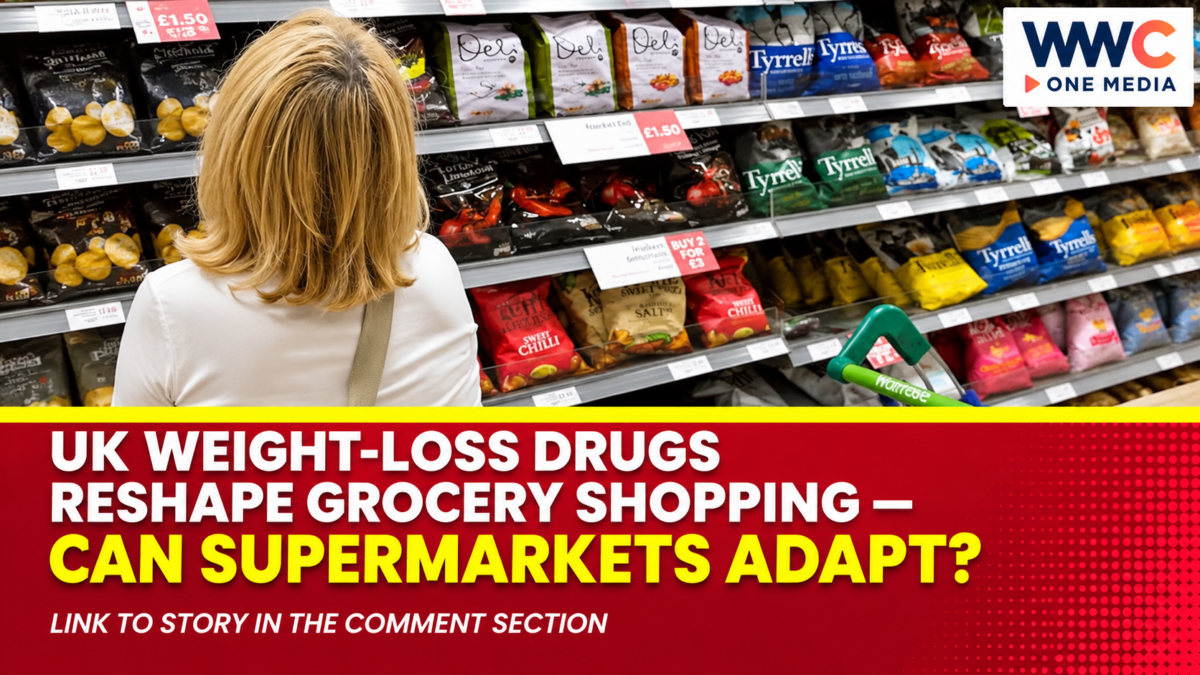
LONDON — Nov. 19, 2026. UK weight-loss drugs are becoming an increasingly important influence on household shopping decisions as consumer researchers examine changes in grocery baskets and food preferences. NielsenIQ reported on Nov. 5 that 11.8% of Great Britain households included at least one GLP-1 medicine user as of June 2026, while UK authorities have authorised additional treatment options during the year.
The business question is whether food manufacturers and supermarkets can adjust their products without confusing reduced appetite with lower spending in every category. A newly reported estimate of more than £1 billion in displaced grocery purchases remains outside this article because the original November research and calculation have not been independently inspected.
UK Weight-Loss Drugs Change the Retail Question
NielsenIQ’s own November research describes GLP-1 medicine adoption as a household-level development rather than a purchasing decision affecting only the person receiving treatment. Its June estimate was about 3.3 million households, or 11.8% of households in Great Britain.
That estimate is a finding from the research company’s methodology, not a national register of prescriptions. An earlier publication by Worldpanel by Numerator cited 6.3% of British households with a user. The two estimates should not be treated as directly comparable measurements of change: they come from different providers and may use different sampling, definitions and fieldwork periods.
One user can change household grocery buying, although researchers must separate treatment effects from prices, income and other dietary preferences. Fewer basket items do not automatically mean equivalent revenue losses.
What Original Research Actually Establishes
Worldpanel’s earlier GLP-1 consumer research reported an estimated £136 million reduction in food and drink spending among households using the medicines, alongside a 2.2-percentage-point greater decline in grocery expenditure than among non-users. That was an earlier estimate, not the latest reported total.
Its July analysis of Saudi Arabian households also identified differences in health monitoring, diet and ingredient awareness among people taking or considering the drugs. That international evidence is useful for understanding possible consumer responses, but Saudi shopping patterns cannot be directly transferred to British supermarkets.
NielsenIQ’s November study offers a more recent first-party snapshot of adoption in Great Britain. It does not, in the publicly accessible material examined for this article, independently prove the reported £1 billion UK spending reduction. No figure of that size should be presented as an audited national retail loss.
Why it matters: Sales displacement is a modelled comparison with what households might otherwise have bought. It is not necessarily an observed collapse in total supermarket sales, which are affected by other shoppers and many unrelated products.
Medicines Policy Is Changing the Market
The Medicines and Healthcare products Regulatory Agency authorised orforglipron, sold as Foundayo, on Aug. 10, 2026, for specified weight-management and type 2 diabetes uses. Its announcement describes an oral treatment and distinguishes regulatory authorisation from subsequent decisions about provision through the National Health Service.
The regulator also explains that medicines in this class work through pathways involved in appetite and feelings of fullness. Authorisation does not make a medicine suitable for everyone, establish that every recipient will eat less, or provide a basis for individual medical advice from a business article.
The MHRA has separately strengthened warnings about rare but serious pancreatitis risks and has advised patients to obtain medicines through appropriate clinical channels. Retail-market enthusiasm should never be mistaken for a recommendation to start, stop or switch prescription treatments.
WWC has previously examined UK restrictions on advertisements for weight-loss treatments. Those advertising rules are a separate consumer-protection question from what supermarkets may learn about purchasing patterns.
Food Brands Face a Product-Mix Test
If changing appetites alter the size and composition of grocery baskets, manufacturers could respond with smaller packs, clearer nutritional information and food choices meeting different needs. That is a commercial possibility, not proof that any one category will grow permanently.
Research on consumers using GLP-1 medicines suggests retailers should consider the entire household. People still buy food for others, and preferences can change after treatment ends. Companies therefore need evidence on repeat purchasing, affordability and actual consumption before redesigning their ranges.
WWC’s earlier report on drinks companies and the changing GLP-1 consumer discusses one adjacent product-market response. Interest in wellness and drinks cannot be converted into a blanket claim that medicine users have abandoned traditional groceries.
What this could mean: Retailers that understand customer needs may develop useful products, but the opportunity should be judged against margins, customer acceptance and independent sales results rather than a dramatic headline estimate.
Grocery Inflation Must Not Be Confused With Consumption
The Office for National Statistics reported that UK food and non-alcoholic beverage prices were 0.9% higher in October 2026 than a year earlier, down from 1.3% annual inflation in September. Those figures measure price change, not the amount of food purchased by GLP-1 users.
A shopper might buy fewer items while spending more if prices increase or if they switch to more expensive foods. Conversely, a lower bill can reflect discounts rather than a sustained change in consumption. Retailers need consistent unit sales, basket values and household comparisons to distinguish the effects.
WWC’s coverage of the UK’s October inflation figures provides wider economic context for household budgets. Price inflation and medication-related shopping changes are distinct variables, even when they affect the same supermarket receipt.
What Happens Next
The most useful next disclosure would be the full original November Worldpanel analysis, including its sampling period, comparison groups and explanation of how displaced grocery spending was calculated. Without that methodology, the reported £1 billion figure remains an attributed claim that cannot pass this desk’s primary-record threshold.
Retailers’ results may clarify volumes and margins, though chains may not isolate medication use. Independent panels can test whether changes last.
For now, original research supports a significant emerging consumer segment. It does not establish that UK supermarkets have collectively booked a verified £1 billion sales loss, nor that any named company will be a certain winner or loser.
Frequently Asked Questions
Are weight-loss drugs changing UK grocery shopping?
Consumer researchers have documented substantial adoption of GLP-1 medicines in Great Britain and studied how users’ households adjust spending. The precise effects differ by survey and cannot be assumed for every household.
Has a £1 billion decline in British grocery spending been proven?
The figure has been reported as a research estimate, but the original November study and calculation were not independently inspected for this article. It should not be described as an official audited loss.
Do GLP-1 medicines come in tablet form in the UK?
Yes. The UK medicines regulator authorised the oral medicine orforglipron in August 2026 for specified uses. Approval does not mean the treatment is suitable for every person or automatically available through the NHS.
Will food prices fall because more people use these medicines?
Not necessarily. Grocery prices depend on production, transport, competition and other costs as well as consumer demand. Changes in shopping quantities do not guarantee lower retail prices.