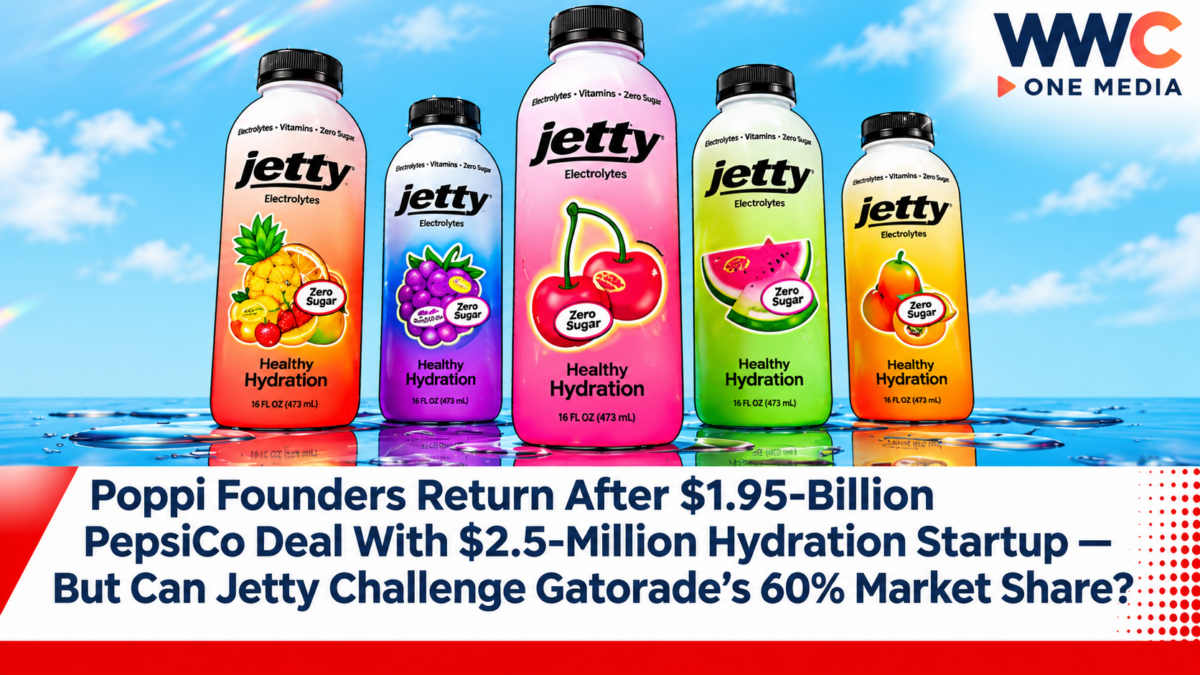
AUSTIN, TEXAS — November 10, 2026 — The husband-and-wife entrepreneurs who turned a little-known prebiotic soda into a nearly $2-billion acquisition are back in business—and this time, they are challenging the sports-drink empire owned by the company that bought their first brand.
Allison and Stephen Ellsworth, the founders of Poppi, officially launched their new beverage company, Jetty, on November 9, introducing a lineup of electrolyte drinks and powdered hydration mixes aimed at younger consumers seeking an alternative to traditional sports beverages.
The launch comes roughly a year and a half after PepsiCo acquired Poppi for approximately $1.95 billion in 2025.
But their next venture puts them in an unusual position.
PepsiCo also owns Gatorade, the dominant brand in the US sports-drink category, with approximately 60% market share, according to Numerator data cited by CNBC.
Now the entrepreneurs behind one of PepsiCo’s most prominent recent acquisitions are entering a market where their former buyer is already the established leader.
Jetty is launching with an initial investment of approximately $2.5 million, funded by the founders themselves.
Its products include ready-to-drink bottles and electrolyte powder packets in five flavors, with lower sugar and sodium levels than many conventional sports drinks.
The company is positioning the lineup for everyday activities rather than high-intensity athletic performance.
According to CNBC’s November 8 report, the Ellsworths believe the growing hydration market offers an opportunity to repeat the strategy that turned Poppi into a valuable consumer brand.
But can the couple successfully challenge Gatorade and a crowded field of hydration startups—or will their second attempt at building a billion-dollar beverage company prove far more difficult?
Poppi Founders Launch Their Next Beverage Company
Jetty officially entered the US market on Monday, November 9.
The brand was founded by Allison and Stephen Ellsworth, who previously built Poppi into one of the best-known names in the prebiotic soda category.
Stephen Ellsworth serves as Jetty’s chief executive officer.
Allison Ellsworth is the company’s co-founder and chief brand officer.
Their responsibilities mirror the complementary roles they developed while building Poppi.
Stephen focuses on business operations and execution, while Allison plays a leading role in product positioning, branding and consumer engagement.
The founders are initially financing Jetty with their own capital rather than relying on venture investors.
CNBC reported an initial funding amount of approximately $2.5 million.
The couple expects to consider outside investment during 2027.
However, no completed external funding round or confirmed valuation for Jetty has been announced.
The startup’s long-term value will depend on actual sales, repeat purchases, distribution and profitability.
Why the Founders Are Taking on Gatorade
The decision places Jetty in competition with one of the world’s most recognizable sports-drink brands.
Gatorade has dominated the US sports beverage market for decades.
Its products are widely associated with athletes, organized sports, physical training and electrolyte replacement.
PepsiCo has invested heavily in the brand’s distribution, sponsorships and product development.
According to Numerator data cited by CNBC, Gatorade controls approximately 60% of the US sports-drink market.
That gives the company significant advantages in retail shelf space, customer familiarity and marketing resources.
But the Ellsworths believe there is an underserved market.
Rather than competing primarily for athletes recovering from strenuous exercise, Jetty is targeting people who want a convenient flavored drink during everyday routines.
The company is particularly interested in younger shoppers and millennial mothers.
Its marketing emphasizes lifestyle, accessibility and beverage enjoyment.
The strategy reflects the founders’ belief that hydration products have become too closely associated with extreme physical performance.
However, it remains to be seen whether consumers will view everyday hydration as a sufficiently distinct category to justify buying Jetty regularly.
Jetty’s Five Flavors Target Everyday Consumers
Jetty is launching with five flavors designed to appeal to consumers seeking familiar, fruit-forward beverages.
The initial lineup includes:
- Watermelon
- Orange Mango
- Fruit Punch
- Black Raspberry
- White Cherry
The drinks are available in ready-to-drink bottles and powdered formats that consumers can mix with water.
The bottled format is intended for convenience.
Powders offer an alternative for customers who prefer preparing their own drinks.
The brand’s packaging and marketing emphasize bright colors and a playful identity.
This approach resembles the consumer-focused strategy that made Poppi popular among younger shoppers.
But product positioning is only one part of the challenge.
Jetty must persuade customers to try the drinks, demonstrate that the flavors meet expectations and encourage repeat purchases.
In a competitive beverage category, attractive packaging can generate initial interest.
It does not guarantee long-term sales.
How Jetty Compares With Traditional Gatorade
Jetty’s formulation is central to its effort to differentiate itself.
According to CNBC and Food Dive, a standard Jetty serving contains:
| Nutritional measure | Jetty |
|---|---|
| Sodium | 100 mg |
| Potassium | 310 mg |
| Magnesium | 100 mg |
| Sugar | 6 g |
| Dietary fiber | 3 g |
| Calories | 45 per bottle |
The company also includes B vitamins and avoids artificial dyes and sweeteners.
By comparison, CNBC reported that a 20-ounce serving of Gatorade Thirst Quencher contains approximately 34 grams of sugar.
However, the serving sizes are different.
A Jetty ready-to-drink bottle contains approximately 15.2 fluid ounces, while the cited Gatorade comparison uses 20 ounces.
The products also serve somewhat different purposes.
Traditional sports drinks may contain more sodium or carbohydrate because they are designed partly for situations involving physical exertion and sweat loss.
A lower-sodium drink is not automatically better for every person or activity.
For ordinary daily hydration, water remains a suitable choice for most healthy adults.
Jetty is offering a flavored electrolyte beverage, not a medically necessary replacement for drinking water.
The Hydration Market Is Growing Rapidly
The founders are entering a market that has attracted substantial investment and consumer interest.
According to SPINS data cited by CNBC, dollar sales of hydration and electrolyte products rose approximately 20% to $2.6 billion during the 52 weeks ending October 4, 2026.
That growth reflects increasing interest in products marketed around hydration, wellness and convenience.
Consumers now encounter a growing range of electrolyte powders, flavored waters, sports drinks and other functional beverages.
Major brands continue expanding their offerings.
Independent startups are also competing for attention through distinctive packaging and social media marketing.
But a growing category does not guarantee success for every participant.
More competition can increase advertising costs and make retail distribution difficult.
Brands must also defend their margins while competing against companies with much larger manufacturing and logistics networks.
Jetty’s challenge is to transform market growth into its own sustainable customer base.
Poppi’s $1.95-Billion Sale Created the Opportunity
The Ellsworths have an unusual advantage over many new beverage entrepreneurs.
They previously built and sold Poppi, a company that became closely associated with the growth of prebiotic sodas.
Poppi began with a concept involving apple cider vinegar and a more appealing alternative to conventional soda.
The business evolved through product development, rebranding, retail distribution and aggressive social media promotion.
Its popularity grew as consumers showed interest in beverages positioned around lower sugar and added ingredients such as prebiotic fiber.
In 2025, PepsiCo acquired Poppi for approximately $1.95 billion.
That acquisition demonstrated how valuable a rapidly growing consumer brand can become when it combines strong customer recognition with broad distribution.
However, the transaction price should not be confused with the personal proceeds received by the founders.
The amount paid in an acquisition can be distributed among founders, investors and other stakeholders, subject to transaction terms.
What is clear is that the deal gave the Ellsworths the experience and resources to pursue another beverage venture.
Why Jetty Is Competing Against Its Former Buyer
One of the most interesting aspects of the launch is its relationship with PepsiCo.
The multinational acquired Poppi to strengthen its presence in the better-for-you beverage category.
But PepsiCo also owns Gatorade and Propel, both established hydration brands.
By launching Jetty, the Ellsworths are now targeting consumers in an adjacent market already served by their previous buyer.
That does not establish a legal dispute between the founders and PepsiCo.
Nor does it mean Jetty is seeking to replace Gatorade in every retail location.
The brands currently emphasize different consumer needs.
Gatorade remains strongly associated with sports and athletic performance.
Jetty is being positioned around everyday hydration and lifestyle occasions.
However, their products could compete for the same consumer spending and retail shelf space.
The situation illustrates how quickly the beverage industry can change.
A startup founder may sell a successful brand to a large corporation, then use the experience gained to create a new company in a neighboring category.
PepsiCo Is Already Facing Pressure From Changing Consumer Habits
Jetty’s launch comes as PepsiCo works to strengthen its North American operations.
The company has been dealing with weaker beverage volumes, selective consumer spending and pressure to improve profitability.
During the third quarter of 2026, PepsiCo’s North American beverage volume declined approximately 2% from a year earlier.
Its North American food volume was broadly flat.
The company has also been adjusting prices, reviewing operating costs and investing in products aligned with changing consumer preferences.
These developments help explain why functional beverages are attracting attention.
Companies are seeking new opportunities as shoppers become more selective about sugary drinks, snacks and discretionary purchases.
As previously reported by WWC ONE MEDIA, PepsiCo’s financial performance has been affected by weak North American demand and investor pressure to improve efficiency.
Related WWC ONE MEDIA coverage: Wall Street’s AI Rally Cracks as Oil Surges and Chip Stocks Sink — But the Dow’s Gain Shows the Market Is Rotating, Not Collapsing
That market report examines PepsiCo’s wider financial challenges.
It does not establish that Jetty has already taken customers or market share from Gatorade.
The competitive impact of the new brand remains to be seen.
Jetty Uses the Marketing Strategy That Made Poppi Famous
The founders are also borrowing elements of Poppi’s marketing playbook.
Allison Ellsworth built a strong online presence by communicating directly with consumers and making the brand part of social media conversations.
Jetty is taking a similar approach.
Before the product launch, the company used teaser campaigns, creator partnerships and social media content to generate curiosity.
One promotional initiative involved the J-Card, a limited-access membership concept offering opportunities for early product access and other brand-related benefits.
The strategy is designed to build a community around the product rather than relying only on traditional advertisements.
In an interview with Retail Brew, Ellsworth emphasized the importance of creating excitement before shoppers could purchase the drinks.
Fast Company also reported that Jetty is prioritizing micro-influencers and online creators instead of relying primarily on expensive celebrity endorsements.
This approach may help a new company generate visibility with a comparatively limited marketing budget.
But viral attention does not always translate into a profitable business.
The real test will come when consumers decide whether to buy Jetty a second or third time.
Distribution Starts With Whole Foods, Target and Amazon
Jetty has launched through several major retail channels.
The initial rollout includes Whole Foods stores nationwide and online availability through Target and Amazon.
The company is also promoting direct access through its own website.
According to the Austin Business Journal, Jetty expects to reach approximately 3,200 stores by January 2027.
That figure is a distribution goal, not a verified current store count.
Retail expansion can be expensive.
Brands must secure inventory, meet product standards, manage logistics and support retailers with marketing.
They also need to avoid expanding so quickly that production costs and unsold inventory become difficult to manage.
Jetty’s national launch gives it an opportunity to reach a broad audience.
But successful distribution will ultimately be judged by sales performance and whether retail partners continue stocking the products.
Is Jetty Taking Advantage of the GLP-1 Consumer Trend?
Another important element of the brand’s origin involves Allison Ellsworth’s personal experience.
She told CNBC that after using a GLP-1 medication, she experienced difficulty maintaining her normal fluid intake.
That experience contributed to her interest in creating a beverage she would enjoy drinking regularly.
The story connects Jetty with a larger trend involving changing eating and drinking habits.
GLP-1 medications are increasingly relevant to the food and beverage industry because some people taking them experience changes in appetite and consumption.
But it would be misleading to suggest that Jetty has been medically proven to treat GLP-1 side effects.
The drink is a consumer beverage, not a prescription treatment.
The founders’ personal experience explains their product idea.
It is not clinical evidence that Jetty treats dehydration or is superior to ordinary water.
For consumers with persistent vomiting, dehydration or other medication-related symptoms, appropriate medical advice remains important.
Consumer Brands Are Competing Through Ingredients and Lifestyle
The emphasis on lower sugar, familiar flavors and wellness positioning is part of a broader industry trend.
Coca-Cola, PepsiCo and smaller beverage companies are exploring new ways to reach customers whose preferences are evolving.
Some consumers want reduced-sugar products.
Others are interested in added ingredients, different flavors or beverages suited to particular activities.
Large manufacturers are also adjusting their marketing to communicate more directly with younger audiences.
In the Philippines, Coca-Cola has invested in digital campaigns, personalized marketing and product positioning across its beverage portfolio.
As WWC ONE MEDIA previously reported, Coca-Cola Philippines earned major recognition at the SMARTIES Philippines 2026 Awards for marketing initiatives involving data and consumer engagement.
Related WWC ONE MEDIA coverage: Coca-Cola Philippines Wins Brand of the Year and 8 Marketing Awards With AI-Powered Campaigns — But Its Biggest Innovation Goes Beyond Advertising
The Coca-Cola marketing initiatives are unrelated to Jetty’s ownership or launch.
However, they illustrate the wider competition for consumer attention in the beverage industry.
Brands increasingly need to communicate why their products fit customers’ lifestyles rather than relying on familiarity alone.
Beverage Innovation Also Creates Supply-Chain Challenges
A successful drink requires more than attractive flavors and packaging.
Manufacturers must secure ingredients, production capacity, distribution and dependable retail relationships.
Sugar and alternative sweeteners are particularly important in beverage manufacturing.
In the Philippines, major beverage producers have been exploring ways to purchase sugar more directly from farmers.
As previously covered by WWC ONE MEDIA, companies including Coca-Cola and Pepsi have shown interest in arrangements that could strengthen relationships between large buyers and local sugar producers.
Related WWC ONE MEDIA coverage: Beverage Makers Explore Buying Sugar Directly From Farmers
The proposal concerns the Philippine sugar industry and is separate from Jetty’s US launch.
But it demonstrates how ingredient sourcing and production economics affect beverage businesses of every size.
For Jetty, future growth will depend partly on manufacturing capacity, procurement arrangements and its ability to maintain product consistency as distribution expands.
Smaller Beverage Startups Are Finding Opportunities in Specialized Markets
Jetty is not the only young business entering a beverage category dominated by much larger companies.
Entrepreneurs in different markets are introducing products designed around specific consumer preferences.
In Hong Kong, 23-year-old founder Nikita Kuwadekar built Busy Brew around plant-based canned coffee, targeting customers looking for dairy-free convenience.
As WWC ONE MEDIA previously reported, the brand found opportunities by identifying a product gap in existing retail offerings.
Related WWC ONE MEDIA coverage: How Hong Kong Gen Z Entrepreneur Turned a Coffee Gap Into Busy Brew
Busy Brew and Jetty are unrelated businesses operating in different beverage categories.
Their shared approach is identifying a consumer need that founders believe existing products do not fully address.
But finding a market gap is only the beginning.
Startups must persuade enough customers to change their purchasing habits to generate sustainable sales.
Can Jetty Become Another Billion-Dollar Brand?
The Ellsworths have already demonstrated that they can build a beverage startup attractive to a major multinational buyer.
But Poppi’s success does not guarantee that Jetty will follow the same trajectory.
The hydration category is highly competitive.
Gatorade has decades of brand recognition and extensive distribution.
Liquid I.V., Propel, Powerade and numerous smaller brands are also competing for consumers interested in hydration and electrolytes.
Jetty must establish a differentiated identity while maintaining affordable production and effective marketing.
Its launch price of approximately $2.49 per bottle, as reported by Quartz, places it in a competitive consumer beverage market.
However, retail prices may vary by store, package format and promotion.
The business must also decide how quickly to raise outside funding.
Accepting investment could accelerate growth but would introduce additional shareholder expectations.
For now, Jetty’s founders are choosing to finance the launch themselves.
The company’s future valuation remains unknown.
What Investors and Competitors Should Watch
Several developments will reveal whether Jetty can become a serious competitor.
First, its initial retail sales will show whether the launch generates sufficient consumer interest.
Second, repeat purchases will indicate whether customers enjoy the formulation enough to make it part of their routines.
Third, distribution growth will determine whether the company can expand beyond its launch partners.
Fourth, marketing efficiency will matter as the company competes against brands with substantial advertising resources.
Finally, its funding strategy will become important if management seeks external capital in 2027.
A large fundraising round would not automatically prove that the business is profitable.
Likewise, early retail availability does not establish significant market share.
The most useful measures will be sustained sales growth, product margins and consumer retention.
The Bigger Picture: Can Poppi’s Founders Disrupt Another Beverage Empire?
Jetty’s arrival represents an unusually compelling entrepreneurial story.
Allison and Stephen Ellsworth built Poppi into a successful consumer brand and sold it to PepsiCo for approximately $1.95 billion.
Now they are returning with a self-funded company that competes in a market dominated by PepsiCo’s own Gatorade.
The strategy is familiar.
The founders want to take an established beverage category, identify consumers who feel underserved and create a product with distinctive flavors, ingredients and branding.
But the hydration market presents different challenges from prebiotic soda.
Gatorade remains dominant.
Other startups are competing aggressively.
And consumers already have access to numerous drinks, powders and ordinary water.
Jetty’s lower-sodium everyday positioning may help it stand apart, but there is no evidence yet that it has taken meaningful market share from established brands.
The founders have proved they can build a valuable beverage company once. Jetty will test whether their combination of product innovation, retail strategy and social media marketing can work a second time.
And as the entrepreneurs behind Poppi challenge the hydration category with a $2.5-million startup, one question remains: Could Jetty become the next billion-dollar brand—or will PepsiCo’s Gatorade prove far harder to disrupt than the soda business they conquered before?