MIAMI, FLORIDA — November 10, 2026 — Wall Street’s push to bring traditional financial assets onto blockchain networks is gaining momentum, and one of the industry’s emerging infrastructure companies is betting that the next major opportunity could lie in a multitrillion-dollar lending market.
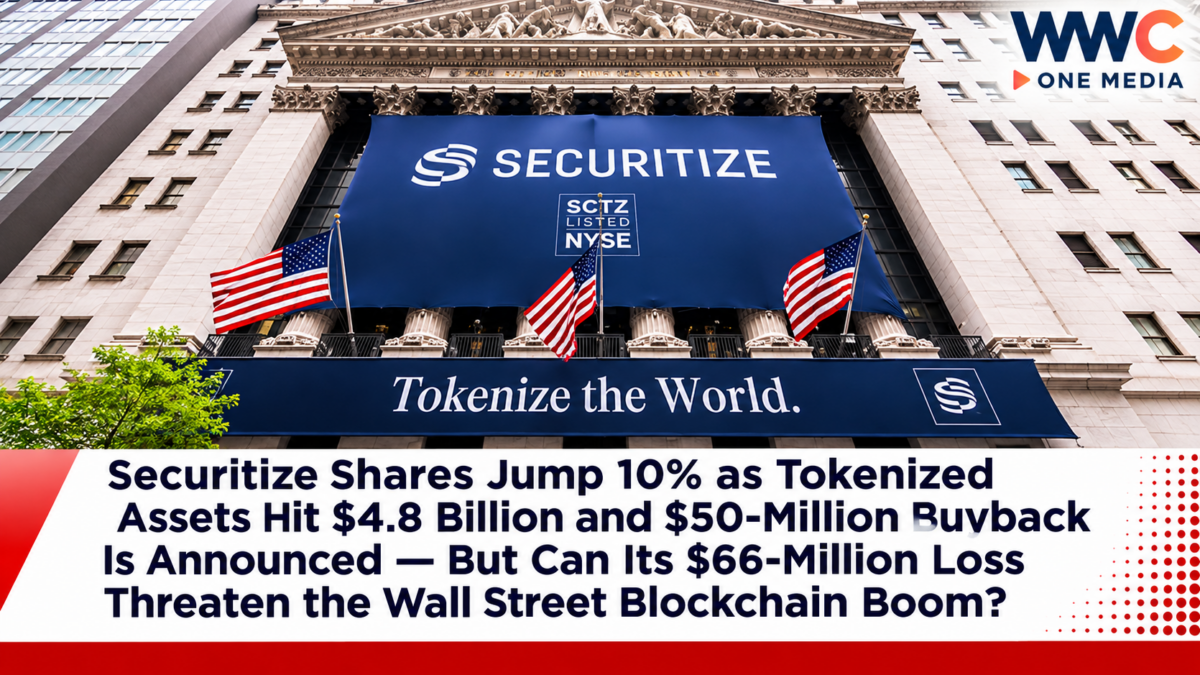
Securitize Corp. (NYSE: SECZ) saw its shares climb approximately 10% in after-hours trading on Monday, November 9, after reporting stronger tokenization activity, announcing a $50-million share repurchase program and unveiling an agreement to acquire institutional financing platform River One.
The company reported $18.6 million in third-quarter revenue, an increase of 13% from a year earlier.
Its tokenization business generated approximately $11.5 million, up 28%, as major financial institutions continued experimenting with blockchain-based securities and investment products.
The total value of tokenized assets on Securitize’s platform reached $4.8 billion at September 30, while quarterly transaction volume increased 20% to $4.3 billion.
But the financial results also exposed a significant challenge.
Securitize recorded a $66.3-million net loss, including approximately $60 million in largely noncash expenses and accounting charges associated primarily with its public listing and business combination.
Adjusted earnings before interest, taxes, depreciation and amortization remained negative.
Despite the losses, chief executive Carlos Domingo believes the next stage of growth could come from expanding beyond tokenized stocks, investment funds and Treasury-related products into asset-backed finance.
The company has agreed to acquire River One, a platform connecting institutional borrowers with financing supported by assets and stablecoin-based capital.
The opportunity could eventually involve a market projected to exceed $9 trillion by 2029, according to industry estimates cited in coverage of the transaction.
But as Securitize pushes deeper into Wall Street’s financial infrastructure, one question is becoming increasingly important: Can the growing popularity of tokenization create a profitable business—or will the cost of building the next generation of capital markets consume more money than investors expect?
Securitize Reports $18.6 Million in Quarterly Revenue
Securitize released its third-quarter financial results on November 9, covering the three months ended September 30, 2026.
The company reported revenue of $18.6 million, compared with approximately $16.5 million in the same period last year.
The 13% increase represented the second-highest quarterly revenue figure in the company’s history.
For the first nine months of 2026, consolidated revenue reached approximately $52.5 million, up 15% from $45.8 million.
These figures demonstrate that Securitize continues attracting financial institutions seeking technology to issue, administer and transfer securities through blockchain infrastructure.
But its revenue consists of more than one business.
The company’s tokenization activities accounted for approximately $11.5 million during the third quarter.
Asset-servicing activities contributed approximately $7.2 million.
This distinction is important because CNBC emphasized the 28% growth in tokenization revenue.
The $11.5-million figure represents tokenization revenue, not the company’s entire quarterly revenue.
The full consolidated figure was $18.6 million.
Tokenization Revenue Jumps 28% as Institutional Demand Grows
Securitize’s tokenization segment was the stronger performer.
Revenue increased from approximately $8.9 million in the third quarter of 2025 to $11.5 million this year.
That growth reflects the increasing adoption of blockchain-based investment products by institutional asset managers.
Securitize provides infrastructure that can support the issuance, administration and transfer of tokenized securities.
A tokenized security represents a financial asset using digital records on a blockchain network.
Depending on the product’s structure, it may provide investors with legally defined ownership interests, security entitlements or other rights connected to an underlying asset.
The approach is attracting interest because it could eventually improve certain processes involving transfers, settlement and recordkeeping.
However, tokenization does not eliminate the need for legal ownership records, investor protection, custody arrangements or regulatory compliance.
Those requirements remain essential when conventional securities are represented digitally.
Securitize’s growth suggests more institutions are willing to adopt the technology.
But rising activity does not automatically guarantee sustained profitability.
Tokenized Assets Reach $4.8 Billion
One of the company’s most important performance indicators is the value of assets represented through its infrastructure.
At September 30, Securitize reported approximately $4.8 billion in tokenized assets on its platform.
That represented a 9% increase from a year earlier.
The average value of tokenized assets during the quarter was even higher, reaching a record $5 billion, up 39% year over year.
These figures measure different things.
The $4.8-billion amount refers to the value at quarter-end.
The $5-billion figure represents the average during the reporting period.
They should not be combined or treated as separate pools of financial assets.
The growth reflects increasing use of Securitize’s services by major asset managers.
Its institutional relationships include BlackRock, Apollo, KKR, Hamilton Lane and other investment firms.
But Securitize does not own the entire $4.8 billion as corporate assets.
The figure refers to assets supported by its platform and should not be confused with company revenue, unrestricted cash or shareholder equity.
BlackRock and Other Financial Giants Are Driving Adoption
Securitize’s institutional relationships are an important part of its competitive position.
BlackRock’s BUIDL fund is one of the best-known examples of tokenized investment products developed with Securitize infrastructure.
The fund uses blockchain technology in connection with a financial product backed by traditional assets.
Securitize has also worked with other established managers offering tokenized investment opportunities.
During the third quarter, the company highlighted activity involving BlackRock, ARK Invest and Neuberger.
These relationships demonstrate that blockchain financial infrastructure is attracting more than cryptocurrency-focused businesses.
Traditional asset managers are testing whether tokenization can make certain investment products more accessible, transferable or efficient.
However, the involvement of prominent institutions does not guarantee that every tokenized fund will attract substantial investor demand.
Each product must compete on its investment merits, fees, liquidity, legal structure and risk.
The technology is a potential improvement to financial infrastructure, not a substitute for investment fundamentals.
Transaction Volume Climbs 20% to $4.3 Billion
Securitize also reported $4.3 billion in aggregate transaction volume during the third quarter.
That was 20% higher than a year earlier.
The figure indicates more financial activity passing through the company’s tokenization infrastructure.
But transaction volume should not be confused with revenue.
A platform can facilitate billions of dollars in transactions while earning only a relatively small amount from associated fees and services.
The relationship between transaction volume and earnings depends on the business model.
For Securitize, future profitability will require its infrastructure to generate sustainable fees at a scale that exceeds operating expenses.
The company must also maintain appropriate compliance and cybersecurity standards.
Growth in transaction activity can create additional revenue opportunities.
But it may also increase operational demands.
Securitize Reports $66.3 Million Net Loss Despite Revenue Growth
The company’s earnings were less encouraging than its revenue figures.
Securitize reported a $66.3-million GAAP net loss during the third quarter.
That compares with net income of approximately $4.1 million in the corresponding period last year.
Management attributed roughly $60 million of the latest loss to largely noncash expenses and accounting charges, primarily connected with its public listing and business combination.
These charges explain much of the reported deterioration.
But noncash charges still matter when assessing financial results and shareholder value.
The company also reported an adjusted EBITDA loss of approximately $2 million.
That compares with positive adjusted EBITDA of $3.6 million a year earlier.
The latest adjusted loss was nevertheless an improvement from the $5.5-million loss recorded in the second quarter of 2026.
These figures create a mixed financial picture.
Operational performance improved sequentially, but profitability remained below the previous year’s level.
Securitize must demonstrate that revenue growth can eventually outpace its expanding cost base.
Operating Expenses Surge as Securitize Builds a Public Company
Securitize’s cost structure expanded substantially during the quarter.
CNBC reported that operating costs and expenses rose approximately 183% from a year earlier.
Management said the company had strengthened functions involving finance, compliance, legal services and cybersecurity.
These investments are particularly important for a business handling regulated securities.
Unlike a consumer cryptocurrency application, a financial infrastructure company must support extensive operational and legal requirements.
Its customers may need regulatory reporting, transfer-agency services, investor records and secure systems.
The transition to a publicly traded company also introduced additional governance and reporting costs.
Securitize began trading on the New York Stock Exchange in July after completing a business combination with Cantor Equity Partners II.
The company’s growth strategy therefore involves two simultaneous expenses.
It must build technology infrastructure while also maintaining the controls expected of a regulated public financial-services company.
River One Acquisition Opens a New Financing Market
The largest strategic announcement came from Securitize’s agreement to acquire River One.
River One is an institutional asset-backed financing platform incubated by Framework Ventures, with financial backing involving Framework Ventures and Maple Finance.
The acquisition is intended to strengthen Securitize’s ability to support financing backed by real-world financial assets.
The companies did not disclose the purchase price.
The transaction is expected to close during the fourth quarter of 2026, subject to customary closing conditions.
That means the acquisition has been announced but is not yet confirmed as completed.
For Securitize, the transaction represents an expansion beyond its established tokenization businesses.
The company wants to participate in financing activities rather than simply administering digital representations of securities.
If successful, the move could create additional revenue sources.
But its financial contribution will depend on actual customer adoption and successful integration.
What Is Asset-Backed Finance?
Asset-backed finance involves lending against assets or pools of assets.
These may include consumer loans, commercial receivables, equipment financing contracts or other financial claims.
A lender can provide money to an institution based partly on the expected cash flows or value of those assets.
For example, a lender may advance funding against a pool of eligible loans.
The borrower can then use the financing to support additional business activity or manage liquidity.
A common structure is warehouse financing.
This allows financial institutions to finance pools of assets before they are refinanced, securitized or sold.
Such arrangements are already established in traditional finance.
River One’s business seeks to connect these lending activities with digital financial infrastructure, including stablecoin-based capital.
Securitize believes this combination could support new tokenized credit products and financing arrangements.
However, tokenization does not eliminate the risks associated with lending.
The quality of the underlying assets, borrower creditworthiness, collateral arrangements and legal enforceability remain crucial.
Why Securitize Sees a Potential $9-Trillion Opportunity
The company believes asset-backed finance could become a major new market for blockchain-based financial services.
Carlos Domingo told CNBC that the opportunity could extend into a market worth approximately $9 trillion.
CoinDesk cited industry research indicating that the private asset-backed finance market was estimated at roughly $6.1 trillion in 2024 and could exceed $9 trillion by 2029.
These are broad market estimates.
They do not represent revenue Securitize is expected to earn.
Nor do they mean the entire market is likely to be tokenized.
Even if blockchain technology captures only part of this activity, the addressable opportunity could still be substantial.
But institutional borrowers and lenders will adopt new infrastructure only if it provides measurable benefits.
Those could include more efficient transfers, transparent records or access to additional sources of capital.
Securitize will need to demonstrate that its technology offers advantages over existing financing arrangements.
Stablecoins Could Become Part of Institutional Lending
The River One transaction also reflects growing interest in stablecoins.
Stablecoins are digital tokens designed to maintain a relatively stable value, often by referencing the US dollar.
They are already widely used for cryptocurrency trading and digital transfers.
But financial institutions are exploring whether they could support more conventional lending and settlement activities.
In an asset-backed finance structure, stablecoin-based capital might potentially be used to fund transactions involving loans or other assets.
The attraction is the possibility of integrating digital money, collateral records and investment positions through programmable systems.
However, stablecoins introduce their own risks.
Investors and institutions must evaluate reserve backing, redemption arrangements, issuer solvency, cybersecurity and applicable laws.
A token designed to maintain a dollar value is not automatically equivalent to a bank deposit.
And lending through a blockchain-based structure does not make an underlying loan risk-free.
As previously reported by WWC ONE MEDIA, major banks including Goldman Sachs and Bank of America have been exploring a jointly backed dollar stablecoin.
Related WWC ONE MEDIA coverage: Goldman Sachs, Bank of America and 19 Financial Giants Are Building a Dollar Stablecoin — What Happens Next Could Reshape Global Payments
That banking initiative is separate from the River One acquisition.
But both developments show how traditional finance is increasingly exploring blockchain-based financial infrastructure.
SEC’s Tokenized Securities Rules Create New Opportunities
Regulation has become another major driver of the tokenization industry.
In September, the US Securities and Exchange Commission established a temporary framework providing conditional relief for certain tokenized securities trading venues and liquidity providers.
The initiative is intended to allow new financial-market structures to operate under specified conditions.
As previously reported by WWC ONE MEDIA, the SEC’s framework created a five-year pathway for eligible tokenized-securities activities.
Related WWC ONE MEDIA coverage: The SEC Just Opened a 5-Year Door for Tokenized Stocks—But There’s a Catch
The regulatory development is important because legal uncertainty has been a major obstacle for tokenized securities.
Investors need to know what rights they hold.
Issuers need clarity about compliance obligations.
Trading platforms must understand which rules apply.
But the SEC’s temporary framework does not authorize every company to offer every type of tokenized security without restrictions.
Securitize says its existing tokenized-stock service operates under its established regulatory infrastructure, rather than relying on the newer temporary exemption.
That distinction matters when assessing its products.
Securitize Stocks Could Bring Blockchain Trading to More Investors
On October 8, Securitize launched Securitize Stocks.
The platform provides eligible investors in permitted jurisdictions with access to tokenized interests in US-listed equities.
The initial offering included companies such as Apple, Microsoft, Nvidia, Tesla and Amazon.
According to Securitize, the structure is backed one-for-one by underlying shares and is designed to preserve applicable shareholder rights and economic benefits.
The company launched the service on the Solana blockchain.
But availability depends on jurisdiction and investor eligibility.
A tokenized security offered to eligible investors in the United States or Europe is not automatically available to everyone in the Philippines.
Financial products must comply with the relevant laws of each market.
The legal structure of the token is also important.
Some tokenized products provide rights connected to underlying shares.
Others may merely track share prices.
Investors should not assume those products are interchangeable.
Wall Street Is Moving Toward Tokenized Securities
Securitize’s expansion comes amid a broader transformation of financial-market infrastructure.
Major exchanges, banks and asset managers are exploring ways to represent traditional securities through blockchain networks.
The New York Stock Exchange has partnered with Securitize on initiatives involving tokenized securities infrastructure.
Nasdaq and other market participants have also announced related projects.
These developments suggest that tokenization is becoming part of mainstream financial-industry planning.
As WWC ONE MEDIA previously examined, companies including Robinhood, Coinbase, Nasdaq and major market infrastructure providers could benefit if blockchain-based financial instruments become more widely adopted.
Related WWC ONE MEDIA coverage: Wall Street Is Putting Stocks on the Blockchain — And These Companies Could Be Sitting on the Biggest Opportunity
The opportunity extends beyond cryptocurrency trading.
Tokenization could potentially influence how securities are issued, held, transferred and settled.
But widespread adoption will depend on regulation, interoperability, custody arrangements, liquidity and operational reliability.
Traditional financial institutions are unlikely to replace established systems unless new technology delivers clear advantages.
Coinbase Is Also Expanding Into Tokenized Assets
The competitive environment is becoming increasingly crowded.
Coinbase, one of the world’s largest cryptocurrency exchanges, has been expanding beyond conventional digital-asset trading.
Its newer businesses include stablecoin services, subscriptions, institutional products and tokenized securities.
As previously reported by WWC ONE MEDIA, Coinbase said tokenized-stock trading volume on its Base network had exceeded $1 billion since launch.
That represents cumulative transaction volume, not revenue earned by Coinbase.
Related WWC ONE MEDIA coverage: Coinbase Returns to Profit as Prediction Markets Top $200 Million in Annualized Revenue — But Can Its New Businesses Outrun the Crypto Slump?
Coinbase and Securitize operate different business models.
Coinbase has a broader consumer and institutional trading platform.
Securitize specializes in regulated infrastructure supporting securities issuance, administration and tokenization.
Both are seeking opportunities as traditional financial assets increasingly move toward blockchain networks.
However, competition may pressure fees and require continued investment in technology.
Securitize Announces $50-Million Share Buyback
Alongside its financial results and acquisition announcement, Securitize unveiled a stock repurchase program.
Its board authorized the company to buy back up to $50 million of common shares through December 31, 2027.
The program may be conducted through open-market purchases or other permitted transactions.
Management said the authorization reflects confidence in the company’s long-term prospects.
Securitize reported approximately $300 million in cash and cash equivalents at the end of September, with no debt.
That provides financial flexibility for acquisitions, technology development and other corporate purposes.
However, the buyback is not a guarantee that the company will spend the full $50 million.
The board’s authorization permits purchases but does not require them.
The company can modify, suspend or terminate the program.
For investors, the announcement may signal management’s belief that its shares offer value.
But a buyback does not eliminate operating losses or ensure that the stock price will rise.
SECZ Stock Jumps After Hours, but Volatility Remains
Securitize shares rose approximately 10% in after-hours trading on November 9 following the announcement.
Investors appeared encouraged by the combination of revenue growth, the proposed River One acquisition and the share-repurchase authorization.
The company’s shares had nevertheless experienced significant volatility since becoming publicly traded.
CoinDesk reported that SECZ remained roughly 50% below its late-September trading level despite the after-hours rebound.
The price movement highlights the uncertainty surrounding young public-market companies operating in emerging financial technologies.
Investors may be attracted to the potential size of the tokenization market.
But valuations also depend on earnings, execution risks and the company’s ability to compete.
A sharp short-term stock gain should not be mistaken for proof that the company’s business model has achieved sustainable profitability.
Could Cybersecurity Become a Major Risk?
Tokenization introduces operational opportunities, but also creates potential security risks.
Financial institutions must ensure that digital securities can be transferred only through authorized arrangements.
They must also manage private keys, digital identities, custody systems and blockchain integrations.
A security failure could create financial losses or disrupt access to investment products.
As tokenized markets expand, companies may need to spend more on cybersecurity, compliance and technical resilience.
Securitize’s management says investments in these areas contributed to higher operating expenses.
Those costs could eventually help strengthen the platform’s competitive position.
But they also illustrate why tokenization infrastructure requires substantial investment before achieving scale.
The challenge is to build systems that are secure enough for major financial institutions while keeping operating costs under control.
What Investors Should Watch Next
Several developments will determine whether Securitize can turn its growth into sustainable earnings.
The first is the completion of the River One acquisition.
The transaction is expected to close during the fourth quarter, but remains subject to conditions.
The second is revenue from asset-backed finance.
Investors will want evidence that the acquisition produces paying institutional customers rather than simply expanding the company’s list of possible services.
The third is tokenization growth.
Higher asset values and transaction volume will be encouraging only if they generate durable fee revenue.
The fourth is profitability.
Securitize must demonstrate that operating expenses can eventually grow more slowly than revenue.
The fifth is the adoption of Securitize Stocks and other tokenized securities products.
A larger addressable market does not necessarily translate into higher profits unless customers use the platform consistently.
Finally, investors will monitor how management balances acquisitions, share repurchases and investments in technology.
The Bigger Picture: Can Tokenization Become a Profitable Wall Street Business?
Securitize’s third-quarter earnings show that institutional tokenization is gaining momentum.
The company reported $18.6 million in revenue, $4.8 billion in tokenized assets and $4.3 billion in quarterly transaction volume.
It also announced an agreement to acquire River One, potentially expanding its reach into a much larger asset-backed lending market.
The company has relationships with major asset managers and has introduced a service designed to bring tokenized US equities to eligible investors.
But the financial picture remains challenging.
Securitize recorded a $66.3-million net loss.
Its adjusted EBITDA remained negative.
And the expense of operating a regulated financial-technology platform continues to rise.
Management believes blockchain infrastructure can make capital markets more efficient.
That opportunity is significant, especially as established banks, exchanges and asset managers explore similar technology.
But future success will require more than growing asset values or transaction volume.
Securitize must demonstrate that its infrastructure can generate reliable fees, support increasingly complex financial products and operate at a sustainable cost.
The company’s latest results show that tokenization is attracting institutional interest. They do not yet establish that the business has achieved durable profitability.