
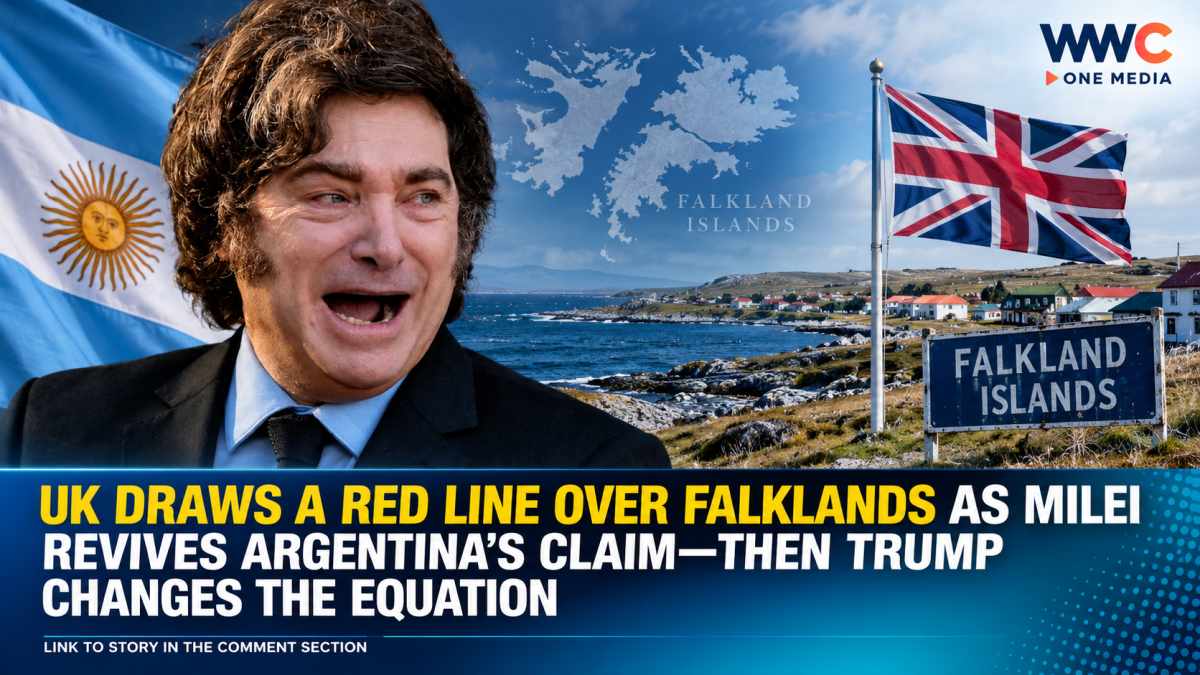
LONDON/BUENOS AIRES — Britain has reaffirmed its sovereignty over the Falkland Islands after Argentine President Javier Milei revived Buenos Aires’ long-standing claim to the disputed South Atlantic territory, setting the stage for renewed diplomatic friction over sovereignty, offshore oil and the role of the United States.
British Foreign Secretary Ed Miliband said the UK’s position remains unchanged, insisting that the islands are British and that the wishes of Falkland Islanders must be respected.
“The Islands are British and will remain so because that is the overwhelming position of the Islanders,” Miliband said, adding that their right to self-determination would be upheld. British Defence Secretary Wes Streeting likewise described the UK’s commitment to the islands as “absolute and unshakeable.”
The sharp British response came after Milei delivered a televised national address in which he said the “winds of change” were becoming favorable to Argentina’s claim over the islands, which Argentina calls the Malvinas.
Milei pointed to recent remarks by U.S. President Donald Trump suggesting Washington could reconsider its long-standing position on the Falklands dispute. Trump also declined to clearly say whether the United States would support Britain in a future conflict over the islands.
Milei targets oil project
The latest confrontation is not only about sovereignty.
Milei has also targeted offshore oil development around the Falklands, announcing measures against companies involved in exploration and production in waters Argentina considers its own.
At the center of the dispute is the Sea Lion oil project, operated by Israel-based Navitas Petroleum and involving London-listed Rockhopper Exploration. The field is estimated to contain about 1.7 billion barrels of oil, with first production expected in 2028.
Argentina considers the project an unauthorized exploitation of resources in territory it claims. The companies, however, maintain that their petroleum licenses were lawfully granted by the Falkland Islands government and backed by the British government. They have said the latest Argentine measures are not expected to materially affect the project’s development timetable.
Milei has threatened tougher measures against companies, shareholders, suppliers and other entities connected to offshore activity around the islands. Argentina has also moved to strengthen its legal framework for responding to what it considers unauthorized hydrocarbon activity.
Why the Falklands dispute remains explosive
The sovereignty dispute stretches back decades and became the subject of war in 1982, when Argentine forces invaded the islands and Britain sent a military task force to retake them.
The conflict lasted roughly 10 weeks and resulted in hundreds of deaths on both sides as well as three Falkland Islanders. Britain ultimately regained control of the territory.
The issue remains deeply sensitive in Argentina, where the claim to the Malvinas is embedded in the country’s constitutional framework.
Britain, meanwhile, emphasizes the right of the islanders to determine their own political future.
That position was reinforced by a 2013 referendum, in which 99.8% of participating voters chose to remain a British overseas territory, on turnout of about 92%. Argentina rejected the referendum.
The UK government has repeatedly argued that any discussion of the islands’ future must respect the wishes of the people who live there. In a June 2026 statement, the British government said the islanders’ right to self-determination was fundamental and that their wishes had been expressed clearly through the referendum.
Trump factor adds a new layer
The latest escalation has attracted unusual attention because of Trump’s comments about the dispute.
For decades, Washington has maintained a broadly neutral position on the competing sovereignty claims while recognizing Britain’s administration of the islands. Trump has now suggested that the U.S. position could be reassessed.
Milei has seized on those comments as evidence that international circumstances may be shifting in Argentina’s favor.
Trump’s remarks also came against the backdrop of tensions between Washington and London over Britain’s level of support for U.S. military operations in the Middle East.
That has raised questions about whether the Falklands issue is being drawn into a much broader dispute over defense cooperation between the United States and Britain.
No immediate return to war—but tensions are rising
Despite the increasingly forceful rhetoric, there has been no indication from Milei that Argentina intends to pursue its sovereignty claim through military action.
Instead, his government is emphasizing diplomatic pressure, legal measures and economic sanctions against companies connected to offshore oil development.
The British government has likewise signaled that it wants to maintain diplomatic relations with Argentina while firmly rejecting any challenge to the islanders’ current status.
The immediate flashpoint, however, is becoming increasingly clear: oil.
With the Sea Lion project moving toward planned production, Argentina’s sovereignty campaign is colliding with Britain’s support for the Falkland Islanders’ right to develop their natural resources.
That means a decades-old territorial dispute is now intersecting with energy interests, U.S. foreign policy and domestic politics in Argentina—creating a potentially volatile mix in the South Atlantic.
For now, London is refusing to give ground.
Buenos Aires is signaling that it intends to push harder.
And with Washington’s position under renewed scrutiny, the next moves could determine whether the latest Falklands dispute remains a diplomatic confrontation—or becomes something much bigger.
WWC ONE MEDIA J.M.S




Leave a Reply