
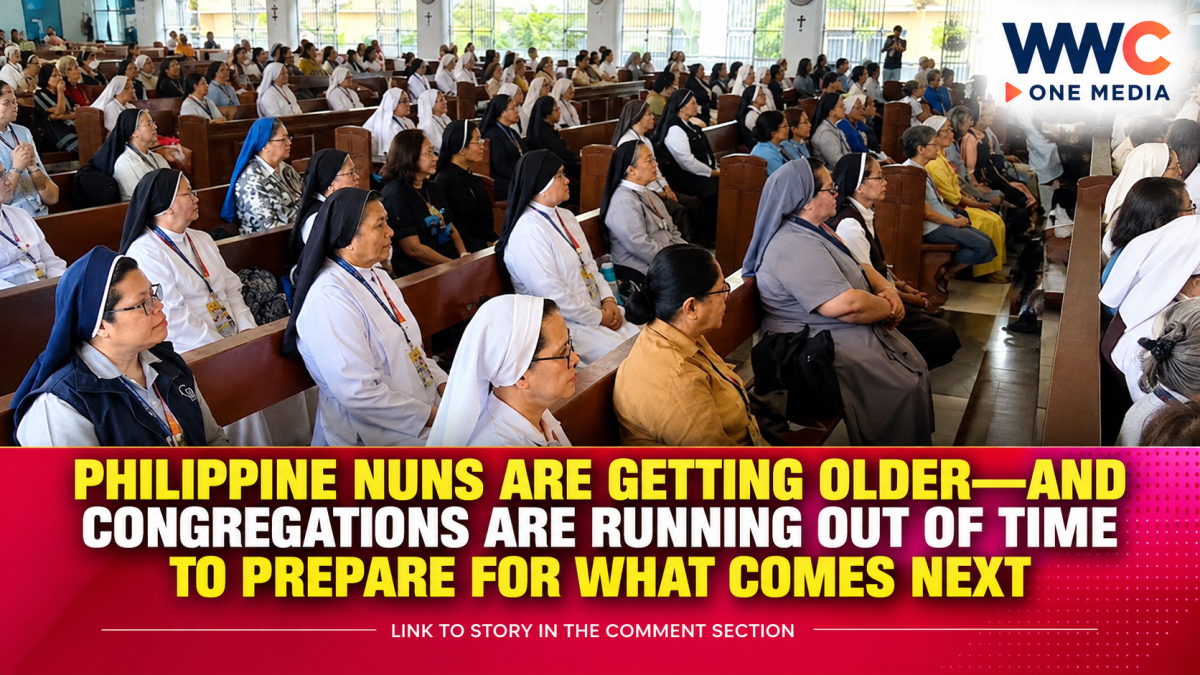
MANILA, Philippines — Catholic religious congregations in the Philippines are confronting a demographic challenge that could reshape religious life in the country: an increasingly aging membership and a growing need for long-term care.
A study involving 45 women religious congregations in the Philippines found that 70% of professed members are aged 50 and above, while only about 30% are below 40.
The findings were presented by Catholic researcher Sr. Thu Do, LHC, during the national convention of the Conference of Major Superiors in the Philippines (CMSP) in Zamboanga City, where more than 233 religious superiors reportedly gathered to discuss the future of consecrated life.
The study was conducted by the Center for Applied Research in the Apostolate (CARA) in cooperation with CMSP.
The numbers point to a difficult question for religious communities: How will congregations care for an aging generation of sisters while sustaining their ministries for the years ahead?
Elder care is becoming a collective concern
According to Sr. Do, caring for elderly religious members can no longer be treated as an issue that each congregation handles independently.
The researcher described elder care as a collective challenge facing religious communities, particularly as more sisters enter their later years.
The financial pressure is already visible.
Nearly 40% of the congregations surveyed said they spend more than half of their annual budgets on caring for elderly members, while 79% identified financial assistance as their leading need.
The study also highlighted another problem: many existing convents were designed primarily for active religious ministry—not for the medical, mobility and long-term-care requirements that can accompany old age.
Congregations consider shared care facilities
One proposal emerging from the discussion is the creation of an inter-congregational elder-care facility that could serve members from multiple religious institutes.
The idea reflects the growing recognition that individual congregations may struggle to build and maintain specialized facilities on their own.
The study found that 57% of congregations expressed interest in such a facility.
Sr. Do also called for greater training in areas such as gerontology, palliative care and elderly care, emphasizing that preparation for aging should begin well before a religious member reaches retirement age.
The challenge mirrors a wider Philippine demographic shift
The issue facing religious congregations is occurring against the backdrop of a rapidly changing Philippine population.
The Philippine Statistics Authority reported in 2026 that Filipinos aged 60 and above reached about 10.98 million in 2025, representing 9.6% of the country’s 113.7 million population.
Government officials said the proportion of older Filipinos is expected to continue increasing, with the country projected to cross the 10% threshold used by some international institutions to characterize an aging society within the coming years.
That demographic transition has implications far beyond government programs. It affects families, healthcare systems, social protection—and religious communities whose members may dedicate decades of their lives to education, healthcare, social services and pastoral work.
Religious retirement programs also face gaps
Research published by San Pedro College examining retirement programs for elderly and convalescing priests and religious in an archdiocese found that the number of retired religious and priests is expected to increase over the next decade.
The study also found that while some retirement services were available, formal and organized retirement programs had not yet been fully established by the congregations and archdiocese examined.
Researchers concluded that existing programs did not fully meet the expectations of aging religious members and that the findings could help guide the development of more appropriate retirement programs.
The research provides another indication that the issue is not simply about getting older—it is about whether religious institutions are prepared for what aging requires.
A changing role, not necessarily an ending
Aging does not necessarily mean that religious members cease contributing to their communities.
Recent research examining the experiences of Filipino Mensa Domini sisters aged 60 and above found that aging involved adapting to new roles while maintaining a sense of mission. The study also highlighted faith, community and support networks as important sources of strength.
The Catholic Bishops’ Conference of the Philippines also maintains a national Commission on Vocations tasked with promoting and accompanying vocations to religious life and conducting research into the country’s changing vocation landscape.
This makes the current situation a two-sided challenge: religious congregations must care for the sisters who built their institutions while also finding ways to sustain vocations for the future.
What happens next?
For many congregations, the question is no longer whether elder care will become a major concern.
The data suggest that it already is.
The more pressing question is whether religious communities can develop sustainable systems for healthcare, retirement, housing and companionship before the demographic pressure becomes even greater.
An aging membership represents the legacy of generations of religious women who spent their lives serving schools, hospitals, parishes and communities.
But as their numbers age, the institutions they helped build are being forced to confront an uncomfortable reality:
Who will care for those who spent their lives caring for others?
WWC ONE MEDIA M.J.E

Leave a Reply