
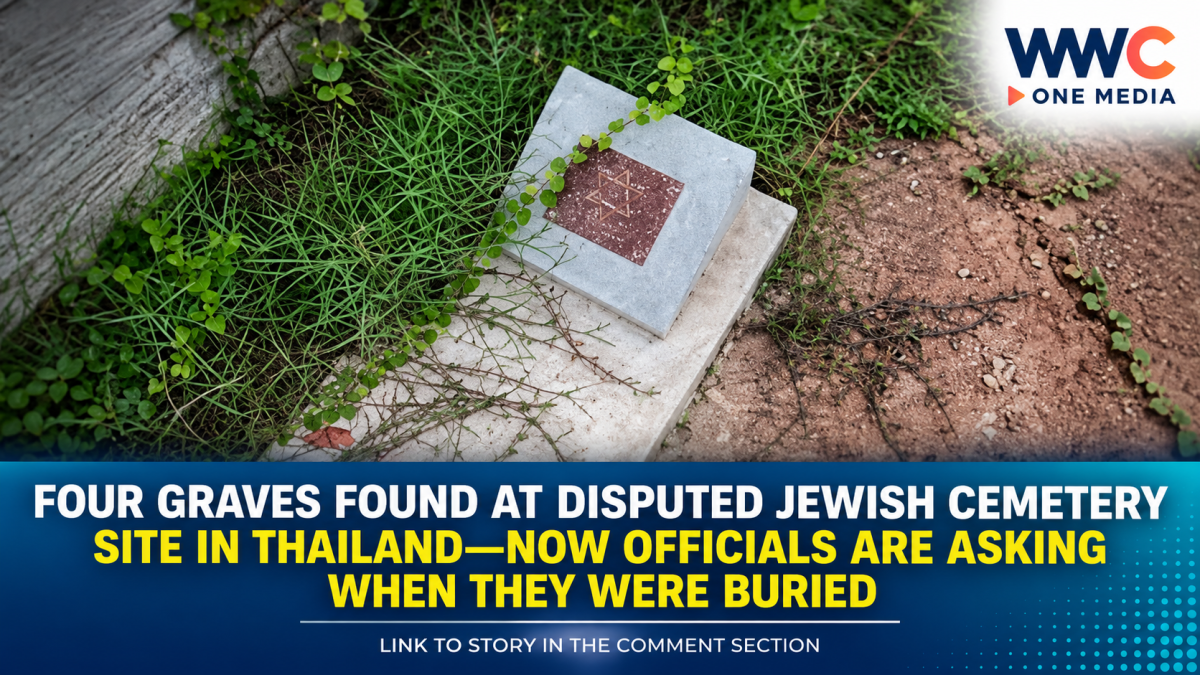
CHACHOENGSAO, Thailand — A growing dispute over a proposed Jewish cemetery in Thailand has taken a dramatic new turn after authorities inspecting the site in Chachoengsao found four apparent burial sites, prompting officials to investigate whether some of the burials took place after the cemetery’s operating authorization had expired.
The discovery was made on September 4 at a privately owned site in Samet Tai subdistrict, Bang Khla district, after renewed public concern over reports that the property could potentially accommodate as many as 1,200 Jewish graves.
The latest inspection marks a significant development in a controversy that had already triggered complaints from nearby residents, questions over the site’s permits and concerns about its proximity to waterways, farms and community facilities.
Four burial sites discovered
According to Thai PBS and other Thai media reports, officials were allowed inside the approximately six-rai property on September 4.
They reportedly found four burial sites. Three appeared to have been covered with concrete, while another was marked with stones and a sign indicating 2025, according to local officials cited in Thai media.
Kittiphong Sileuang, president of the Samet Tai Subdistrict Administrative Organisation, said authorities initially believed that one burial may have occurred while the cemetery authorization was still valid.
The status of the other three is now the key issue.
Officials said they must determine whether those burials took place after the relevant permit had expired and renewal had been rejected. Authorities have indicated that legal action could follow if violations are confirmed.
Importantly, authorities have not yet publicly established that all four burials were unauthorized.
That distinction matters.
The controversy over the cemetery began years ago
The property, located in Samet Tai, had already been at the center of a long-running dispute before the latest discovery.
The site covers roughly 6 rai and 20 square wah and is surrounded by a high wall. Thai PBS reported that the property sits near natural waterways, shrimp and fish ponds, a child-development center, a school and a local health facility.
Residents became increasingly aware of the site’s intended use after a burial reportedly took place in 2024.
Local leaders said residents had previously opposed the cemetery because of concerns about its location and possible environmental effects, particularly given the nearby water sources and agricultural activity.
What happened to the cemetery permit?
The legal history is complicated.
According to reporting from The Nation and Thai Rath, an application to establish the cemetery was made in 2021, while the original cemetery authorization was valid for three years.
Authorities subsequently rejected an application to renew the authorization.
The case eventually reached the Interior Ministry, which dismissed the operator’s administrative appeal in September 2025 because it was filed after the applicable deadline. The operator was informed of the right to pursue the matter through the administrative court system, and the dispute is now being pursued at the Rayong Administrative Court.
The site therefore became the subject of an unusual legal situation: a property associated with a proposed Jewish cemetery whose permit was not renewed, while questions over its future use remained unresolved.
Earlier officials said there were no bodies
This is where the latest development becomes particularly important.
Just one day before the September 4 inspection, officials were publicly saying that no bodies were currently buried at the site.
The Nation reported on September 4 that Samet Tai officials had said there were no bodies at the property and that the original cemetery authorization had expired.
Thai Rath likewise reported on September 3 that the provincial government had stated that one body previously buried under the authorization had been removed and that no bodies remained at the location.
The subsequent physical inspection, however, produced a very different picture.
Officials reported finding four apparent burial sites.
That discrepancy is now likely to become a central part of the investigation.
What about the reported 1,200 graves?
Reports circulating online had claimed that the Chachoengsao property could be developed to accommodate approximately 1,200 burials.
However, authorities and local officials have cautioned against treating that figure as an established fact.
Thai PBS reported that residents were seeking clarification over claims that the property could be upgraded to accommodate 1,200 graves. The source of that figure and whether such a plan has actually been approved remain matters requiring clarification.
The Nation similarly described the 1,200-plot figure as a report that had circulated online and triggered concern among residents.
Why residents are worried
For nearby residents, the dispute is not simply about the cemetery itself.
The site is close to waterways, shrimp farms and fish ponds, making environmental concerns a major part of the local opposition.
Residents have questioned whether extensive burial activity could affect surrounding water sources, particularly because some households depend on local agricultural and aquaculture resources.
There are also community concerns because the property is located near residential areas and public facilities.
Local officials have therefore been under pressure to establish exactly what the property is authorized to do—and whether any activity has taken place outside those permissions.
The Jewish community’s side adds another layer
The dispute should also be understood in the context of the Jewish community’s need for dedicated burial grounds in Thailand.
The Jewish Community of Thailand has publicly described the difficulty of maintaining adequate Jewish burial space in Bangkok and says a new cemetery site in Chachoengsao was acquired and consecrated for Jewish burials.
In a May 2026 account, the community described a burial in what it called its new cemetery in Chachoengsao, saying the burial was the third at the new site.
That account provides important context: the issue is not simply about an unexplained piece of land. There is a documented effort by members of Thailand’s Jewish community to establish and maintain appropriate Jewish burial facilities.
At the same time, the existence of a religious need does not settle questions concerning local permits, land-use requirements or environmental regulations.
Those issues remain for Thai authorities and the courts to determine.
The question now is simple—but consequential
After the latest inspection, authorities face several questions:
- When were the four people buried?
- Was the required authorization valid at the time of each burial?
- Why did earlier officials report that no bodies remained?
- Did any burials take place after the permit expired?
- What is the current legal status of the property while the court case continues?
- Is there actually any approved plan for 1,200 graves?
Officials have said they intend to examine the permits and relevant records before determining what legal action, if any, should follow.
For now, the most accurate description is not simply an “illegal Jewish cemetery.”
It is a disputed cemetery site where authorities have now reported finding four burial sites while investigating the property’s permit and legal status.
And that distinction could become crucial as the investigation moves forward.
WWC ONE MEDIA M.J.E




Leave a Reply