
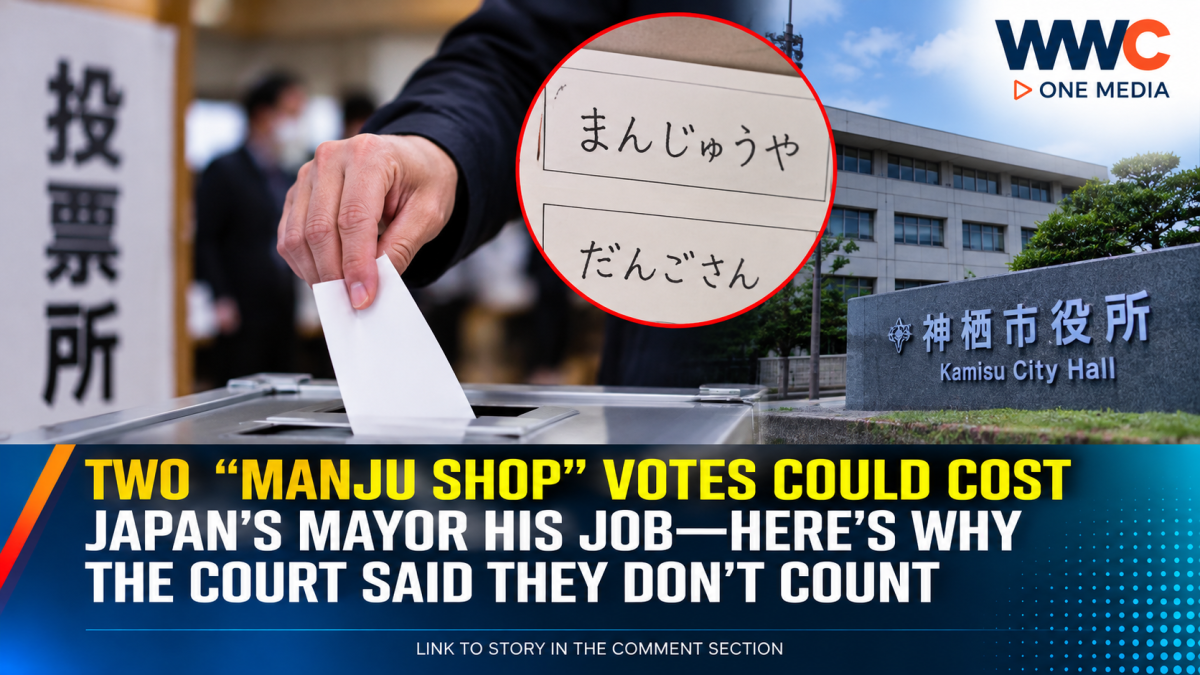
TOKYO — Two handwritten ballots containing the words “manju shop” and “Mr. Dango” have become the unlikely center of a Japanese election dispute that could determine who leads the city of Kamisu in Ibaraki Prefecture.
On Sept. 3, the Tokyo High Court upheld a decision invalidating the two ballots, rejecting Kamisu Mayor Toshiyuki Kiuchi’s challenge against the Ibaraki Prefectural Election Commission.
The ruling could ultimately cost Kiuchi his mayoral position if it becomes final.
It started with a perfect tie
The extraordinary dispute goes back to Kamisu’s mayoral election held on Nov. 9, 2025.
Kiuchi and former mayor Susumu Ishida each received exactly 16,724 votes.
With the candidates tied, the winner was determined by a lottery, as provided under Japan’s election rules. Kiuchi won the draw and initially became mayor.
But Ishida challenged the result, setting off a chain of recounts and administrative reviews.
The first recount did not change the result. Kamisu’s election commission confirmed that both candidates still had 16,724 votes.
The dispute then moved to the prefectural election commission.
Then two unusual ballots appeared
During the subsequent review, two ballots counted for Kiuchi contained descriptions rather than his legal name:
- “まんじゅうや” — roughly, “manju shop”
- “だんごさん” — roughly, “Mr. Dango”
Kiuchi argued that the descriptions clearly referred to him because his family operates a long-established Japanese confectionery business.
He has said that people in the area have called him “the manju shop’s son” since childhood and that the nickname remained familiar locally.
The prefectural election commission, however, reached a different conclusion.
It determined that the two descriptions could not be sufficiently established as Kiuchi’s widely recognized nickname and therefore treated the ballots as invalid.
One ballot can change the entire election
The mathematics behind the case is remarkable.
The prefectural commission also found one invalid ballot among Ishida’s votes.
That left the revised totals at:
Ishida: 16,723
Kiuchi: 16,722
Instead of a tie requiring a lottery, Ishida moved ahead by one vote.
The prefectural commission consequently ruled that Kiuchi’s election victory was invalid.
Kiuchi challenged that decision in court.
Why did the court reject “manju shop”?
The Tokyo High Court’s reasoning centered on whether the words could reasonably and clearly identify Kiuchi.
The court noted that “manju shop” and “Mr. Dango” are ordinary expressions rather than names uniquely identifying one person.
There are reportedly at least nine Japanese confectionery shops in Kamisu, making it difficult to establish that those expressions uniquely referred to Kiuchi’s family business or to Kiuchi himself.
The court therefore upheld the election commission’s conclusion that the ballots did not clearly identify Kiuchi.
That does not mean the court concluded nobody ever called him “manju shop.”
Rather, the issue was whether the expressions were sufficiently established as a customary designation identifying the candidate for the votes to be counted.
Kiuchi says the ruling ignores local reality
Kiuchi has strongly objected to the decision.
He has argued that his family’s confectionery business was historically the only such shop in the old Kamisu area and that he has been known locally by the nickname since childhood.
After the ruling, he said he would consult his lawyers about whether to appeal to Japan’s Supreme Court.
His position is essentially that the voters who wrote those descriptions knew exactly whom they were voting for.
Ishida wants his old job back
For Ishida, the ruling represents a major step toward returning to the mayor’s office.
He has argued that residents could not reasonably be expected to interpret generic terms such as “manju shop” or “Mr. Dango” as a specific candidate’s name.
If the ruling becomes final, Ishida would take office as mayor, according to Japanese media reports.
But there is another unusual consequence.
Because nearly a year has already passed since the original election, Ishida would not be starting a completely fresh four-year term from the date of the court ruling. He has expressed frustration that the prolonged legal dispute has already consumed a substantial portion of the mayoral term.
Japan’s handwritten voting system is now under the spotlight
The Kamisu case has also revived a broader debate over Japan’s distinctive voting system.
Japan generally requires voters to write candidates’ names by hand rather than simply marking a box next to a printed name.
That system creates a difficult question: How much variation from a candidate’s official name should election officials accept?
Japanese election law provides room for ballots to be counted when the voter’s intention is sufficiently clear, even when the writing is not a perfect reproduction of the candidate’s name.
But determining whether a nickname, abbreviation, typo or other description clearly identifies one candidate can become highly fact-specific.
That is precisely where the Kamisu dispute became so contentious.
Another Japanese election case is raising the same question
The issue is not unique to Kamisu.
In Nasu, Tochigi Prefecture, another election dispute concerns ballots that combined portions of two candidates’ names.
The controversy again raises the question of how election authorities should determine voter intent when the writing does not precisely match a candidate’s registered name.
The cases have prompted discussion among election experts about whether Japan’s handwritten ballot system adequately captures voters’ intentions in unusual circumstances.
Why this bizarre case actually matters
At first glance, the dispute may sound almost comical: Can writing “manju shop” on a ballot really determine who becomes mayor?
But the legal issue is much more serious.
Elections ultimately depend on determining what the voter intended.
If election officials accept descriptions too readily, a vague expression could potentially be interpreted as support for the wrong candidate.
If officials reject descriptions too strictly, however, a legitimate vote could fail to reflect the voter’s actual intention.
The Kamisu case sits directly in that tension.
And because Kiuchi and Ishida originally finished with exactly the same number of votes, the question of how those two ballots are classified has an extraordinary consequence.
Two words on two pieces of paper effectively became the difference between winning and losing city hall.
What happens next?
The Tokyo High Court has upheld the prefectural election commission’s decision, but Kiuchi still has the option of seeking further review.
Japanese media reports say he has 14 days to appeal to the Supreme Court. If he does not, the ruling becomes final and the result could lead to Ishida taking over as mayor.
For now, Kiuchi remains in office while the legal process continues.
The final chapter of the election may therefore depend not on another campaign, another vote—or even another lottery.
It could come down to whether Japan’s highest court agrees that “manju shop” and “Mr. Dango” were enough to tell election officials exactly who those two voters intended to choose.
WWC ONE MEDIA M.J.E

Leave a Reply