
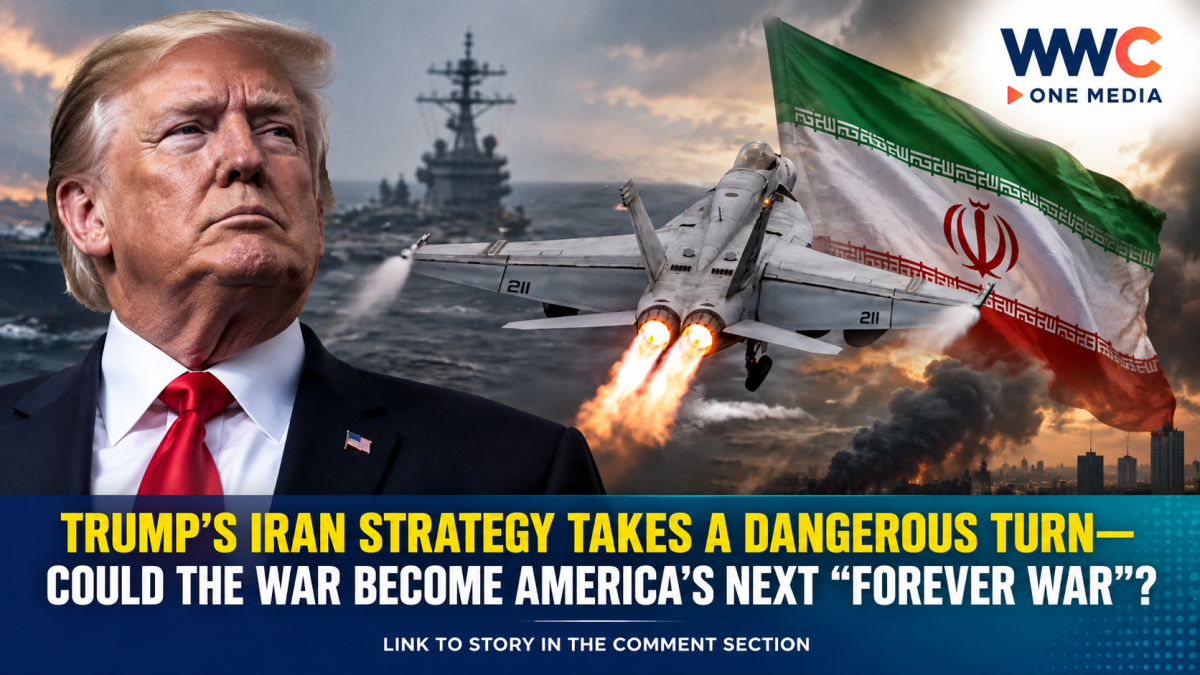
WASHINGTON — What began as a campaign that U.S. President Donald Trump had portrayed as a short military operation is increasingly raising a very different question: What if the war with Iran has no clear ending?
Six months into the conflict, the Trump administration is confronting a difficult strategic dilemma. Washington has demonstrated that it can repeatedly destroy Iranian military infrastructure, but eliminating Iran’s ability to rebuild those capabilities is a far more difficult proposition.
That has fueled concern that the United States could become locked into a cycle of strike, reconstruction and another strike—a pattern that critics warn could evolve into another American “forever war.”
The concern has gained new urgency as U.S. forces have resumed attacks on Iranian military targets and Iran has retaliated against American and allied positions across the region. Reuters reported this week that U.S. and Iranian forces exchanged fire around the Gulf, while the conflict continues to put pressure on the strategically vital Strait of Hormuz.
The strategy Washington is considering: “mowing the grass”
One of the most significant developments is the emergence of what has been described as a “mowing the grass” strategy.
The concept does not necessarily seek to permanently defeat an adversary. Instead, the objective is to repeatedly degrade its military capabilities whenever they are rebuilt to a level considered threatening.
According to recent reporting, U.S. officials have considered periodic, limited strikes aimed at preventing Iran from restoring radar systems, air defenses, anti-ship missiles and other military capabilities around the Strait of Hormuz.
The logic is straightforward: If Iran rebuilds, the United States strikes again.
But that creates an uncomfortable question.
How many times can Washington repeat the cycle before temporary military operations effectively become a permanent conflict?
Iran can rebuild—and that may be the problem
U.S. military power gives Washington the ability to destroy Iranian facilities and weapons systems from the air and sea.
But military strikes cannot easily erase Iran’s industrial base, technical expertise or ability to manufacture new weapons.
Defense systems can be rebuilt. Radar installations can be replaced. Missiles can be produced again.
That means American attacks could delay Iran’s military recovery without necessarily preventing it.
Deutsche Welle’s analysis warns that this could produce a downward spiral in which Iranian reconstruction creates the justification for another American attack, which then creates another round of reconstruction.
Mona Yacoubian of the Center for Strategic and International Studies raised a similar concern months earlier, warning that periodic attacks could develop into an enduring low-intensity conflict interrupted by larger military interventions.
Why the Strait of Hormuz changes everything
The biggest complication is the Strait of Hormuz, one of the world’s most strategically important shipping routes.
For Washington, keeping the waterway open is a major military and economic priority.
For Tehran, however, even the perception that the route is dangerous can create enormous economic consequences.
That gives Iran an asymmetric advantage.
The United States may have overwhelming military power, but it also has to protect commercial shipping, reassure regional allies and prevent energy markets from being destabilized.
Recent fighting has already demonstrated the danger.
Reuters reported that U.S. forces struck Iranian vessels near the Gulf after Iranian forces launched missiles at U.S. Navy ships. Iran subsequently targeted vessels and warned ships against unauthorized movements through the Strait of Hormuz. Brent crude climbed to around $96 a barrel amid fears of further supply disruptions.
The longer the confrontation continues, the greater the potential economic consequences.
The nuclear question could make the conflict even harder to end
Perhaps the most dangerous unintended consequence involves Iran’s nuclear ambitions.
Repeated military attacks could convince Iranian leaders that conventional military capabilities alone cannot provide sufficient deterrence against another U.S. or Israeli attack.
That is precisely the concern raised by Yacoubian.
If Tehran concludes that only a nuclear weapon could guarantee the regime’s survival, an American strategy intended to prevent Iran from becoming more dangerous could potentially create an incentive for Iran to pursue an even more dangerous capability.
Meanwhile, the nuclear issue remains unresolved.
Reuters reported that the United States, Britain, France and Germany are pushing for the International Atomic Energy Agency’s board to refer Iran to the U.N. Security Council over Tehran’s nuclear safeguards obligations. The IAEA has also raised concerns about Iran’s stockpile of uranium enriched to 60 percent and the lack of access to damaged nuclear facilities.
That leaves Washington facing a difficult balancing act: military pressure may weaken Iran, but prolonged pressure without a diplomatic settlement could also deepen Tehran’s determination to develop a stronger deterrent.
Trump’s short-war promise is becoming harder to recognize
The length of the conflict is another major warning sign.
Trump initially presented the military campaign as something that could be completed within weeks. Six months later, the United States remains engaged in military operations while the administration continues to search for a viable exit.
Axios reported in August that Trump’s proposed endgame had shifted several times—from military victory, to negotiations, to economic pressure and efforts to force Iran back to the bargaining table.
Now, the administration is also working on a broader postwar Middle East strategy.
Axios reported this week that the Trump administration is developing plans for a regional alignment designed to contain Iran and potentially expand normalization between Israel and other Arab states.
That suggests Washington is thinking beyond simply ending the immediate fighting.
But it also raises another question:
If the United States is already planning the political order that could follow the war, how close is the conflict really to ending?
The political clock is also ticking
The conflict is increasingly intersecting with American domestic politics.
Reuters reported that senior Trump aides are seeking to prevent the Iran war from escalating further ahead of the November U.S. midterm elections. However, officials reportedly believe more intense military action could return after the elections.
That creates another layer of uncertainty.
A temporary reduction in attacks does not necessarily mean a lasting ceasefire.
It could instead mean a pause.
And if the underlying disputes over Iran’s nuclear program, military capabilities, the Strait of Hormuz and regional influence remain unresolved, the conflict could return in another form.
Could this really become a “forever war”?
The comparison with America’s previous long conflicts must be made carefully.
Unlike Afghanistan and Iraq, the United States is not currently trying to occupy Iran or maintain a massive ground force inside the country.
That makes this conflict fundamentally different.
But a “forever war” does not necessarily require an occupation.
A conflict can become open-ended if there is no sustainable political settlement and both sides retain the ability and willingness to periodically resume hostilities.
That is the central danger behind the “mowing the grass” approach.
Washington could avoid a large ground invasion while still conducting air and naval operations every time Iran rebuilds its military capabilities.
Iran, meanwhile, could retaliate through missiles, drones, maritime attacks and pressure on shipping.
The result would not necessarily look like Iraq or Afghanistan.
It could look like something potentially more difficult to define: a permanent cycle of limited warfare punctuated by sudden escalations.
And that may be exactly what Washington is trying to avoid.
The real endgame remains uncertain
The fundamental problem is that military superiority does not automatically produce a political settlement.
The United States can destroy Iranian military targets.
Iran can rebuild some of them.
Washington can strike again.
Tehran can retaliate.
Unless both sides eventually agree on a framework that addresses the nuclear issue, regional security, military reconstruction and the Strait of Hormuz, the cycle could continue.
As CSIS’s Yacoubian has argued, a periodic-strike strategy against Iran risks becoming an open-ended attrition campaign rather than a genuine solution.
For Trump, that creates an extraordinary strategic dilemma.
He came to power promising to reject America’s endless wars.
Yet the strategy now taking shape could produce a conflict that does not require a permanent occupation to become permanent.
The question is no longer simply whether Trump can win the war in Iran.
It is whether he can find a way to end it.
WWC ONE MEDIA J.M.S




Leave a Reply