
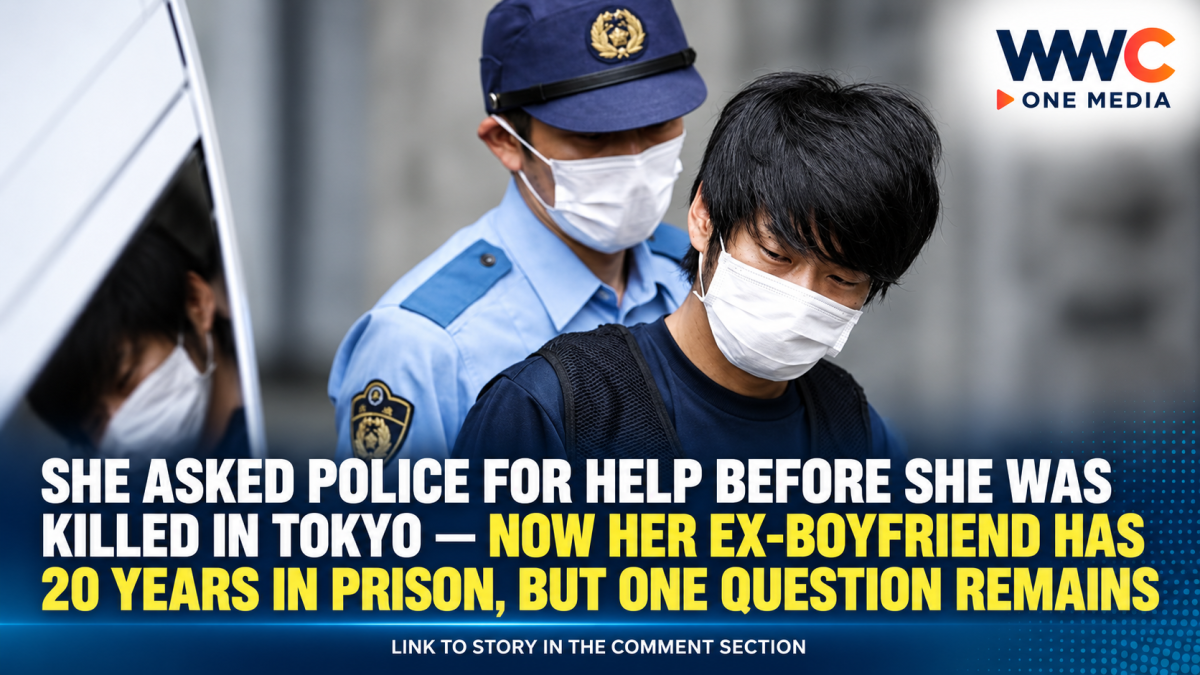
TOKYO — A South Korean man has been sentenced to 20 years in prison in Japan for stalking and killing his former girlfriend in Tokyo, bringing a closely watched case to a legal conclusion — but leaving difficult questions about stalking, police intervention and how quickly relationship violence can escalate.
The Tokyo District Court on September 4 sentenced Park Yong-jun, 31, after finding him guilty of murder and violating Japan’s anti-stalking law in the September 2025 killing of Bang Ji-won, 40, a South Korean national living and working in Japan.
The court imposed the same 20-year term prosecutors had requested.
What makes the case particularly troubling is what happened before the killing.
Bang had already gone to Japanese police for help.
And Park had already been warned to stay away.
A Relationship That Turned Into Stalking
According to court reporting and police accounts, Park and Bang met through a Japanese-language learning app and later entered a long-distance relationship.
Park traveled from South Korea to Japan in August 2025.
But the relationship deteriorated rapidly.
Bang told police on August 29, 2025, that Park had become violent after she tried to end their relationship. Japanese reporting says officers instructed Park not to approach her and helped Bang move temporarily to a safer location.
Police also urged Park to return to South Korea.
But he did not leave.
Trial reporting says police eventually escorted him to Narita Airport, but he canceled his flight. In the following days, prosecutors said, Park repeatedly appeared near Bang’s residence, contacted her and continued stalking her despite police warnings.
Investigators later alleged that he entered or appeared around her apartment building repeatedly.
The Korea Herald reported that he visited her home more than 10 times and made dozens of calls and messages. SBS, citing Japanese reporting, said prosecutors accused him of appearing at the apartment 13 times between August 29 and September 1. The Japan Times separately reported seven alleged intrusions into the entrance and hallways of the building during part of that period.
Those figures refer to somewhat different alleged acts and time periods, so they should not be treated as contradictory totals.
What is clear is that the unwanted contact continued after police intervention.
Prosecutors Said He Waited for Her for Hours
On September 1, 2025, prosecutors said Park went to the area around Bang’s workplace in Tokyo’s Setagaya Ward and waited for her.
The court concluded that he attacked her with a knife after she emerged from the building.
Bang suffered fatal injuries and was pronounced dead after being transported to hospital.
Park fled.
Japanese police located him at Haneda Airport later that day, where he had reportedly booked travel to South Korea. He was detained there and formally arrested on suspicion of murder early the following day.
The case immediately drew attention in both Japan and South Korea because Bang had sought police assistance only days before she was killed.
Defense Denied He Intended to Kill Her
The question of intent became a central issue at trial.
Park admitted the stalking-related conduct but disputed prosecutors’ claim that he deliberately intended to kill Bang.
His defense argued that the fatal injury occurred during a struggle and that prosecutors had not proved murderous intent.
Prosecutors rejected that account.
During closing arguments on August 31, they described the crime as exceptionally serious and argued that the nature of the injury showed the stabbing was deliberate. They also emphasized that Park had continued pursuing Bang even after police warnings. Prosecutors asked for a 20-year sentence.
The Tokyo District Court ultimately sided with the prosecution on the central issue.
According to the Korea Herald, the court said Park had been unwilling to accept Bang’s decision to end their relationship and had waited for her before killing her.
The court imposed the full 20 years sought by prosecutors.
The Case Also Exposed an Important Police-Protection Question
Perhaps the most significant part of the case extends beyond the sentence.
Bang did what authorities routinely encourage people who fear a partner or former partner to do:
She contacted police.
Police did take action.
Japanese reports indicate that officers warned Park, instructed him not to approach Bang, helped move her to another location and repeatedly encouraged him to return to South Korea. At one stage, officers escorted him to Narita Airport.
Yet the killing still occurred.
This is also where reporting needs precision.
The Korea Herald says authorities had issued Park a “restraining order.” Japanese reports available on the case more specifically describe police warnings, instructions not to approach her and a written pledge, rather than consistently describing the measure as a formal court-issued restraining order.
For that reason, the safest formulation is that Japanese police had already instructed and warned Park to stay away from Bang before the killing.
That distinction matters when assessing whether authorities possessed stronger legal powers that were not used.
Japan Was Already Rethinking Its Approach to Stalking
The murder occurred amid a broader debate inside Japan over how authorities respond to stalking cases.
Just days before Bang’s death, Japan’s National Police Agency was considering changes that would allow officers to issue stalking warnings even when victims were reluctant to formally request them, partly because fear of retaliation can prevent victims from taking that step.
Other serious stalking cases had also drawn scrutiny.
In September 2025, Kanagawa Prefectural Police acknowledged failures in their handling of a separate stalking-murder case involving a woman whose family had repeatedly sought help. Police concluded that opportunities to protect the victim had been missed.
Those cases are legally separate and should not be conflated.
But together they underline the same challenge confronting law enforcement: a warning can be issued in minutes, while determining whether someone is about to become violent is far more difficult.
The 20-Year Sentence Falls Under Japan’s New Prison System
The ruling also comes during an historic change to Japanese criminal punishment.
On June 1, 2025, Japan abolished the century-old distinction between imprisonment with compulsory labor and imprisonment without labor.
Both were replaced by a new unified sentence known as 拘禁刑, commonly translated as imprisonment or incarceration.
Under the new system, prison work is no longer automatically required for every inmate. Authorities instead can combine work, education, treatment and rehabilitation according to the prisoner’s individual circumstances.
Japan’s Ministry of Justice says it was the country’s first change in the basic type of imprisonment since the Penal Code took effect in 1907.
Park’s 20-year punishment is therefore being imposed under this new correctional framework.
A Verdict — But Not the End of the Questions
The court has now answered the central legal question.
Park was convicted of killing Bang and stalking her, and he received the sentence prosecutors requested.
But the chronology before her death remains the part of the case likely to receive the greatest scrutiny.
Bang reported violence.
Police intervened.
Park was told to stay away.
Police tried to get him to leave Japan.
He continued pursuing her anyway.
And within days, Bang was dead.
A 20-year prison sentence punishes the crime that happened.
The harder question for Japan is whether the next stalking case can be stopped before it reaches a courtroom at all.
WWC ONE MEDIA M.J.E




Leave a Reply