
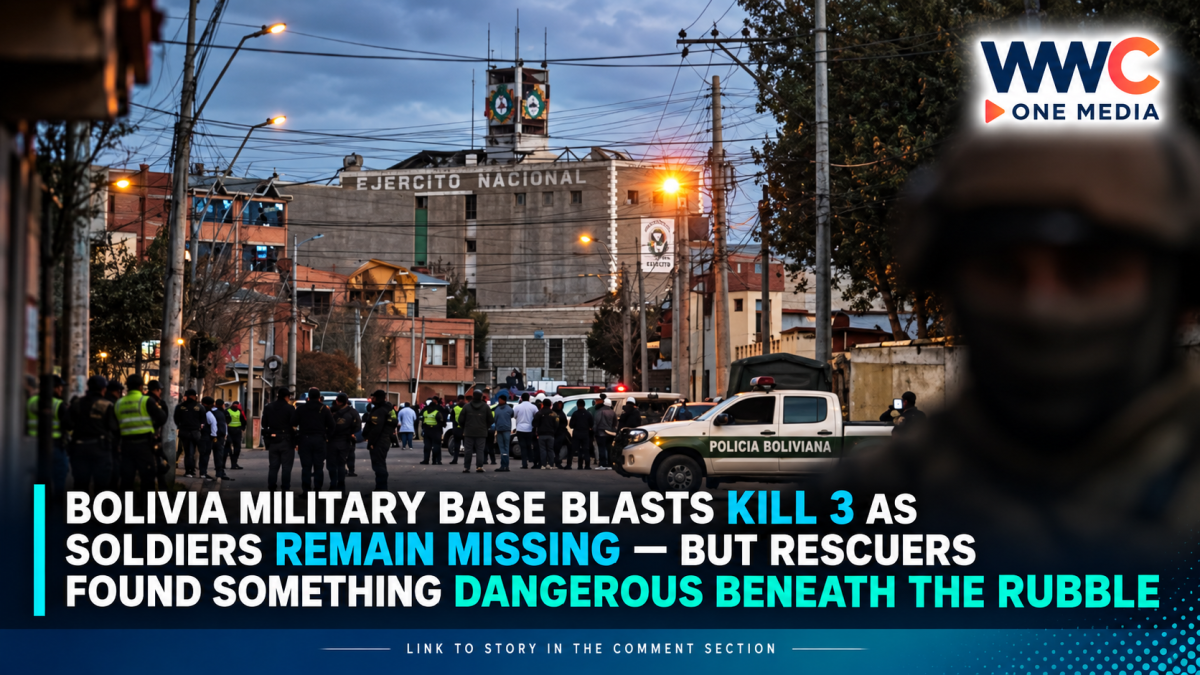
VIACHA, Bolivia — What began with an explosion authorities initially linked to stored pyrotechnic material has turned into a deadly military disaster involving three confirmed deaths, scores of injuries, missing young soldiers and unexploded military ordnance scattered through a wrecked army facility.
Two powerful blasts tore through the Centro General de Mantenimiento of the RAM-2 “Bolívar” military complex in Viacha on Friday afternoon, Sept. 4, sending a massive shock wave into surrounding neighborhoods roughly 30 kilometers southwest of Bolivia’s administrative capital, La Paz.
Roofs were damaged. Windows shattered across nearby homes. Debris and rocks were hurled through the area, trees were uprooted and terrified residents rushed outside as a thick plume of smoke rose over the military installation.
But more than a day after the explosions, one of the biggest obstacles facing rescuers was still inside the base.
Grenades, TNT and other potentially live explosive material remained among or near the ruins, making a full-scale excavation dangerously difficult.
And that means families waiting for missing soldiers are trapped in an agonizing race between two priorities:
search faster — but do not trigger another explosion.
Death toll rises from two to three
The Korea Herald, citing AFP, reported that two people had died and 14 uniformed personnel were missing after the twin explosions. That was accurate at the time of the underlying report, but the casualty picture changed afterward.
Bolivia’s Institute of Forensic Investigations later confirmed that rescuers recovered the body of another man from beneath the debris.
That raised the confirmed death toll to three.
The Bolivian Army subsequently identified the third victim as soldier Wilson Copa Mamani, who had been carrying out his military service at the Regimiento Bolívar.
The first two confirmed victims were also young men completing mandatory military service, according to Bolivia’s Defense Ministry.
That detail makes the disaster particularly painful.
Many of the people closest to the blast were not career officers but teenage conscripts performing compulsory service.
The missing list included 13 conscripts and one sergeant
On Saturday, Regimiento Bolívar commander Lt. Col. Antonio Amaru released the names of 14 military personnel who had not been located after the blasts.
The group included 13 conscripts and one first sergeant, many of them only 18 or 19 years old.
Amaru was careful to emphasize something crucial:
Being listed as missing did not mean the soldiers had been confirmed dead. Rescue teams were still trying to determine where they were.
But the later identification of Copa Mamani creates a reporting complication.
His name was among the original 14 missing personnel, and he was subsequently confirmed as the third fatality. Mathematically, that could reduce the outstanding number to 13, but authorities had not yet published a uniformly reflected revised manifest across all official and media channels when this article was checked.
For that reason, the safest current wording is:
“Soldiers remain missing after an original list identified 14 unaccounted-for personnel.”
It would be premature to continue publishing “14 missing” without qualification.
More than 80 people were injured
The injury toll has also shifted as hospitals reconcile patient lists.
Bolivia’s Defense Ministry reported a consolidated total of 84 injured people, according to Los Tiempos. Forty-nine patients remained at Viacha hospital at one stage, although 47 had already been discharged, while patients requiring additional treatment were transferred elsewhere.
Associated Press reported 85 injured, while another local hospital-based tally reached 88 patients received.
These differences are common during rapidly developing disasters because one agency may count people treated at the scene, another counts hospital admissions and others update totals at different times.
The most defensible formulation for publication is therefore:
at least 84 people were injured.
Reuters reported that some victims sustained serious trauma and burns, including a girl transferred to La Paz with third-degree burns.
What caused the first explosion?
Authorities have a preliminary theory — but only for part of the disaster.
Defense Minister Ernesto Justiniano said the first explosion appeared to involve black powder associated with pyrotechnic material stored at the military facility.
But the second explosion was substantially more powerful.
And investigators have not yet established conclusively what triggered it.
That distinction is essential.
It would be inaccurate at this stage to declare that “fireworks caused both explosions.”
Authorities have only publicly connected the first detonation, on a preliminary basis, with black powder or pyrotechnic material.
The second blast remains under technical investigation.
Then rescuers discovered something more dangerous
As emergency crews prepared to remove debris, drones and specialized teams detected grenades and other military explosive material in damaged sections of the complex.
Justiniano said the risk remained too high for heavy equipment to enter parts of the site.
Some explosive devices still had substantial destructive potential, according to local reports.
Bolivia TV also reported warnings about dangerous unexploded devices, including explosive boosters, and authorities instructed residents not to touch suspicious objects found around the affected zone.
That discovery explains why families watching rescue crews from outside the security perimeter may see progress that appears frustratingly slow.
Removing concrete with excavators is straightforward compared with removing concrete while grenades, TNT and unidentified explosive material may still be buried beneath it.
Families gathered outside the base desperate for answers
The human scenes outside the military compound quickly became one of the defining images of the disaster.
Families crowded around the security perimeter seeking information about their sons and relatives.
AFP described Indigenous Aymara families crying and attempting to obtain information from military personnel, while one father said he simply wanted officials to tell him whether his son appeared on the missing list.
Some relatives complained that the search was progressing too slowly.
But authorities said explosives scattered through the area made rapid debris removal potentially lethal to rescuers themselves.
The military has promised to continue updating families as personnel are located.
The blast hit far beyond the barracks
The damage was not confined to the army installation.
The shock wave ripped through residential areas around the base.
Windows shattered, roofs were damaged and homes were struck by flying material. Residents were temporarily evacuated because some structures were considered unsafe.
Electricity was cut in parts of the affected zone.
Military police established a security cordon while emergency personnel worked through the wreckage.
Viacha has a population of roughly 114,000, which means the explosives were being stored inside or near a sizable urban community rather than an isolated desert testing ground.
That fact is likely to become central to the investigation.
Viacha’s mayor says the disaster exposed another vulnerability
Mayor Jenrry Patzi publicly complained that his city did not have sufficient higher-level medical infrastructure to cope with an emergency of this scale.
Seriously injured patients had to be transferred from Viacha to larger medical centers in El Alto and La Paz.
For a city struck by a major military explosion, that immediately raises a second question beyond what happened inside the barracks:
Was the surrounding community adequately prepared for an accident at a facility storing explosives?
Viacha declared three days of mourning for the victims.
Prosecutors are now treating this as a criminal investigation
Bolivia’s Public Prosecutor’s Office opened an investigation on its own initiative following the disaster.
Prosecutors said they were examining possible offenses equivalent to culpable homicide, negligent injury and other destructive acts, while forensic and police teams began collecting evidence from the scene.
That means the investigation will go beyond determining which explosive detonated.
Authorities will also need to establish:
how the materials were stored;
whether safety regulations were followed;
whether pyrotechnic material was kept appropriately near military explosives;
whether personnel handling the materials were properly trained;
and whether anyone’s negligence contributed to the deaths and injuries.
Those questions have not yet been answered.
Bolivia’s president promises a transparent investigation
President Rodrigo Paz expressed solidarity with the victims and ordered what he described as a thorough, technical and transparent investigation.
He said authorities must establish the cause, verify compliance with safety protocols and determine whatever responsibilities emerge from the evidence.
Vice President Edmand Lara separately pushed back against treating the disaster merely as a “fireworks” accident.
Lara demanded an exhaustive investigation and warned against minimizing the severity of what occurred inside the military facility.
His intervention matters because the physical evidence discovered after the explosions includes much more than consumer pyrotechnics.
Military explosives were clearly present in the broader damaged complex.
Exactly what role those materials played in the second blast remains unknown.
Early reports of 10 to 15 deaths were not confirmed
Another important newsroom correction concerns reports that circulated immediately after the explosions.
Viacha health director Rita Nebraska initially told local television that preliminary information suggested as many as 10 to 15 people might have died.
That estimate spread rapidly through international news reports.
National authorities later issued a lower confirmed figure.
The official toll first stood at two and subsequently rose to three after another body was recovered.
Therefore, “10 dead” should not be used as the confirmed death toll.
It was an early estimate made before authorities completed identification and recovery work.
For a breaking story like this, distinguishing an initial estimate from a confirmed fatality count is essential.
The disaster comes amid wider scrutiny of military-site security
The Viacha explosions are also landing at an uncomfortable moment for Bolivia’s armed forces.
Los Tiempos reported that several separate security incidents have affected military facilities this year.
Just two days before the Viacha disaster, the Defense Ministry announced an investigation into the disappearance of 33,608 rounds of 5.56×45mm ammunition from a military depot in Montero, Santa Cruz.
Earlier in the year, weapons were reported stolen from another military installation in La Paz, while a separate fire occurred at old military facilities in Viacha in May.
There is no evidence that those incidents caused or are operationally connected to the Sept. 4 explosions.
But collectively, they are likely to intensify questions about inventory controls, storage standards and security procedures within Bolivia’s military infrastructure.
And that could turn the Viacha disaster from an isolated accident investigation into a much broader examination of how dangerous military material is being managed.
The biggest unanswered question is now beneath the rubble
For the families waiting outside the Regimiento Bolívar, political accountability can come later.
Their immediate question is much simpler.
Who is still alive beneath the wreckage?
Rescue teams know where many of the missing personnel had been assigned.
But the same explosions that collapsed structures also scattered dangerous ordnance through the site, restricting how quickly crews can dig.
The government says search operations will continue.
The Army says it will cooperate fully with prosecutors.
The president says there will be a transparent investigation.
And the Defense Ministry says the second, larger explosion is still being analyzed.
That last point may prove decisive.
Because the first explosion may have begun with black powder associated with pyrotechnics.
What investigators still need to explain is what made the second blast so much more powerful — and whether everything stored inside that military compound was being handled as safely as authorities believed.
WWC ONE MEDIA M.J.E




Leave a Reply