
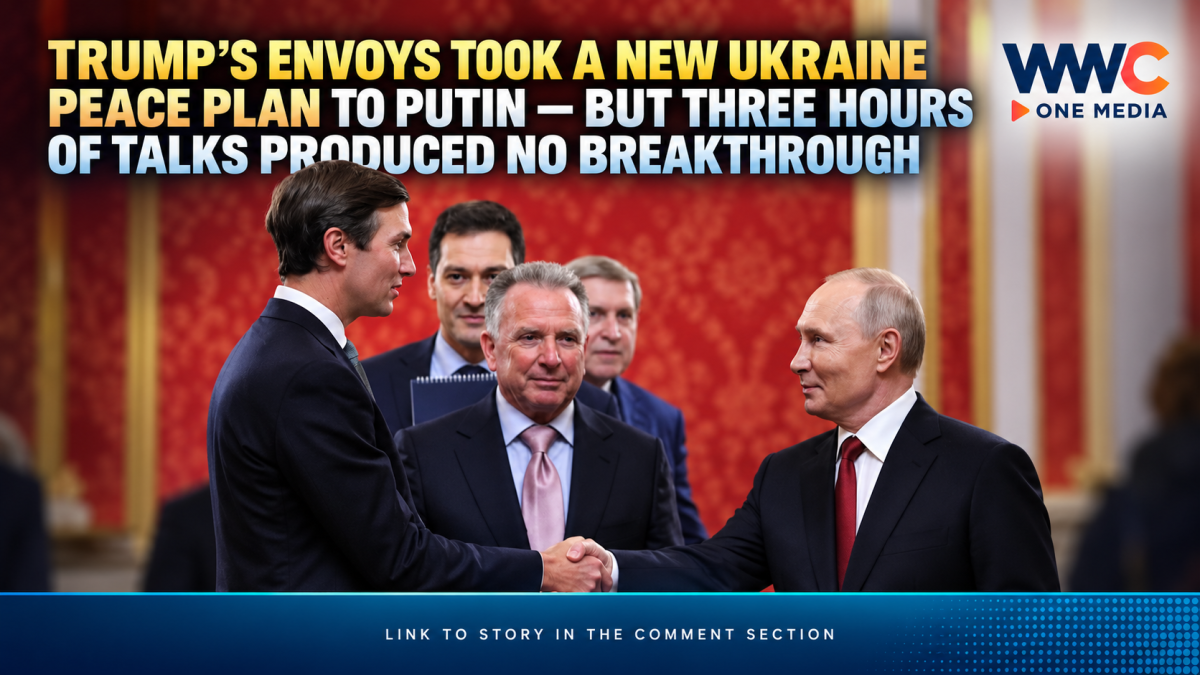
MOSCOW/KYIV — Donald Trump’s latest attempt to end the Russia-Ukraine war has moved from announcement to face-to-face diplomacy — but the first major meeting has already shown how difficult the road to peace remains.
U.S. special envoy Steve Witkoff and presidential adviser Jared Kushner, Trump’s son-in-law, held more than three hours of talks with Russian President Vladimir Putin at the Kremlin on Saturday, carrying what Trump has called a new proposal aimed at ending the conflict.
The Kremlin described the talks as useful, frank and constructive.
But it announced no ceasefire agreement, no territorial compromise and no breakthrough toward ending a war now well into its fifth year.
The American envoys then traveled to Kyiv, arriving Sunday for their first official visit to the Ukrainian capital in the renewed peace push. There they are meeting President Volodymyr Zelenskyy and Ukrainian officials to present what they heard in Moscow and discuss Washington’s next steps.
That makes this weekend one of the most consequential diplomatic moments in months.
It also exposes the biggest problem confronting Trump’s plan:
Russia and Ukraine are talking about peace, but they still appear to disagree on what peace actually means.
Trump says there is a plan — but he has not revealed it
Trump announced the mission Friday, telling reporters that Witkoff and Kushner were being dispatched because Washington believed there was still a possibility of reaching an agreement.
He said the pair were carrying “a proposal to end the war.”
But when reporters asked whether the proposal would require Ukraine to surrender territory, Trump declined to provide details, saying only that the United States had an idea for peace.
That distinction matters.
Earlier U.S.-Ukraine negotiations produced a detailed 20-point framework involving security guarantees, reconstruction, economic arrangements and an eventual ceasefire, but some of the hardest questions — especially territorial control — remained unresolved.
The Trump administration has not publicly said whether the proposal now being carried by Witkoff and Kushner is simply a revised version of that framework or something substantially different.
So reports claiming that the latest plan contains specific territorial concessions should be treated cautiously until Washington, Moscow or Kyiv confirms them.
Putin listened — but did not appear to change his basic position
After Saturday’s Kremlin meeting, Putin’s foreign-policy adviser Yuri Ushakov said the Americans had presented a number of possible approaches to a settlement.
He described the discussion as highly useful.
But his account also made clear that Putin continues to believe Russia is improving its military position and can achieve its objectives if negotiations fail.
According to Ushakov, Putin again emphasized what Moscow calls the need to eliminate the “root causes” of the war.
That phrase has repeatedly been used by Russian officials to encompass demands involving Ukraine’s geopolitical orientation, NATO membership ambitions and territorial arrangements.
Reuters reported that the fundamental gap remains substantial: Russia wants Ukraine to relinquish territory Moscow claims and abandon NATO aspirations, while Kyiv refuses to formally surrender Ukrainian land.
That means Trump’s negotiators are not simply trying to arrange a ceasefire.
They are trying to reconcile two visions of the postwar order that remain deeply incompatible.
Territory remains the issue most likely to break any deal
Russia currently occupies significant portions of eastern and southern Ukraine and formally claims four Ukrainian regions in addition to Crimea, which it annexed in 2014.
Moscow has repeatedly demanded recognition of territorial changes as part of a settlement.
Ukraine says occupied territory remains legally Ukrainian and has resisted agreements that would force it to formally renounce sovereignty over land seized by Russia.
That distinction is politically explosive for Zelenskyy.
A ceasefire that freezes existing battle lines is one thing.
A treaty permanently recognizing Russian sovereignty over occupied Ukrainian territory would be something much more difficult for Kyiv to accept.
The earlier 20-point U.S.-Ukraine framework showed just how sensitive the question remains: territorial arrangements were among the major issues still unresolved even after months of negotiation.
So unless the new U.S. plan finds some formula that both sides can tolerate, territory could once again stop negotiations from progressing.
Security guarantees may be just as difficult
Ukraine’s second major concern is what happens after any ceasefire.
Zelenskyy has repeatedly argued that Ukraine cannot simply sign an agreement, reduce its defenses and trust Russia not to attack again.
Kyiv wants credible security guarantees strong enough to deter another invasion.
Earlier this year, the United States backed a coalition of Ukrainian allies promising binding security commitments in the event of renewed Russian aggression.
The earlier peace framework discussed arrangements resembling NATO-style guarantees, continued Ukrainian military strength and substantial postwar reconstruction.
Moscow has historically objected to arrangements it believes could turn Ukraine into a heavily armed Western military partner on Russia’s border.
That creates another contradiction negotiators have yet to solve:
Ukraine wants guarantees strong enough to discourage Russia.
Russia wants a settlement that reduces what it considers a Western security threat.
Both conditions are difficult to satisfy simultaneously.
Putin and Trump could meet again — but Trump says not yet
Trump has also floated the possibility of another personal summit with Putin.
On Sept. 2, he said the Russian president would meet him if asked.
But Trump added an important condition: he wants the summit when the parties are ready to move toward an actual agreement rather than simply stage another diplomatic encounter.
That suggests Witkoff and Kushner’s weekend mission has another purpose beyond presenting proposals.
They are effectively testing whether enough common ground exists to justify bringing Trump and Putin together again.
If their reports from Moscow and Kyiv suggest that the positions remain irreconcilable, a summit could be postponed.
If they identify movement, Trump may try to personally close the deal.
One concrete result emerged: a limited pause around the capitals
There has been at least one immediate diplomatic concession.
Russia and Ukraine agreed to temporarily halt attacks on Kyiv and Moscow while the American envoys conducted their visits.
Putin ordered Russian forces not to strike Kyiv for three days, while Zelenskyy said Ukraine would refrain from attacks on Moscow through Monday.
That sounds like a ceasefire.
But it is important not to overstate it.
This is not a nationwide cessation of hostilities.
Fighting continues elsewhere.
Russian missile and drone attacks continued in other Ukrainian regions, and Ukrainian operations against targets inside Russia also continued.
So the agreement is better described as a temporary capital-to-capital strike pause, intended partly to facilitate the safety and logistics of the diplomatic mission.
It does, however, demonstrate that Moscow and Kyiv remain capable of agreeing to narrowly defined limits when both see an immediate reason to do so.
Whether that can be expanded is another question entirely.
The peace mission comes after a sharp escalation in the air war
The diplomatic push is taking place against an increasingly violent backdrop.
Only hours before Trump’s announcement, a Russian drone struck the headquarters of Ukraine’s SBU security service in central Kyiv, according to Zelenskyy — the first such strike on the headquarters since the full-scale invasion began.
Other Russian strikes killed civilians in several Ukrainian regions.
Ukraine, meanwhile, has intensified deep strikes against Russian infrastructure, including oil, logistics and military-related targets.
The escalation has transformed the war even as front-line movement remains relatively slow.
Russia has expanded the use of long-range missiles and newer high-speed drones.
Ukraine has increasingly tried to bring the cost of war directly into Russia.
That makes diplomacy harder because both governments still believe military pressure can improve their negotiating position.
Civilian casualties have climbed sharply
The human cost has also worsened.
The United Nations reported that July 2026 produced the highest monthly civilian casualty total in Ukraine since March 2022.
UN human-rights monitors verified at least 437 civilians killed and 2,610 injured in July alone, though the actual numbers are likely higher because many cases remain unverified.
The number represented a 70% increase from July 2025.
Those figures help explain why Washington is trying to revive negotiations now despite repeated diplomatic failures.
Every additional month of stalemate means more missiles, drones and civilian deaths.
This is not Witkoff and Kushner’s first attempt
The two American negotiators already know Putin.
Witkoff has traveled repeatedly to Moscow as Trump’s special envoy.
The Washington Post described Saturday’s trip as his eighth visit to the Russian capital in that role.
Witkoff and Kushner had also met Putin previously, including lengthy talks earlier in the Trump administration.
Those conversations produced optimistic language but no lasting settlement.
This weekend is different in one respect:
they are now traveling directly from Putin to Zelenskyy.
Their Kyiv visit is their first official trip to Ukraine in this peace effort, allowing them to hear the two leaders’ positions within hours of each other rather than through intermediaries.
That could shorten diplomatic communication.
It does not necessarily narrow the underlying disagreement.
Kyiv is willing to talk — but appears deeply wary
Zelenskyy said before Sunday’s meeting that Ukraine was ready for constructive discussions.
But his conditions remain familiar.
Kyiv wants an end to Russian attacks, meaningful security guarantees and a postwar settlement that preserves Ukrainian sovereignty and leaves the country capable of defending itself.
Ukrainian officials also have reason to be cautious.
Trump has previously argued that territorial compromise may be unavoidable.
Putin has repeatedly insisted he will not abandon Russia’s principal objectives.
And previous rounds of U.S.-led diplomacy have ended without resolving the same central dispute.
That means Ukrainian leaders will scrutinize the new proposal for any provision they believe would reward military conquest or leave the country vulnerable to another attack.
European allies are making sure they are not left outside the room
Another significant detail from Sunday’s Kyiv meetings is the presence of senior officials from major European allies.
British, French and German national-security representatives were also in Kyiv as the American delegation arrived.
Their involvement matters because Europe would likely play a major role in any settlement.
European countries may be expected to contribute troops, weapons, air defenses, reconstruction funding or long-term security support.
They would also be heavily affected by any sanctions relief offered to Russia.
That means a durable peace agreement cannot realistically be reduced to a bargain involving Trump, Putin and Zelenskyy alone.
The European states expected to help enforce or finance the settlement will want a role in shaping it.
Russia also wants economic normalization
The Kremlin revealed another dimension of Saturday’s meeting that received less attention than the ceasefire discussion.
Ushakov said Putin and the American envoys discussed potential large-scale economic projects involving Russia and the United States.
That matters because sanctions relief could eventually become one of Washington’s bargaining tools.
Russia has faced extensive Western sanctions since its invasion.
A peace agreement could theoretically open the door to renewed commercial ties, investment or restrictions being lifted.
Trump himself has spoken openly about the economic opportunities that could accompany better relations with Moscow, saying Russia possesses valuable land and resources and that improved ties could be good for business.
But sanctions relief would be politically controversial if Russia retained large amounts of occupied Ukrainian territory without major concessions.
For Moscow, economics could be an incentive.
For Kyiv and Europe, it could become another battlefield in negotiations.
Trump’s Iran war helped freeze the previous peace effort
The timing also reflects another major geopolitical shift.
The earlier U.S.-led peace drive lost momentum as Washington became consumed by its widening conflict with Iran.
Reuters and AP report that substantive Russia-Ukraine diplomacy had been largely frozen for months while the United States focused heavily on the Middle East.
During that diplomatic lull, the military situation intensified.
Long-range strikes increased.
Civilian casualties climbed.
Russia continued trying to expand its position in eastern Ukraine.
Ukraine escalated strikes deep inside Russia.
Now Trump appears to be trying to restart the process before the conflict enters another winter with no political path forward.
Putin may believe time is working in his favor
This could be the biggest obstacle to Trump’s strategy.
Putin told the American envoys that Russia is making “real progress” on the battlefield and remains confident that it can achieve its objectives.
If Moscow believes its military position will improve over the coming months, it has less incentive to make significant compromises now.
Russia has repeatedly said it intends to gain full control of territory it claims in eastern Ukraine.
Western analysts dispute some Russian forecasts about how rapidly those gains can be achieved, and the battlefield remains costly and contested.
But diplomacy usually moves fastest when both sides believe continuing the war is worse than compromising.
There is little public evidence yet that Putin has reached that conclusion.
Ukraine also has reasons not to accept a rushed bargain
Kyiv faces a different calculation.
Ukraine has suffered enormous casualties and infrastructure damage.
Its population is exhausted.
Its air-defense requirements are growing.
And years of war have placed immense pressure on the economy.
But Ukrainian leaders also know that a poorly designed peace agreement could merely create an interval before another war.
That is why Zelenskyy continues to emphasize not simply ending combat but creating a “dignified” and durable peace with effective security guarantees.
The question for Washington is whether it can create a settlement sufficiently attractive to Russia without making it unacceptable to Ukraine — and vice versa.
So far, no administration has found that formula.
Three hours with Putin produced dialogue, not a deal
The rhetoric following Saturday’s Kremlin meeting was diplomatic.
Useful.
Frank.
Constructive.
Substantive.
Those words sound encouraging.
But there was one phrase missing:
agreement reached.
No broader ceasefire was announced.
No territorial formula was revealed.
No Putin-Zelenskyy meeting was scheduled.
No Trump-Putin summit was confirmed.
And no timetable for ending the war emerged.
The White House has indicated that further steps may be announced in the coming weeks.
That makes Sunday’s Kyiv talks especially important.
Witkoff and Kushner now know what Putin says he wants.
Their next task is discovering what Zelenskyy believes Ukraine can actually accept.
This peace mission may succeed or expose how wide the gap really is
Trump has repeatedly promised that he can bring the war to an end.
His envoys are now attempting perhaps the clearest test of that claim.
They have carried a proposal into the Kremlin.
They have heard Putin’s response.
They are now taking that response directly to Kyiv.
But the central contradictions remain.
Russia wants territorial and strategic concessions.
Ukraine wants sovereignty and enforceable security.
Moscow believes it can still improve its battlefield position.
Kyiv believes an agreement without credible guarantees could simply prepare the ground for another invasion.
And the details of Trump’s newest proposal remain hidden from the public.
So the diplomatic movement is real.
The breakthrough is not.
Trump has managed to put Moscow and Kyiv back into the same diplomatic process.
Now his envoys have to discover whether they are actually negotiating toward the same destination.
WWC ONE MEDIA M.J.E


Leave a Reply