
MANILA, Philippines — For years, one of the frustrations facing investors in the Philippines has not necessarily been a lack of opportunity.
It has been figuring out which permit comes first, which government office issues it, which document another agency requires—and whether the rules changed while the project was still being processed.
The Board of Investments is now trying to make that maze easier to navigate.
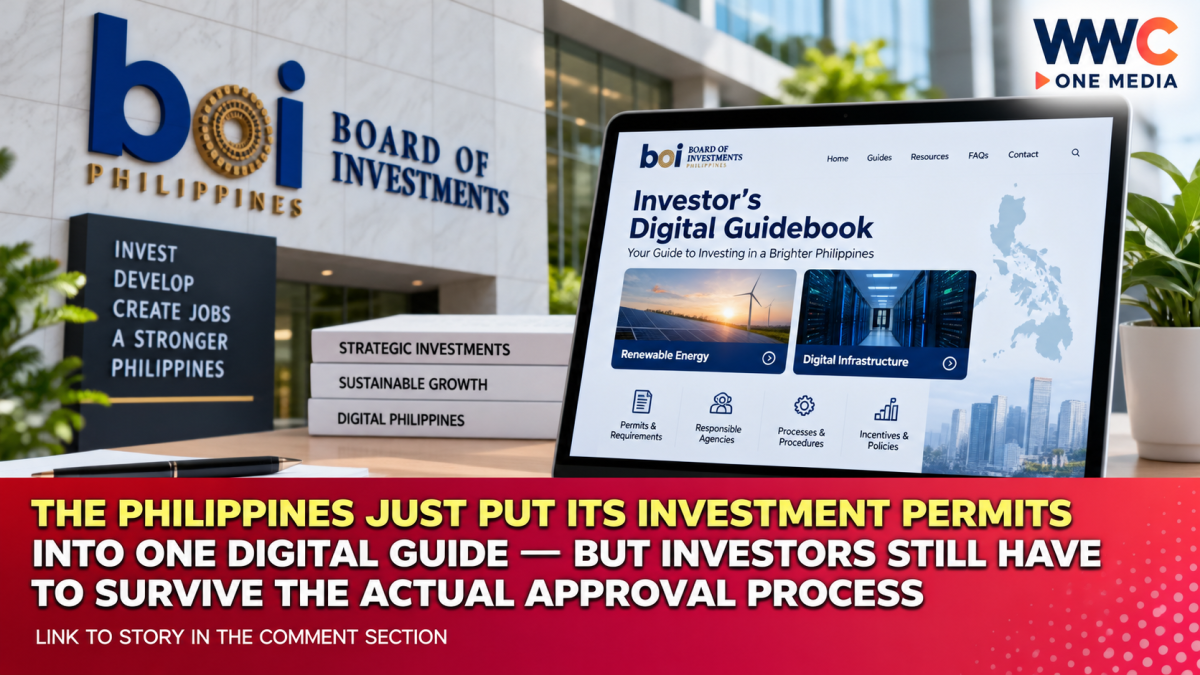
The BOI has formally received a Digital Investor’s Guidebook that consolidates government requirements, permits, responsible agencies and regulatory procedures into a single online resource designed to give investors a clearer view of what they must accomplish before major projects can move from proposal to construction.
The initial platform focuses on two sectors where permitting speed can have enormous economic consequences:
renewable energy and digital infrastructure.
For renewable energy, the guide provides step-by-step information for solar and wind developments.
For digital infrastructure, it initially focuses on data centers and telecommunications towers, including relevant government processes, policies, incentives and responsible agencies.
Critical minerals and agriculture are among the sectors being considered for future expansion.
The idea sounds simple.
But the problem it is trying to solve has been one of the Philippines’ longest-running investment complaints.
An Investor May Know What to Build — But Not Who to Ask First
Major infrastructure projects rarely require permission from only one government office.
A renewable-energy developer may need to coordinate with national agencies, local governments, environmental regulators, land authorities, energy officials and utilities before construction can begin.
A data-center developer can face another combination of permits involving telecommunications, power, land use, construction and local-government requirements.
Information has traditionally been distributed across different agencies, websites, circulars and permitting systems.
The new guidebook attempts to place that regulatory journey in one location.
Context.ph reported that the platform identifies what requirements are needed, which agency is responsible and how the relevant government processes fit together.
Finance Secretary Frederick Go said the objective is to reduce unnecessary back-and-forth while increasing regulatory predictability for businesses considering Philippine investments.
That word—predictability—may ultimately matter more than the website itself.
Investors can factor a known permit cost into a financial model.
What is much harder to price is uncertainty.
But the New Guide Does Not Actually Eliminate the Permits
This distinction is important.
The Digital Investor’s Guidebook is not an automatic permit-approval system.
PwC Philippines, which developed the guidebooks with support from the Asian Development Bank, described the project as giving investors an end-to-end view of the regulatory journey—not changing the actual approval process.
That means environmental rules still apply.
Local permits still apply.
Technical evaluations still apply.
Agency approvals still apply.
The guidebook’s value is that investors should have a clearer understanding of those requirements before they encounter them halfway through a project.
That may sound modest.
For projects worth billions of pesos, however, avoiding even months of unnecessary regulatory delay can affect financing costs, construction schedules and ultimately whether investors proceed at all.
The Project Is Part of Marcos’ ‘Green Lane’ Strategy
The guidebook did not appear in isolation.
It traces directly to Executive Order No. 18, issued by President Ferdinand Marcos Jr. in February 2023.
EO 18 created Green Lanes for Strategic Investments, requiring national agencies and local governments to establish systems for expediting qualifying high-impact projects.
The order also created the One-Stop Action Center for Strategic Investments, or OSAC-SI, under the BOI.
That center serves as the central entry point for projects seeking Green Lane treatment and coordinates their permits with relevant national agencies, local governments and quasi-judicial bodies.
EO 18 specifically instructed BOI to prepare and regularly update an investor manual or guidebook identifying government requirements by strategic sector.
In other words, the new digital resource is not simply an optional BOI information campaign.
It is part of a wider attempt to implement a presidential directive to make strategic investment permitting more transparent and coordinated.
What Projects Can Qualify for Green Lane Treatment?
The Green Lane is aimed at investments considered strategically important to the Philippines.
Current BOI information lists sectors that include:
- clean energy;
- electronics;
- green metals;
- aerospace;
- defense-related industries;
- electric vehicles;
- pharmaceuticals;
- LNG storage and regasification;
- public-private partnership and infrastructure projects;
- specialty hospitals;
- water treatment and distribution; and
- projects involving new products or technologies.
Qualifying projects apply through the BOI’s One-Stop Action Center.
Executive Order 18 requires participating agencies and LGUs to establish Green Lanes, coordinate with designated account officers and streamline outdated or redundant procedures where possible.
But “Green Lane” should not be interpreted as “no rules.”
The system is designed to speed up coordination and simultaneous processing—not to allow investors to bypass legally required environmental, safety or technical standards.
Renewable Energy Dominates the Green Lane Pipeline
The stakes are already enormous.
During the first half of 2026, BOI certified 17 new projects worth ₱351.02 billion under the Green Lane program.
Fourteen were renewable-energy projects representing approximately ₱349.38 billion—or 99.53% of the total project cost certified during the period.
Those 17 projects are projected by BOI to generate almost 39,400 jobs, although these are projected employment figures rather than jobs already created.
Since the Green Lane system began, BOI reported in July that 239 strategic projects worth approximately ₱6.32 trillion had been certified across sectors including renewable energy, digital infrastructure, infrastructure and PPPs, food security, manufacturing, water and pharmaceuticals.
Renewable energy alone accounted for 183 projects and about ₱5.42 trillion of that certified project value.
That explains why renewable-energy permitting is one of the first subjects covered by the Digital Investor’s Guidebook.
There is simply too much capital waiting in the pipeline for regulatory confusion to be treated as a minor administrative inconvenience.
BOI Is Also Seeing Investment Approvals Rise
The broader investment picture provides additional context.
BOI approved ₱461.84 billion in investment commitments during the first six months of 2026, up 21% from ₱382.24 billion during the comparable period in 2025.
Those approvals covered 124 projects expected to create 14,415 direct jobs.
Energy, including renewable energy, dominated again, accounting for about ₱343.47 billion—or roughly three quarters of BOI-approved investment value during the period.
That reinforces the government’s rationale.
If energy investment continues arriving at that scale, shaving unnecessary friction from project development becomes an economic issue rather than merely a customer-service improvement.
There is one important caveat:
Approved or Green Lane-certified investment commitments are not the same as money already fully spent in the economy.
Projects still have to secure permits, financing, construction contracts and ultimately reach commercial operation.
BOI itself has emphasized that the next challenge is converting investment commitments into operating businesses.
Data Centers Are the Other Major Target
The inclusion of digital infrastructure is equally strategic.
The Digital Infrastructure Investor’s Guidebook focuses specifically on data centers and telecommunications towers, two areas increasingly important as artificial intelligence, cloud computing and digital services drive demand for processing capacity and connectivity.
But data centers are unusually complex investments.
They need land.
Reliable fiber connections.
Large amounts of electricity.
Cooling and water systems.
Construction permits.
Environmental compliance.
Backup-power infrastructure.
And, depending on their design and location, coordination with several levels of government.
A single unclear regulatory requirement can therefore affect a project much larger than an ordinary commercial building.
Putting those requirements into an end-to-end guide allows developers to map the permitting process before committing substantial capital.
ADB and PwC Helped Build the Platform
The project was developed through cooperation between BOI, Asian Development Bank and PwC Philippines under ADB’s Business Environment Strengthening through Technology, or BEST, program.
PwC said the guidebooks were developed from an investor’s perspective and involved coordination with government agencies responsible for renewable-energy and digital-infrastructure regulations.
The formal turnover on September 4, 2026 was attended by Finance Secretary Frederick Go, BOI Managing Head and Trade Undersecretary Ceferino Rodolfo, ADB Country Director Andrew Jeffries and PwC Philippines Managing Partner Mary Jade Roxas-Divinagracia.
That multi-agency involvement is significant because the basic problem cannot be solved by BOI alone.
BOI can explain another agency’s requirements.
It cannot unilaterally rewrite them.
There Is an Important Timeline Detail
Some reports describe the September event as the “launch” of the guidebooks.
That is broadly understandable, but the timeline is more complicated.
An earlier BOI government planning document records the Digital Infrastructure Investor’s Guidebook as launched on July 28, 2025 and the Renewable Energy guidebook on August 8, 2025.
What happened on September 4, 2026 was the formal ceremonial turnover of the completed collaborative project to BOI, according to BOI and PwC.
So the most precise wording is not that investors received their first-ever access to these materials this week.
Rather:
BOI has now formally taken over and is expanding the digital guidebook platform developed with ADB and PwC, while positioning it as part of the government’s wider Green Lane infrastructure.
That distinction avoids overstating what is genuinely new.
The Guidebook Has Another Advantage: It Can Change
Traditional government investment manuals have one obvious weakness.
They can become outdated almost immediately after publication.
Permit rules change.
Agency names change.
Requirements are amended.
New executive issuances are released.
The BOI’s online guidebooks state that their contents are subject to periodic review and can be updated annually—or sooner when revised information is formally provided.
That gives the digital format an advantage over static printed manuals.
But it also creates a responsibility.
For investors to trust the platform, government agencies must keep feeding updated information into it.
A beautifully designed guide pointing to yesterday’s rules could be worse than no guide at all.
A Digital Guide Cannot Fix a Slow Agency
This is where the government’s initiative faces its real test.
A clear digital map can tell an investor:
Go to Agency A. Submit Permit B. Complete Requirement C.
But if Agency A still takes months to act, the investor remains stuck.
If a local government applies requirements differently from national guidance, uncertainty remains.
If agencies do not share information electronically, applicants may still submit the same documents repeatedly.
And if approval deadlines are ignored without consequence, digitizing the instruction manual does not eliminate the underlying bottleneck.
That is why the Digital Investor’s Guidebook should be judged alongside the actual Green Lane process—not separately from it.
The real measure will be processing times.
How many projects move from certification into construction?
How many regulatory steps are eliminated?
How many can be processed simultaneously?
How frequently are investors asked for documents that another government agency already possesses?
Those questions determine whether the project becomes genuine regulatory reform or merely better documentation of bureaucracy.
The 2026 SIPP Raises the Stakes Further
The government is simultaneously implementing its 2026 Strategic Investment Priority Plan, approved by President Marcos earlier this year.
The SIPP identifies activities the Philippines wants to attract and support through incentives and coordinated government policy.
The administration directed agencies to implement the plan in a synchronized manner and avoid policies inconsistent with it.
That creates an obvious connection with the guidebook.
The SIPP determines what kinds of strategic investments the Philippines wants.
Green Lanes attempt to help qualifying projects move through government.
The Digital Investor’s Guidebook tells investors how that government system works.
If those three elements function together, the country has a more coherent investment architecture.
If they do not, investors will still encounter the same fragmented bureaucracy—just with a better website explaining it.
The Philippines Is Competing Against the Rest of Southeast Asia
That may be the most important reason this matters.
Investors considering a semiconductor plant, wind farm, data center or logistics complex rarely evaluate the Philippines in isolation.
They compare it with Vietnam.
Malaysia.
Thailand.
Indonesia.
Singapore.
And increasingly other emerging locations competing aggressively for the same multinational capital.
Taxes and labor costs matter.
So do electricity prices, infrastructure and market size.
But a company’s financial model also cares about one less visible variable:
How long will it take before we are actually allowed to build?
Every month spent waiting for an approval can mean interest expenses, delayed revenues and capital sitting idle.
That turns government processing time into an investment cost.
Finance Secretary Go’s argument that predictability lowers the cost of doing business therefore gets to the heart of the initiative.
The Guidebook Solves the First Question — Not the Last One
The Digital Investor’s Guidebook is potentially useful precisely because it addresses a surprisingly basic question:
What do I actually have to do to build this project in the Philippines?
For years, answering that could require investors and consultants to piece together regulations across multiple agencies.
BOI now wants the answer visible in one place.
That is progress.
But a map of the bureaucracy is not the same thing as reforming the bureaucracy itself.
The Philippines has now given strategic investors a clearer route through government.
The bigger test is whether the government offices along that route can move as quickly as the map says they should.
WWC ONE MEDIA M.J.E

Leave a Reply