
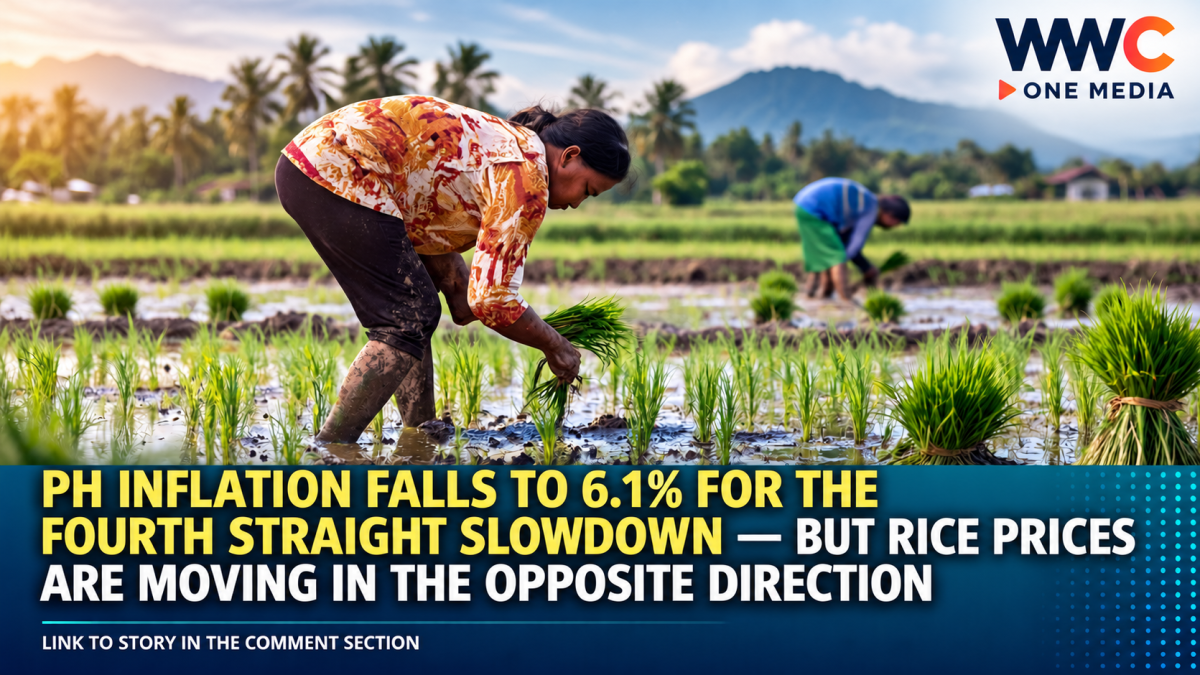
MANILA, Philippines — Philippine inflation eased for a fourth consecutive month in August, offering another sign that the country’s severe price pressures may be losing some momentum.
But underneath the encouraging headline figure lies a more complicated—and potentially more painful—story for Filipino households.
The Philippine Statistics Authority said headline inflation slowed to 6.1% in August from 6.2% in July, primarily because food, electricity and other household costs rose more slowly. The latest figure brought average inflation for January through August to 5.2%.
The 6.1% reading was also slightly higher than the 6% median forecast in a Reuters poll, although it remained inside the Bangko Sentral ng Pilipinas’ narrower 5.5% to 6.5% forecast range for August.
Yet there is an important distinction consumers should not miss:
Lower inflation does not mean prices are falling.
It means prices overall are still increasing—but somewhat more slowly than they were a month earlier.
And at 6.1%, inflation remains well above the government’s 2% to 4% target range. Average inflation for the first eight months of the year, at 5.2%, is also above that range.
Food brought inflation down—but rice went the other way
The biggest relief came from food.
Inflation for food and non-alcoholic beverages eased to 4.6% from 5.2% in July, while overall food inflation slowed to 4.6% from 5.3%.
Vegetables were a particularly significant factor.
According to the Department of Agriculture, inflation for vegetables, tubers, plantains, cooking bananas and pulses swung dramatically from an 8.4% increase in July to a 3.4% decline in August. Fish prices also increased more slowly.
For consumers walking through wet markets and supermarkets, however, the improvement was far from universal.
Rice inflation accelerated to 19.4% in August from 17.1% in July. The BSP attributed part of that increase to higher logistics costs.
That is significant because rice carries an outsized importance in Filipino household budgets, particularly among lower-income families.
PSA data cited by Daily Tribune showed average well-milled rice prices at around ₱56.29 per kilogram during the middle of August, compared with ₱55.69 during a comparable period in July.
So although vegetable and fish prices helped pull the national inflation number down, higher rice prices continued to bite.
The poorest households are experiencing a very different inflation story
Perhaps the most important number in the August report is not 6.1%.
For households belonging to the bottom 30% income group, inflation remained at 8.2% in August—more than two percentage points above the nationwide headline rate.
Their average inflation rate from January through August stood at 6.2%. Outside Metro Manila, inflation among this income group actually climbed slightly to 8.4% from 8.3%.
That gap helps explain why an improving national inflation statistic may feel disconnected from the experience of many ordinary families.
Poorer households typically devote a larger share of their income to necessities such as food. When staple prices rise quickly, they have fewer discretionary expenses that can be reduced to compensate.
Electricity and housing costs provided some relief
Another contributor to the slowdown was the category covering housing, water, electricity, gas and other fuels.
Its annual inflation rate eased to 7.9% from 8.2% in July, according to the PSA.
The central bank said lower electricity and water rates helped moderate inflation in this category.
But energy remains a major risk.
Higher global crude-oil prices pushed domestic pump prices upward during August, accelerating transport inflation, the BSP said.
That matters beyond motorists because fuel costs can eventually spread through the economy—from trucking and agricultural production to shipping, public transportation and supermarket prices.
Inflation actually rose from July on a monthly basis
Another statistic adds nuance to the headline improvement.
After adjusting for normal seasonal patterns, consumer prices rose 0.5% in August from July, compared with zero month-on-month growth in July.
In other words, the annual inflation rate eased, but prices were still moving upward during the month.
Underlying inflation pressures also remain elevated.
Core inflation, which strips out volatile food and energy components, slipped to 4.1% from 4.2%, remaining just above the government’s inflation tolerance ceiling.
For perspective, headline inflation was only 1.5% in August 2025, while core inflation stood at 2.7%.
That year-on-year comparison shows how dramatically the inflation environment has changed.
BSP is still fighting inflation with higher interest rates
The continued inflation problem has already forced the Bangko Sentral ng Pilipinas into a tighter monetary-policy stance.
The central bank’s target reverse repurchase rate now stands at 5.0%, following another 25-basis-point increase.
Reuters reported that the increase represented the BSP’s third consecutive 25-basis-point rate hike, as policymakers try to prevent high inflation from becoming embedded in consumer and business expectations.
Higher interest rates are designed to restrain demand and inflation, but there is a trade-off: they also make borrowing more expensive for households and companies.
That can affect housing loans, business financing, investment and eventually economic growth.
The central bank’s next monetary-policy meeting is scheduled for October 22, making the next several inflation readings particularly important.
Government rolls out food and fuel measures
The Marcos administration, meanwhile, says it is continuing interventions aimed at protecting consumers.
Department of Economy, Planning and Development Secretary Arsenio Balisacan said moderating food inflation was encouraging but stressed the need for longer-term improvements in food security and logistics.
Government measures cited by DEPDev include more than 700 KADIWA outlets, distribution of more than 26,000 metric tons of free rice to over 2.5 million Filipinos, and fuel assistance for vulnerable transport groups.
The fuel subsidy for eligible public-utility vehicle drivers and operators was expanded to ₱12 per liter, with the program expected to continue through September subject to government assessment.
Agriculture authorities are also updating their El Niño response plans, focusing on irrigation, farm inputs, inventories and market interventions as weather disruptions threaten food supplies.
The bigger risk isn’t gone
For policymakers, four consecutive months of easing inflation is clearly better than renewed acceleration.
But the numbers do not yet amount to victory.
The BSP said it remains particularly alert to developments in the Middle East and weather-related disruptions, both of which could push food, fuel and transportation costs higher again.
Global conditions are not especially comforting either. The United Nations’ FAO Food Price Index climbed to its highest level since late 2022 in August, with geopolitical conflict, weather problems and supply disruptions pushing several international commodity prices higher.
That means the Philippines remains vulnerable to price shocks it cannot fully control.
For now, the direction of inflation is improving.
But with rice inflation approaching 20%, poorer households experiencing inflation above 8%, fuel costs under pressure and headline inflation still far outside the desired 2% to 4% range, 6.1% is less a declaration of victory than a sign that the squeeze may finally be easing—very slowly.
WWC ONE MEDIA M.J.E

Leave a Reply