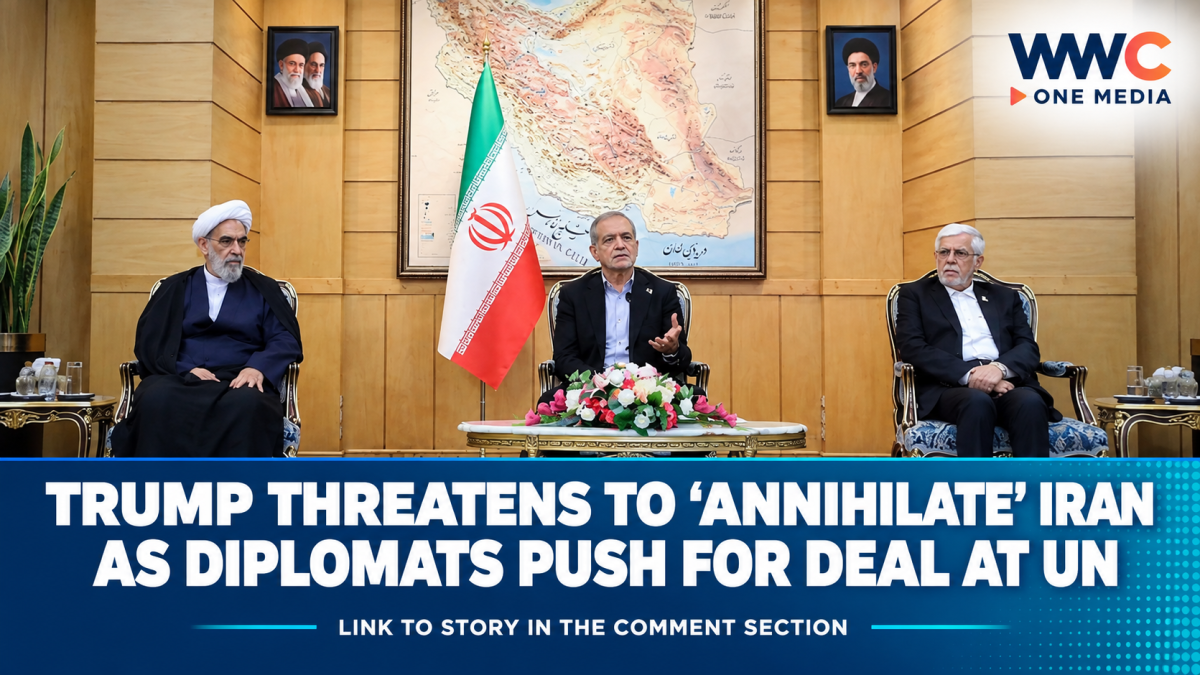
US President Donald Trump has warned that he could “annihilate” Iran if Tehran does not agree to a deal to end the ongoing conflict, while diplomatic efforts to reopen negotiations intensified on the sidelines of the United Nations General Assembly in New York.
Speaking at the UN on Sept. 22, Trump presented what he described as a choice between reaching an agreement that would allow Iran to rebuild or taking further military action against the Islamic Republic. He said he believed a deal could eventually be reached, potentially after the US midterm elections on Nov. 3.
Trump also called on other countries to join the United States in economically isolating Iran, arguing that increased pressure could push Tehran toward negotiations. He said his central concern remained preventing Iran from obtaining a nuclear weapon.
The warning came as diplomatic contacts continued despite the escalation in rhetoric. Trump later told reporters that US and Iranian officials had held a three-hour meeting in New York and described it as a “very good” and productive discussion. He said another meeting was expected, although details about the participants and substance of the talks were not immediately disclosed.
Iran has also signalled that it remains open to negotiations, but Tehran has tied a potential reopening of the Strait of Hormuz to changes in US military pressure and the lifting of a US blockade on Iranian ports.
A senior Iranian official told Reuters that Iran could reopen the strategically important waterway within seven days if Washington took steps toward reducing military pressure. The official said Iran’s delegation in New York had authority to pursue diplomatic discussions through mediators.
The Strait of Hormuz has become a major pressure point in the conflict because it is one of the world’s most important energy shipping routes. Disruptions there have contributed to higher energy costs and added pressure on countries dependent on oil imports.
Iranian President Masoud Pezeshkian is attending the UN General Assembly, but Iranian officials said he would not meet Trump directly. Instead, negotiations could proceed through intermediaries and diplomatic channels in New York.
The confrontation also comes after Washington allowed a core Iranian delegation, including Pezeshkian and Foreign Minister Abbas Araqchi, to attend the General Assembly despite the ongoing conflict. The US said the decision was consistent with its obligations as host of the United Nations while imposing restrictions on the Iranian delegation’s movements and activities.
Trump’s speech therefore delivered two contrasting signals: a renewed threat of major military escalation if no agreement is reached, alongside indications that Washington and Tehran are still exploring a diplomatic route.
For now, there is no announced peace agreement, and both sides continue to publicly state conditions for ending the conflict. The talks in New York could determine whether those conditions can be narrowed enough to produce a negotiated path forward.