
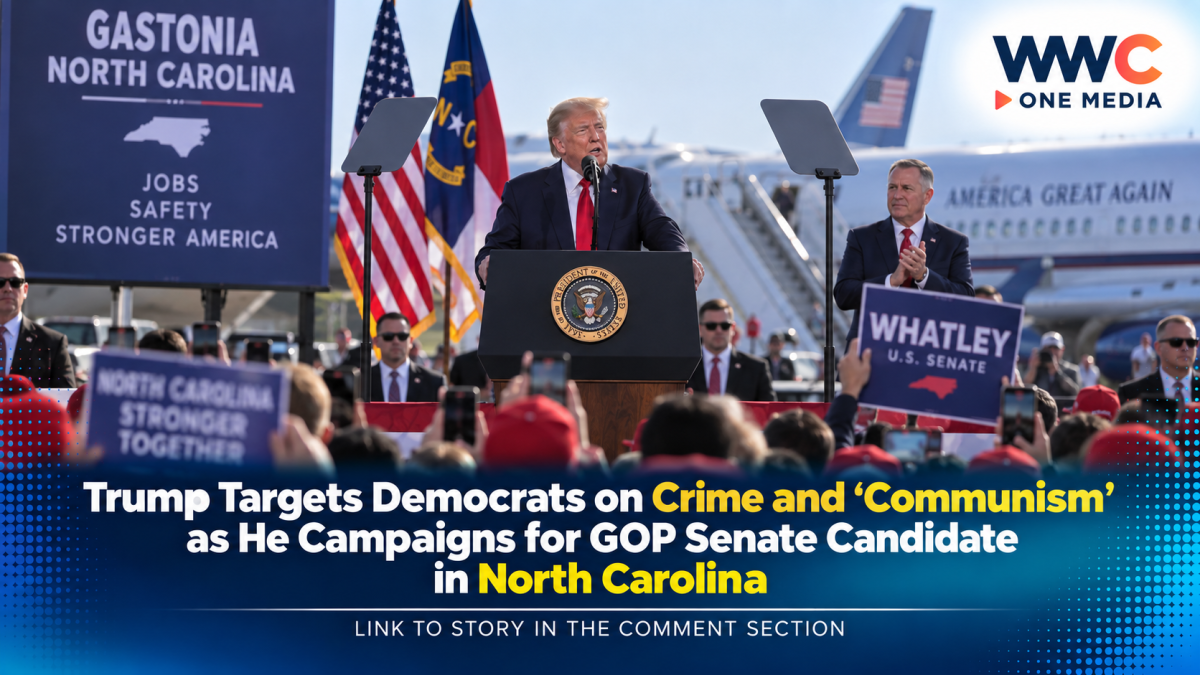
GASTONIA, North Carolina — President Donald Trump took an aggressive approach to the 2026 midterm campaign trail Wednesday, attacking Democrats over crime and repeatedly accusing the party of embracing what he described as communist ideas.
Trump made the remarks at a rally in Gastonia aimed at supporting Republican Senate nominee Michael Whatley, who is challenging Democratic former Gov. Roy Cooper in one of the closely watched Senate contests of the 2026 midterm elections.
The appearance marked an important effort by Trump to mobilize Republican voters ahead of the Nov. 3 midterm elections, with the North Carolina Senate race among the contests that could affect control of the chamber.
Trump makes crime a central issue
Trump portrayed Democrats as too lenient on crime and used Cooper’s record as governor as a major target of his speech.
He criticized Cooper over policies connected to the release of some inmates during the COVID-19 pandemic and sought to link those decisions to broader arguments about public safety.
Reuters reported that Trump’s descriptions of Democrats’ approach to crime included exaggerated claims, while Cooper’s campaign has rejected Trump’s characterization of the former governor’s record.
The dispute reflects a familiar campaign divide in U.S. politics, with Republicans emphasizing law enforcement and public safety while Democrats have challenged Republican portrayals of their criminal-justice policies.
‘Communism’ becomes another campaign weapon
Trump also returned to one of his increasingly prominent themes in the 2026 campaign: warnings about communism.
At the North Carolina rally, he used the term while attacking Democrats and said Republicans needed to defeat what he characterized as communist influence.
Trump has increasingly incorporated anti-communist rhetoric into his political messaging this year. NPR previously reported that the president had made warnings about communism a recurring part of his attacks on Democrats as economic concerns and the midterm campaign intensified.
The terminology has become particularly contentious because Democrats and Republicans disagree sharply over whether the label accurately describes progressive policies and political movements within the United States.
Whatley’s Senate campaign is at the center of the visit
Trump’s appearance was primarily designed to boost Michael Whatley, the Republican nominee for the open North Carolina Senate seat.
Whatley previously served as chairman of the Republican National Committee and has Trump’s endorsement. He is running against Cooper, who served as North Carolina governor from 2017 to 2025.
The seat is open because Republican Sen. Thom Tillis is not seeking reelection, making the contest a major target for both parties.
Trump’s involvement underscores the importance Republicans place on maintaining the seat, while Democrats are seeking to capitalize on economic concerns and opposition to Trump’s policies.
Economy also looms over the campaign
Although crime and political ideology dominated Trump’s rhetoric, economic issues were also central to the rally.
Trump sought to defend his administration’s economic record while addressing concerns over inflation and fuel prices. Reuters reported that he linked higher gasoline costs to the ongoing war in Iran, while Democrats have made affordability a major issue in their campaign messaging.
The economic debate could prove significant as voters weigh household costs alongside issues such as crime, immigration and national security.
A broader midterm test for Trump
The North Carolina appearance is part of Trump’s broader effort to help Republican candidates ahead of the November elections.
His strategy combines direct attacks on Democrats with appeals to his core supporters on crime, immigration, economic policy and opposition to what he describes as left-wing or communist politics.
For Democrats, the North Carolina contest provides an opportunity to challenge Republican control of a state that has become highly competitive in recent national elections.
For Republicans, Trump’s ability to energize his supporters remains an important part of the campaign strategy.
The North Carolina race will therefore be watched not only for the Senate contest itself, but also as another test of how Trump’s political message performs beyond his presidential campaign.
And with voting still weeks away, the battle over crime, the economy and the meaning of “communism” in American politics is likely to remain at the center of the campaign.



Leave a Reply