
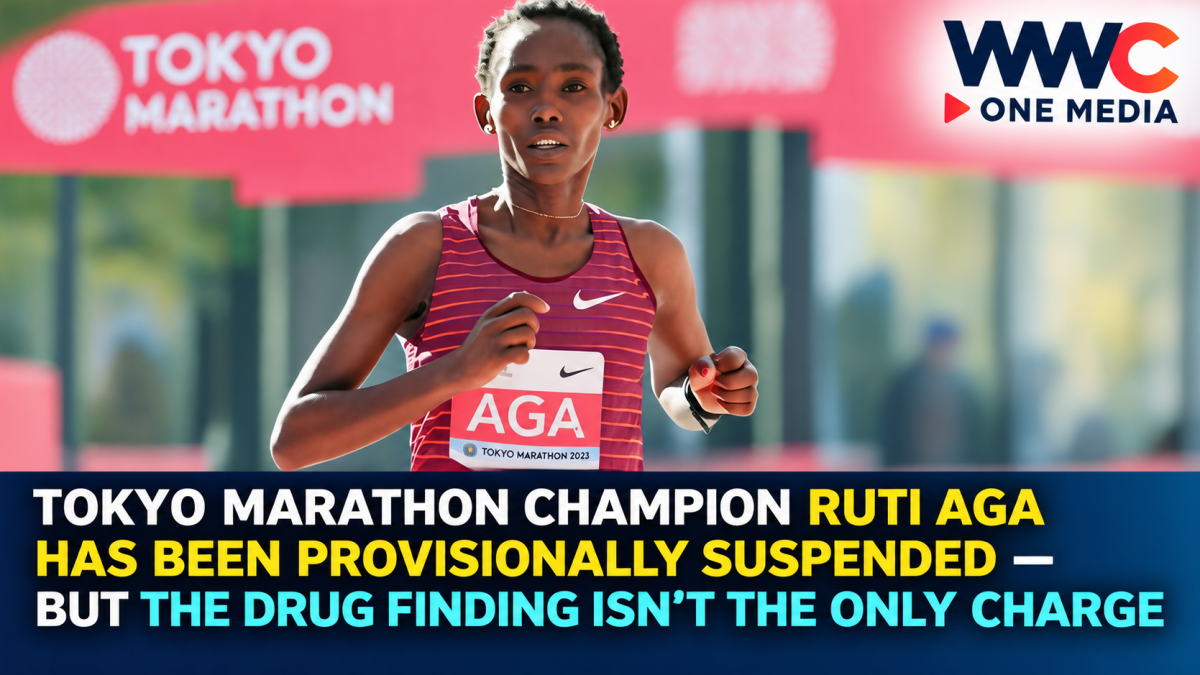
MONACO — Ethiopian marathon star Ruti Aga, winner of the 2019 Tokyo Marathon and one of the fastest women in road-running history, has been provisionally suspended after the Athletics Integrity Unit charged her over the presence or use of the glucocorticoid methylprednisolone and alleged tampering with the anti-doping process.
The AIU placed the 32-year-old under provisional suspension and issued a notice of charge, according to the integrity body’s disciplinary records and Reuters reporting on Thursday, September 17.
That means Aga is temporarily barred from athletics competition while the disciplinary process continues.
It does not amount to a final determination that she committed the alleged anti-doping violations.
The AIU itself defines provisional suspension as a precautionary measure imposed before a final decision is reached. Cases may still be investigated or proceed to a hearing before the World Athletics Disciplinary Tribunal.
That distinction is particularly important in Aga’s case because methylprednisolone is more complicated under anti-doping rules than headlines describing it simply as a “banned steroid” might suggest.
Methylprednisolone is prohibited in competition — but not in every circumstance
Methylprednisolone is a glucocorticoid, a class of medicines commonly used medically to reduce inflammation and treat various inflammatory and immune conditions.
Under the 2026 World Anti-Doping Agency Prohibited List, glucocorticoids including methylprednisolone are prohibited in competition when administered by oral, injectable or rectal routes.
But WADA does not prohibit every possible use.
Inhaled and several topical routes — including dermatological, intranasal, ophthalmic and ear treatments — are not prohibited when used within licensed doses and therapeutic indications.
That is why the exact circumstances surrounding Aga’s case matter.
The AIU’s public summary cited by Reuters did not disclose the route of administration, dosage, medical explanation, timing of the sample or whether a Therapeutic Use Exemption is part of her response.
Those details could become significant as the case proceeds.
WADA also requires athletes to observe washout periods
Even legitimate medical treatment can create anti-doping complications if a prohibited-in-competition drug remains detectable when an athlete enters the competition period.
WADA’s 2026 guidance gives methylprednisolone a recommended five-day washout period after intramuscular administration, while oral glucocorticoids generally have a three-day washout period. Different routes and formulations can have different clearance times.
The purpose of those periods is to allow medication concentrations to fall below anti-doping reporting levels before competition.
Again, there is no public evidence yet establishing whether any of these timing considerations apply to Aga specifically.
The AIU has disclosed the allegation.
It has not publicly released the full case file.
The tampering allegation makes this more than a simple positive-test story
Aga also faces a separate charge of tampering.
Under anti-doping rules, tampering broadly concerns conduct that interferes with or subverts the doping-control process. Previous cases have involved actions such as providing fraudulent information or documentation, interfering with testing procedures or otherwise attempting to obstruct results management.
But there is an essential caveat:
The AIU has not publicly disclosed what it alleges Aga actually did.
It would therefore be inaccurate to claim she falsified records, interfered with a sample or committed any other specific act unless the AIU later provides those details.
Reuters reported only that the notice of charge includes tampering alongside the methylprednisolone allegation.
Why tampering matters under athletics rules
Tampering is treated as an independent anti-doping rule violation.
Recent AIU cases show that Article 2.5 violations can lead to substantial periods of ineligibility, but sanctions vary depending on the facts, whether other violations are involved and how the case is resolved.
Spanish distance runner Mohamed Katir, for example, received a four-year sanction for tampering in a separate case upheld in 2025. Other athletes facing prohibited-substance and tampering charges have received different penalties depending on their circumstances.
Those examples should not be used to predict Aga’s eventual punishment.
No final sanction has been announced in her case.
Aga is not an obscure runner — she is a major marathon champion
The suspension is particularly significant because Aga has spent much of the past decade among international marathon running’s elite.
Her biggest victory came at the 2019 Tokyo Marathon, where she won in 2 hours, 20 minutes and 40 seconds in cold and wet conditions.
Reuters says her World Marathon Majors record also includes three runner-up finishes and two third-place finishes.
World Athletics lists her marathon personal best at 2:18:09, achieved in 2023, placing her firmly within the sport’s elite sub-2:20 group.
She has also been part of the World Athletics road-running testing pool, meaning she has been subject to the international federation’s anti-doping testing requirements.
And she was still winning in 2026
This is not a case involving an athlete whose competitive career had already faded.
Aga began 2026 by successfully defending her title at the Xiamen Marathon in China on January 11.
She won in 2:22:45, finishing more than two minutes ahead of fellow Ethiopian Meseret Abebayehu as Ethiopian runners swept the women’s podium.
A year earlier, Aga had run 2:18:46 to win the same race and set its course record.
Her 2026 strategy was different: rather than chasing another exceptionally fast time, she stayed patient with the lead group and focused on defending the title.
That made her one of Ethiopia’s prominent active marathoners entering this season.
Her career has stretched from the track to the marathon
Before becoming an elite marathon runner, Aga was already succeeding internationally on the track.
World Athletics lists her as a former World Under-20 Championships silver medallist and African junior champion.
She later shifted toward longer road distances, recording a half-marathon best of 1:06:39 before developing into one of Ethiopia’s leading marathon specialists.
By the time she arrived at the Tokyo Marathon in 2019, she had already recorded multiple podium finishes in Berlin.
World Athletics described her Tokyo victory as the first marathon win of her career.
Seven years later, she was still winning Platinum Label marathons.
That is why the provisional suspension immediately becomes a significant story for women’s distance running.
What happens to Aga now?
For the moment, competition stops.
The AIU says athletes under provisional suspension are temporarily excluded from competition and other athletics activities covered by the rules while their case proceeds.
A notice of charge means the case has moved beyond an initial allegation and into formal disciplinary proceedings.
Depending on how an athlete responds, cases can be resolved through an agreement with the AIU or referred to the independent World Athletics Disciplinary Tribunal for a first-instance decision.
Aga can contest the allegations and present evidence as part of that process.
No timetable for a final ruling was disclosed in the reporting available Thursday.
Could her previous results be affected?
Possibly — but it is too early to say which ones, if any.
When an athlete ultimately receives an anti-doping sanction, results from a specified period can sometimes be disqualified.
But the beginning of that period depends on the facts of the case, including the date of an alleged violation and the eventual decision. AIU decisions routinely identify separately both the period of ineligibility and the competitions whose results are disqualified.
In Aga’s case, the AIU’s brief public notice reported by Reuters did not disclose the test date or identify the competition connected with the methylprednisolone finding.
There is therefore no factual basis at this stage to say her January 2026 Xiamen victory, her 2019 Tokyo title or any other specific result will be stripped.
Unless the eventual case decision says so, those results should not be described as disqualified.
The Xiamen title is particularly important to handle carefully
Because Aga won a major race earlier this year, there will naturally be questions about that result.
But chronology alone proves nothing.
Aga won Xiamen on January 11 in 2:22:45.
Her provisional suspension was announced publicly in September.
The available AIU and Reuters reporting does not establish that the relevant sample came from Xiamen or that January’s performance is directly connected to the current charge.
Any headline stating that she “failed a test at Xiamen” would therefore go beyond the evidence currently available.
The substance itself requires careful language
Methylprednisolone is often described broadly as a steroid.
Technically, it is a corticosteroid or glucocorticoid, not an anabolic steroid of the type commonly associated with muscle-building drugs such as testosterone derivatives.
WADA places it in Section S9: Glucocorticoids of the 2026 Prohibited List.
All substances in that category are classified as Specified Substances.
That designation does not mean they are harmless or permitted.
Rather, under anti-doping rules, specified substances can arise in circumstances that sometimes allow greater flexibility in assessing intent, fault and sanction.
The eventual result still depends on the evidence in the individual case.
Medical use does not automatically excuse an anti-doping finding
Glucocorticoids are widely used as legitimate medicines.
But elite athletes remain responsible for ensuring prohibited medication is not present during the competition period unless they have the appropriate medical justification and regulatory documentation.
That is why anti-doping authorities publish detailed washout guidance.
A medically prescribed treatment can still trigger an adverse finding if it is administered too close to competition through a prohibited route.
Conversely, the mere fact that methylprednisolone has legitimate medical uses does not establish that Aga’s finding was innocent.
Both questions remain open until her case is adjudicated or otherwise resolved.
Ethiopia has not yet publicly given Aga’s explanation
Reuters said it sought comment from the Ethiopian Athletics Federation following the suspension announcement. No response from Aga or the federation was included in its initial report.
That leaves several unanswered questions:
Why was methylprednisolone detected or alleged to have been used?
Was there medical treatment involved?
What does Aga say happened?
What exactly supports the separate tampering allegation?
And when did the alleged violations occur?
Those answers will determine whether the current story develops into a lengthy ban, a reduced sanction, a successful challenge or another outcome.
For now, those facts are simply not public.
One recent methylprednisolone case shows why sanctions cannot be guessed
In December 2025, the AIU imposed a two-year period of ineligibility on Kenyan athlete Alice Koigi in a separate case involving methylprednisolone.
But Aga’s case is already materially different because her notice also includes a tampering allegation.
Other anti-doping cases involving tampering have led to considerably longer sanctions.
This is exactly why applying another athlete’s suspension length to Aga would be misleading.
The charge has been filed.
The penalty has not.
For road running, the timing is significant
Aga’s case arrives while elite road running continues to tighten testing and integrity controls around some of the world’s biggest marathons.
The AIU operates dedicated registered and road-running testing pools covering leading international athletes, and Aga was listed among Ethiopian marathoners in that system.
Top road races now sit inside an increasingly sophisticated anti-doping structure involving both in-competition testing and out-of-competition monitoring.
That becomes especially important in marathon running because elite athletes compete relatively infrequently compared with track athletes.
Major performances may be separated by months.
Testing cannot therefore be limited only to race day.
What is certain — and what is not
The confirmed facts are significant enough without exaggeration.
Ruti Aga is a 32-year-old Ethiopian marathon star.
She won Tokyo in 2019.
She has a personal best of 2:18:09.
She successfully defended the Xiamen Marathon in January 2026.
And on September 17, Reuters reported that the Athletics Integrity Unit had provisionally suspended her after issuing charges involving methylprednisolone and tampering.
What is not yet established publicly is equally important.
There is no final disciplinary ruling.
The AIU has not publicly detailed the alleged tampering.
The public summary does not identify the event at which the relevant sample was collected.
And there has been no announced sanction or confirmed disqualification of her previous marathon results.
For one of Ethiopia’s best-known active marathoners, that means the next important result will not come from a finish line.
It will come from the disciplinary process that decides whether a provisional suspension becomes a career-changing ban — or something very different.




Leave a Reply