
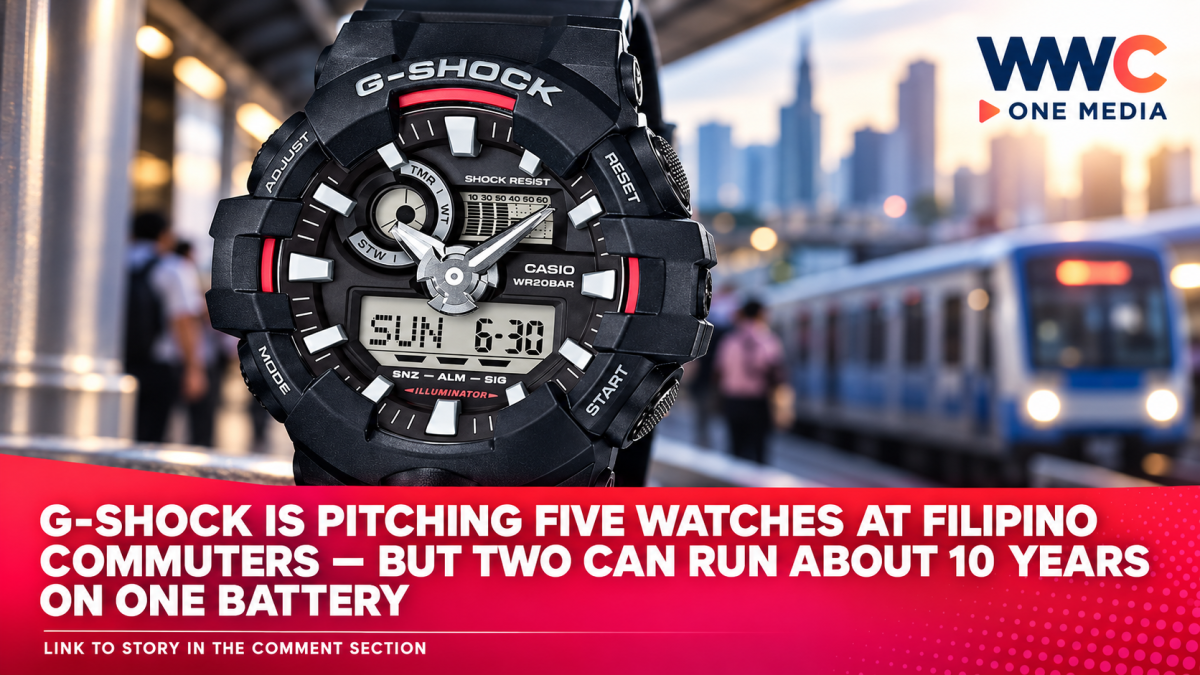
MANILA — A sudden downpour, a packed train, a long jeepney ride and another late trip home.
Casio is betting that the daily frustrations familiar to many Filipino commuters can become a new selling point for one of Japan’s most recognisable watch brands.
Casio Philippines has highlighted five G-SHOCK models — the GA-140-1A1, GA-700-1A, GA-010-1A, GD-010-1 and GA-100-1A1 — as watches aimed at people moving through unpredictable weather, crowded public transport and long days away from home. InsiderPH and Philippine technology outlet Unbox both reported the campaign on September 17.
The watches range from retro analog-digital models to oversized digital designs, with prices quoted by InsiderPH at between ₱7,770 and ₱8,870. All five carry Casio’s shock-resistant construction and 200-meter water-resistance rating.
But the most interesting part of the campaign may not be the watches themselves.
It is what Casio is trying to make G-SHOCK represent.
A brand originally built around surviving impacts is increasingly being positioned as something that survives ordinary urban life.
Casio is turning the Philippine commute into a product story
Casio Philippines regional sales manager Sena Kuroda said Filipino commuters may encounter intense heat, sudden rain and crowded transport within a single day, arguing that G-SHOCK’s durability makes the watches suited to that unpredictability.
That positioning is deliberate.
Instead of focusing on mountaineering, diving or extreme sports, the campaign talks about trains, jeepneys, low-light commutes and everyday bumps.
Timers become useful for routines.
LED illumination helps when travelling after dark.
Long battery life means less maintenance.
And water resistance becomes less about underwater adventure than getting caught in a tropical downpour.
It is effectively an attempt to redefine “rugged” for someone whose toughest environment may be Monday morning rush hour.
Two of the watches are built around a 10-year battery claim
The most practical specifications belong to the GA-010-1A and GD-010-1.
Casio says both are designed for approximately 10 years of battery operation using a CR2025 battery, depending on usage conditions.
That is far longer than the battery-replacement cycle of many conventional quartz watches and radically different from smartwatches that commonly require charging every few days or even daily.
The GA-010 combines analog hands with a digital display.
The GD-010 is entirely digital and uses a large LCD aimed at faster readability. Both include world time, stopwatch functions, alarms and high-brightness LED illumination.
Both also use Casio’s Carbon Core Guard construction and bio-based resin in key external components.
That combination makes them the clearest examples of what this commuter campaign is really selling:
not maximum technology, but minimum maintenance.
The 10-year battery idea actually dates back to 2024
The GA-010 and GD-010 are not new 2026 designs.
Casio originally launched the two series internationally in September 2024, promoting them around their long battery life, rugged construction and workwear-inspired styling.
The Philippine campaign therefore represents a repositioning of existing products rather than the launch of five entirely new watches.
That distinction matters.
Casio is not saying it invented a new “commuter G-SHOCK”.
It is taking models already in its catalogue and arguing that their existing features happen to fit the realities of commuting in the Philippines.
The GA-010 is the analog-digital option
The GA-010-1A measures 55.1mm by 51.9mm by 17.5mm and weighs 67 grams.
It uses an analog-digital display, includes world time across 31 time zones, a 1/100-second stopwatch, countdown timer, five daily alarms and a Super Illuminator LED.
Casio says the Carbon Core Guard case uses carbon-fibre-reinforced resin for a combination of strength and relatively low weight.
It also includes a hand-shift feature so the analog hands can temporarily move away from the digital display when necessary.
InsiderPH listed the model at ₱7,770 in the commuter campaign.
The GD-010 trades hands for a bigger display
The GD-010-1 uses essentially the same long-life-battery concept but removes the analog hands.
Casio gives the watch dimensions of 54.9mm by 51.9mm by 16.1mm and a weight of 65 grams.
Its main selling point is a large LCD designed for high visibility, supported by an automatic high-brightness LED backlight.
It also provides multiple-city time, world time, alarms, stopwatch and timer functions.
InsiderPH listed it at ₱7,960.
For someone who wants to glance at the time quickly while standing on a platform or moving between vehicles, the digital display may arguably fit the commuter pitch more directly than the more complicated analog-digital models.
The GA-700 focuses on visibility — but it is enormous
The GA-700-1A is one of the largest watches in the group.
Its case measures 57.5mm by 53.4mm by 18.4mm and weighs 69 grams.
Casio designed it around large sculpted hands and a three-dimensional face, with a prominent front button providing quick access to the LED light.
It also has an approximately five-year battery, 31-time-zone world time and a hand-shift function that clears the digital screen.
That size could be an advantage for readability.
It could also be a disadvantage for commuters who prefer a watch that disappears beneath a shirt cuff.
Calling every model equally suited to everyone would therefore be marketing rather than objective fact.
There is also a price discrepancy worth noting
InsiderPH’s September 17 article lists the GA-700-1A at ₱7,920.
Casio Philippines’ own current product page, however, lists an MSRP of ₱7,540.
Prices can differ because of timing, retailer pricing, promotions or changes in suggested retail pricing.
For publication, the safest approach is therefore to attribute the ₱7,920 figure specifically to the Casio Philippines commuter campaign reported by InsiderPH rather than describe it as a permanent nationwide retail price.
The GA-140 goes deliberately retro
For buyers who treat a watch as fashion as much as a tool, Casio is highlighting the GA-140-1A1.
The model borrows design cues from stereos and portable music players of the 1990s, according to Casio, while retaining the oversized format associated with the GA-100 family.
InsiderPH puts its campaign price at ₱8,860.
It still provides the standard G-SHOCK formula — shock resistance, 200-meter water resistance and an analog-digital display — but its appeal is more visual than utilitarian.
That illustrates another part of Casio’s strategy.
A commuter watch does not have to look like industrial equipment.
The GA-100 adds magnetic resistance
The fifth watch, the GA-100-1A1, is one of G-SHOCK’s long-running large analog-digital designs.
Casio specifies JIS Class 1 magnetic resistance, along with a 1/1000-second stopwatch, world time, countdown timer and five daily alarms.
It measures 55mm by 51.2mm by 16.9mm and weighs 70 grams.
Battery life is approximately two years using a CR1220 cell — significantly shorter than the 10-year GA-010 and GD-010 models.
InsiderPH quoted a price of ₱8,870, making it the most expensive of the five watches in the commuter campaign.
What does “200-meter water resistance” actually mean?
All five watches carry Casio’s 200-meter water-resistance specification, also described by the company as 20-bar water resistance.
For a commuter, that is far beyond what is normally required for rain.
But one important wording distinction should remain.
Casio describes the watches as water resistant, not literally impervious to water under every circumstance.
Water-resistance ratings are based on defined test conditions, and seals can deteriorate over time.
So a headline saying the watches are “waterproof against anything” would overstate the specification.
For ordinary rain exposure, however, the claimed rating leaves a very large margin above the conditions normally encountered during commuting.
The “heat” claim deserves even more caution
The campaign repeatedly frames the products around both rain and heat.
But the official product pages for these five models primarily specify shock resistance, water resistance, battery performance and display functions.
They do not advertise a special Philippine-heat certification or extraordinary high-temperature rating for these specific models in the materials reviewed.
So “made for hot commutes” is best understood as Casio’s lifestyle positioning, not evidence that the five watches have passed some special extreme-heat test beyond ordinary product specifications.
That distinction is particularly important when converting a corporate product statement into a news article.
Bio-based resin does not make the watches automatically “green”
Casio also highlights bio-based resin in the GA-010 and GD-010.
The company says key resin components are manufactured using materials derived from renewable organic resources and that the approach is expected to help reduce environmental impact.
That is carefully worded.
Casio does not claim that the watches are carbon neutral, biodegradable or entirely made from renewable material.
The bio-based resin is one material choice within a complete manufactured product.
So “more environmentally conscious material” is fair.
“Eco-friendly watch” without qualification would be much broader than the evidence supports.
The deeper story is Casio’s Philippine growth strategy
The commuter campaign also makes more sense when viewed against Casio’s corporate plans.
In its current medium-term management strategy, Casio identifies ASEAN as a growth region for G-SHOCK and CASIO WATCH and specifically lists the Philippines, Thailand and Vietnam as priority investment markets.
That makes this five-watch campaign more than random local advertising.
The Philippines is one of the markets where Casio says it wants to invest more heavily to expand its watch business.
The company’s broader timepiece strategy is built around two core brands:
G-SHOCK, positioned around toughness, distinctive design, technology and higher-value products;
and CASIO WATCH, positioned around lightweight practicality and wider reach.
A commuter-oriented G-SHOCK campaign sits almost perfectly inside that strategy.
It takes the brand’s existing toughness image and tries to broaden its relevance.
G-SHOCK itself began with a much simpler toughness problem
The brand dates back to 1983.
Casio engineer Kikuo Ibe and his team developed the first G-SHOCK around the idea of creating a wristwatch that could survive being dropped.
Casio says more than 200 prototypes were tested before the original DW-5000C reached the market.
That original concept was summarised around the so-called “Triple 10” targets:
a 10-year battery,
10-bar water resistance,
and survival from a 10-meter drop.
More than four decades later, the irony is that one of the brand’s newest Philippine marketing ideas has circled back to something very similar.
The GA-010 and GD-010 again emphasise a roughly 10-year battery.
Only now the target environment is not a laboratory drop test.
It is everyday life in Metro Manila and other Philippine cities.
Casio is also deliberately moving G-SHOCK beyond extreme sports
This shift can be seen throughout the brand.
Modern G-SHOCK ranges now extend from inexpensive resin watches to metal models, Bluetooth-connected watches, fitness-focused G-SQUAD products and high-end MR-G models.
Casio’s corporate strategy says it wants G-SHOCK to capture a broad customer base while strengthening appeal among younger consumers and expanding across price categories.
That means “toughness” increasingly has to work as a fashion idea as well as an engineering claim.
The commuter campaign illustrates that evolution.
The GA-140 is retro streetwear.
The GA-700 is oversized and aggressive.
The GA-010 and GD-010 emphasise workwear-like styling and longevity.
The GA-100 uses the familiar technical G-SHOCK look.
They are different aesthetic interpretations of the same brand promise.
What none of these watches does is replace a smartwatch
That may actually be part of the point.
The five models highlighted by Casio Philippines are fundamentally watches rather than miniature wrist computers.
They offer combinations of world time, timers, alarms, stopwatches and lighting.
But the highlighted models do not depend on daily phone notifications, app ecosystems or frequent charging to perform their core functions.
For the GA-010 and GD-010 in particular, the trade-off is stark:
fewer smart features,
but potentially a decade between battery changes.
That creates a different type of convenience.
For someone already carrying a smartphone all day, Casio is effectively asking whether the watch needs to become another screen demanding attention.
The real competition may be the phone in your pocket
That is the bigger challenge facing traditional watchmakers.
Most people no longer need a wristwatch simply to know the time.
Their phones already do that.
A modern watch therefore has to provide another reason to exist.
Luxury brands sell heritage and craftsmanship.
Smartwatches sell health tracking and connectivity.
Casio sells durability, design recognition and low maintenance.
This Philippine campaign turns commuting into another justification.
The argument is not that somebody needs a G-SHOCK to board a jeepney.
It is that an everyday accessory can survive being knocked around, soaked by rain and worn for years without demanding much attention.
And the 10-year battery may be the most compelling part
Rain resistance is easy to understand.
Shock resistance has defined G-SHOCK for decades.
But long battery life may increasingly be the feature that differentiates traditional digital watches from rechargeable electronics.
Casio says the GA-010 and GD-010 achieve their approximately decade-long battery life through a high-capacity battery and reduced power consumption, while still retaining alarms, lighting and other functions.
Ten years is an estimate, not a guarantee: actual battery life varies according to how functions such as lights and alarms are used.
Still, it changes the maintenance equation dramatically.
A commuter can forget to charge a smartwatch overnight.
It is much harder to forget to charge a watch that does not need charging at all.
The five-watch lineup
For readers comparing the five models, the campaign essentially breaks down like this:
| Model | Main angle | Battery | Key specification | Campaign price* |
|---|---|---|---|---|
| GA-140-1A1 | Retro analog-digital styling | Conventional battery | 200m water resistance, shock resistance | ₱8,860 |
| GA-700-1A | Large, easy-to-read face | ~5 years | 200m water resistance, front LED button | ₱7,920 |
| GA-010-1A | Long-life analog-digital | ~10 years | Carbon Core Guard, 200m water resistance | ₱7,770 |
| GD-010-1 | Long-life full digital | ~10 years | Large LCD, Carbon Core Guard, 200m water resistance | ₱7,960 |
| GA-100-1A1 | Magnetic resistance, technical styling | ~2 years | JIS Class 1 magnetic resistance, 200m water resistance | ₱8,870 |
*Prices are those quoted in InsiderPH’s September 17 report and may differ from Casio’s current MSRP or retailer pricing. Specifications are based on Casio product information.
Casio’s real bet is that “tough” can become ordinary
There is nothing especially glamorous about commuting.
That may be exactly why Casio wants to own the category.
A watch does not have to survive climbing Everest to justify shock resistance.
It only has to survive being pushed against a train door, knocked against a handrail, soaked during an unexpected storm or worn for hours through a long workday.
The five models Casio Philippines is highlighting were not invented specifically for those scenarios.
Some have been on the market for years.
But the campaign shows how the brand is adapting an old promise — toughness — to a very different customer story.
And with Casio formally naming the Philippines as one of its priority ASEAN markets, the larger message is clear.
G-SHOCK is no longer selling toughness only for extreme conditions. It is betting that, for millions of commuters, the daily trip to work is extreme enough.




Leave a Reply