
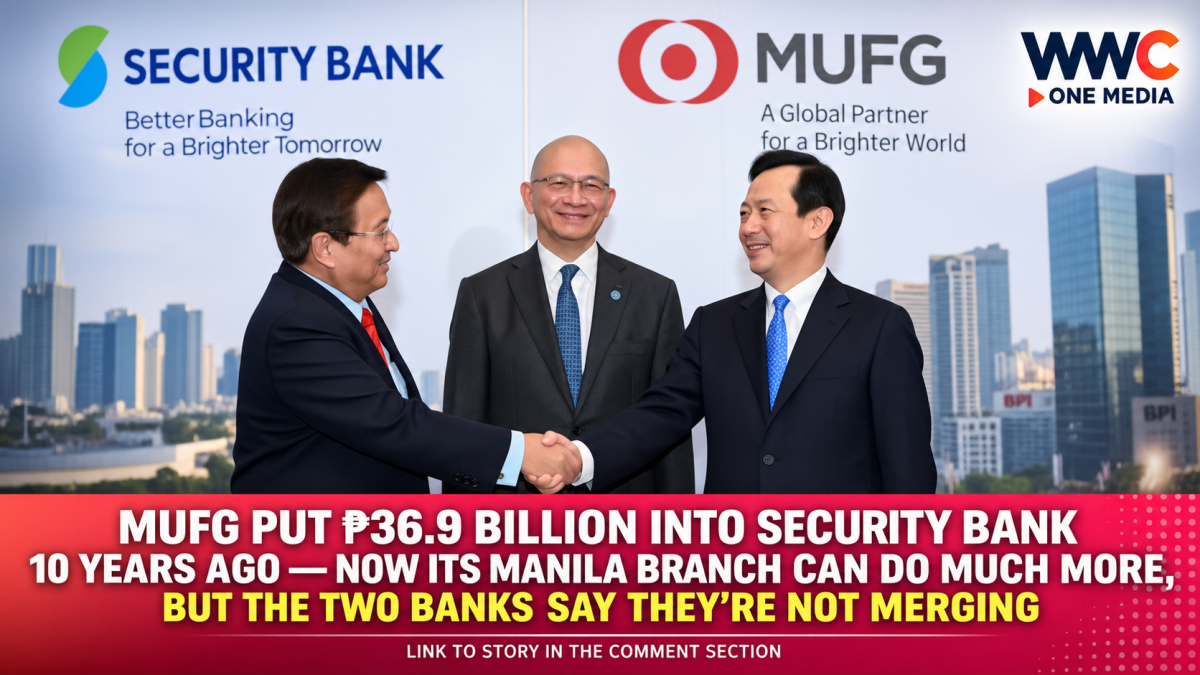
MANILA — Ten years after Japan’s MUFG made one of the biggest foreign investments ever seen in Philippine banking, the relationship is entering a more complicated — and potentially more powerful — phase.
Security Bank and MUFG Bank are reaffirming their strategic alliance as the Japanese financial giant upgrades its Manila operation from a commercial bank to a universal bank, giving the branch broader powers just as the two institutions mark a decade of partnership.
At first glance, that may appear to create a competitive problem.
MUFG already owns a 20% stake in Security Bank.
Security Bank itself is a universal bank.
And now MUFG’s own Manila branch has gained broader powers that overlap more closely with services already offered by its Philippine partner.
But both lenders are stressing a different message:
MUFG is expanding its own capabilities without walking away from Security Bank.
Security Bank president and CEO Victor Lee said the partnership works because the institutions bring different strengths — Security Bank contributes local market knowledge and a broad Philippine network, while MUFG brings global reach and institutional expertise.
MUFG Manila country head Masami Yoshitake similarly described the Philippines as an important market and Security Bank as a continuing strategic partner.
That makes the real story less about one bank replacing another.
It is about whether two increasingly capable institutions can keep finding ways to make the partnership more valuable.
MUFG’s Manila branch officially became a universal bank on September 1
The Bangko Sentral ng Pilipinas approved MUFG Manila’s application to upgrade its license on May 21, 2026.
The central bank issued the certificate of authority on June 5, and the Manila branch began operating as a universal bank on September 1.
That is a meaningful regulatory change.
Under Philippine banking rules, a universal bank can perform the powers of a commercial bank while also exercising investment-house functions and, subject to legal limits, investing in certain non-banking and related businesses.
In simple terms:
MUFG Manila now has a broader legal toolbox.
That could potentially support more sophisticated financing, investment-banking and institutional transactions in the Philippines.
But there is an important caveat.
The BSP circular did not specify exactly which new products MUFG will launch as a result of the upgrade.
So it would be premature to say MUFG is immediately entering every segment of Philippine universal banking.
The license allows broader activity.
It does not automatically mean every possible service is launching tomorrow.
The partnership started with a massive ₱36.9-billion investment
The relationship goes back to 2016.
Then known as the Bank of Tokyo-Mitsubishi UFJ, MUFG agreed to invest ₱36.9 billion in newly issued Security Bank shares.
The transaction gave the Japanese bank a 20% voting stake and two seats on Security Bank’s board.
Security Bank described the deal at the time as the largest foreign equity investment in a Philippine financial institution.
MUFG became Security Bank’s second-largest shareholder behind the Dy Group, while Security Bank became an equity-method affiliate of the Japanese bank.
The original logic was straightforward.
Security Bank understood the Philippine market.
MUFG had deep relationships with Japanese and multinational companies, along with expertise in trade finance, capital markets, project finance and cross-border banking.
The idea was to combine the two.
Ten years later, that basic rationale has not changed.
MUFG still owns 20%
MUFG continues to describe Security Bank as one of its strategic partner banks in Southeast Asia and says it owns a 20% equity interest in the Philippine lender.
That matters because MUFG’s strategy in Southeast Asia has long relied on local banking partners rather than trying to build every capability entirely from scratch.
Its regional partner network includes Security Bank in the Philippines, Krungsri in Thailand, VietinBank in Vietnam and Bank Danamon in Indonesia.
MUFG has said partner banks account for roughly 60% of its net operating profit from its Asia business, underscoring how important the model is to the group’s regional strategy.
So the Security Bank stake is not a passive financial holding.
It sits inside a much broader ASEAN strategy.
That is why MUFG getting stronger on its own does not necessarily weaken the partnership
MUFG already had a direct Philippine presence long before it bought into Security Bank.
Its operations in the country date back to 1953, when a predecessor opened a representative office in Manila.
It later gained offshore banking status in 1977 and a full banking license in 1995.
The partnership with Security Bank therefore never meant MUFG would disappear behind the local lender.
The two businesses have always existed side by side.
The difference now is that MUFG’s Manila branch has more regulatory capacity than before.
That could create overlap.
But it could also create more opportunities to structure larger or more sophisticated deals jointly.
The bigger opportunity is likely corporate and cross-border banking
Security Bank and MUFG have repeatedly highlighted cross-border business as one of the strongest reasons for their alliance.
Security Bank says the partnership improves its ability to support multinational companies, Japanese corporates and Philippine firms needing international capital, project finance, capital-markets access and cross-border business matching.
MUFG, meanwhile, says its Manila operation has strong loan-syndication, project-finance and export-credit-agency financing capabilities.
Put together, that can be particularly useful for:
large infrastructure projects,
renewable-energy investments,
Japanese companies expanding into the Philippines,
Philippine companies raising capital overseas,
and businesses managing regional supply chains.
That is where the universal-banking upgrade could matter most.
Security Bank has become much bigger since the alliance began
Security Bank today is considerably larger than it was when MUFG first invested.
As of June 30, 2026, the bank had ₱1.19 trillion in total assets, according to its first-half results.
It reported ₱6.1 billion in first-half net income, up 4% from a year earlier, with total revenues rising 11% to ₱34.9 billion.
The bank also had:
₱675 billion in net loans,
₱891 billion in deposits,
and ₱155.7 billion in shareholders’ capital at end-June.
InsiderPH reported that Security Bank operated 396 branches nationwide as of June 30.
That gives MUFG a partner with significant domestic reach — something a foreign bank branch cannot easily replicate overnight.
Security Bank is also shifting toward a “one-bank” strategy
Security Bank’s broader strategy helps explain why MUFG remains useful even as the Japanese lender expands independently.
The Philippine bank is concentrating growth around three major areas:
wealth management, entrepreneur banking, and corporate and institutional banking.
Security Bank says its wealth assets under management increased from ₱40 billion in 2017 to ₱560 billion in 2025, while its MSME portfolio grew from ₱13 billion in 2021 to ₱32.5 billion in 2025.
Its strategy increasingly involves serving the same client across multiple needs.
An entrepreneur may need a business loan, payroll, payments and wealth management.
A corporation may need project finance, treasury, trade finance and capital-markets support.
That is exactly where a global partner becomes useful.
Security Bank can provide the domestic relationship.
MUFG can extend that relationship internationally.
The Japan Desk remains one of the clearest examples
Security Bank specifically identifies its Japan Desk as one area where the MUFG partnership has created an advantage.
The bank says it sees further opportunities to support Japanese and multinational companies entering the Philippines and to facilitate investment and trade flows across international corridors.
That remains commercially relevant because Japan continues to be one of the Philippines’ major economic partners, with Japanese companies deeply embedded in sectors including manufacturing, infrastructure, automotive, logistics and energy.
MUFG’s long-standing relationships with Japanese corporates give Security Bank access to client networks that would be far more difficult to build alone.
The partnership has expanded beyond traditional banking
The Security Bank–MUFG relationship has also produced businesses beyond standard corporate lending.
One important example is SB Finance, a consumer-finance joint venture involving Security Bank and MUFG-linked Thai lender Krungsri.
More recently, Security Bank acquired a 25% stake in Home Credit Philippines from MUFG.
Security Bank announced the transaction in 2024 at approximately ₱11 billion, while Krungsri retained the other 75%.
That may sound like MUFG stepping away.
But Security Bank itself framed the transaction as another evolution of the partnership.
MUFG effectively transferred its Home Credit stake to its Philippine strategic partner while another MUFG-linked bank, Krungsri, remained the controlling shareholder.
That is less a breakup than a rearrangement inside the broader network.
Security Bank now uses Home Credit to reach more consumers
Security Bank completed the 25% Home Credit investment in May 2025.
Its integrated report says the stake gives it more exposure to the Philippines’ fast-growing consumer-finance segment.
Home Credit has served more than 11 million Filipino customers and operates through thousands of point-of-sale locations.
This illustrates how the MUFG relationship has moved beyond the original 2016 idea of simply introducing Japanese corporations to a Philippine bank.
The partnership has increasingly become an ecosystem.
The two banks are also working together on startups
Earlier this year, Security Bank and MUFG joined Thailand’s Krungsri, MUFG Innovation Partners, Krungsri Finnovate and the Philippine Department of Trade and Industry in an agreement aimed at strengthening cross-border startup collaboration.
The idea is to connect Philippine startups with corporate and investor networks across Asia while also helping foreign startups explore opportunities in the Philippines.
Security Bank provides relationships with domestic companies.
MUFG provides its regional and Japanese network.
Krungsri brings Thailand.
The venture-capital arms contribute startup connections.
That is another example of the partnership evolving beyond basic banking.
Sustainability has become another shared business line
Security Bank and MUFG have also been working together on sustainable finance.
In June, the two banks held their third MUFG N0W forum in the Philippines, focusing on energy security, renewable investment, transition finance and regional connectivity.
MUFG’s sustainability reporting also identifies Security Bank as one of the partner banks covered by its sustainable-finance framework with the Japan International Cooperation Agency.
The framework is designed to support green and social financing through MUFG’s Southeast Asian partner banks.
That matters because the Philippines requires enormous capital for renewable power, grids, transport, climate adaptation and other infrastructure.
Banks with both domestic origination capability and international funding access are well placed to compete for those deals.
MUFG itself is already a sizable bank in the Philippines
The universal-banking upgrade should not be interpreted as MUFG suddenly arriving in the country.
As of the end of March, its Manila branch had around ₱155.2 billion in assets, ranking 18th among Philippine universal and commercial banks, according to BusinessWorld reporting based on industry data.
That makes MUFG meaningful on its own.
But it remains far smaller domestically than Security Bank’s ₱1.19-trillion balance sheet and nationwide branch network.
That scale difference helps explain why the partnership can still make strategic sense even after MUFG’s license expansion.
MUFG has global depth.
Security Bank has domestic breadth.
So will MUFG compete with Security Bank more directly now?
Potentially, in some areas.
That is unavoidable.
Both can serve large corporations.
Both can structure financing.
Both can operate in institutional banking.
And both now hold universal-bank status in the Philippines.
But strategic partnerships between banks do not require that their businesses never overlap.
The more important question is whether cooperation produces more value than competition destroys.
Both lenders say it still does.
InsiderPH reported that they will continue operating independently and that any additional cooperation will be evaluated under normal regulatory and governance requirements.
That wording is important.
There is no announced merger.
There is no announced increase in MUFG’s 20% stake.
There is no announcement that Security Bank will become a subsidiary of MUFG.
And there is no announcement that the two will combine their Philippine operations.
The Dy Group still controls Security Bank
When MUFG made its ₱36.9-billion investment in 2016, the Dy Group remained Security Bank’s largest shareholder group and retained majority voting control.
MUFG became the second-largest shareholder and an important strategic investor.
That arrangement was designed to combine foreign capital and expertise with local ownership and management.
The current partnership still follows that model.
MUFG’s broader ASEAN strategy makes the Philippine relationship easier to understand
Security Bank is one piece of a much larger regional network.
MUFG operates across 18 Asia-Pacific markets outside Japan and maintains strategic relationships with leading banks in Vietnam, Thailand, Indonesia and the Philippines.
The idea is not necessarily to turn every partner into a fully owned MUFG subsidiary.
Instead, MUFG uses local banks to access domestic customers, distribution and market knowledge while offering those partners international expertise, capital and corporate relationships.
That model gives MUFG far greater regional coverage than its own branches alone could provide.
Security Bank is the Philippine version of that strategy.
The universal license could make the partnership more valuable — or more complicated
The new license gives MUFG Manila more options.
It can potentially participate more directly in sophisticated financial activities that previously may have required different structures or relied more heavily on partners.
That could create new ways for MUFG and Security Bank to work together.
It could also put them across the table from each other competing for some of the same mandates.
That tension is normal in large financial partnerships.
What matters is whether the alliance keeps producing business that neither side could capture as effectively alone.
And there is no guarantee that every new capability will be used immediately
This is another area where headlines can overstate the change.
MUFG’s universal-bank license expands what the Manila branch may do.
The BSP has not announced a list of new products that MUFG will immediately launch.
So claims such as “MUFG is entering Philippine retail banking in force” or “MUFG will now compete directly for Security Bank’s customers” would go beyond what has been publicly confirmed.
The current announcement is about regulatory capacity and strategic commitment.
Specific new businesses will still need to be announced separately.
The decade-long alliance has already survived one major strategic reshuffling
The Home Credit transaction is probably the clearest example.
MUFG sold its 25% stake in Home Credit Philippines to Security Bank.
That could have been interpreted as MUFG exiting a Philippine consumer asset.
Instead, the transaction placed Security Bank alongside Krungsri — another major MUFG-linked regional bank — as the Home Credit owners.
The broader MUFG network remained involved.
Only the ownership structure changed.
That flexibility may be one reason the partnership has lasted a decade.
The next decade will likely be less about equity — and more about execution
The 2016 story was easy to measure.
MUFG invested ₱36.9 billion.
It received a 20% stake.
Security Bank gained a global strategic shareholder.
The next phase is more complicated.
The value now has to come from:
cross-border deals,
project finance,
sustainable finance,
capital markets,
Japanese corporate relationships,
regional startups,
consumer-finance partnerships,
and possibly new services made possible by MUFG’s universal-bank status.
Those are harder to summarise in one number.
But they are what will determine whether the alliance remains commercially important.
The most important thing that did not happen is a merger
That may ultimately be the best way to understand Thursday’s announcement.
MUFG has strengthened itself in the Philippines.
Security Bank has grown substantially.
Their businesses overlap more than they did 10 years ago.
But both sides are choosing to preserve the structure they built in 2016.
Independent banks.
One global.
One deeply domestic.
One owns 20% of the other.
And both say the partnership still works.
That makes MUFG’s new universal license less a signal that Security Bank is becoming unnecessary and more a test of whether the alliance can evolve as both institutions become more powerful.
Ten years ago, MUFG’s Philippine strategy began with ₱36.9 billion and a 20% stake.
Today, it has its own broader banking license, a partner with ₱1.19 trillion in assets, and a regional strategy that increasingly connects traditional banking with infrastructure, sustainability, consumer finance and cross-border investment.
The question for the next decade is no longer whether MUFG believes in the Philippine market.
It is whether two banks with increasingly similar capabilities can keep finding more reasons to cooperate than to compete.



Leave a Reply