
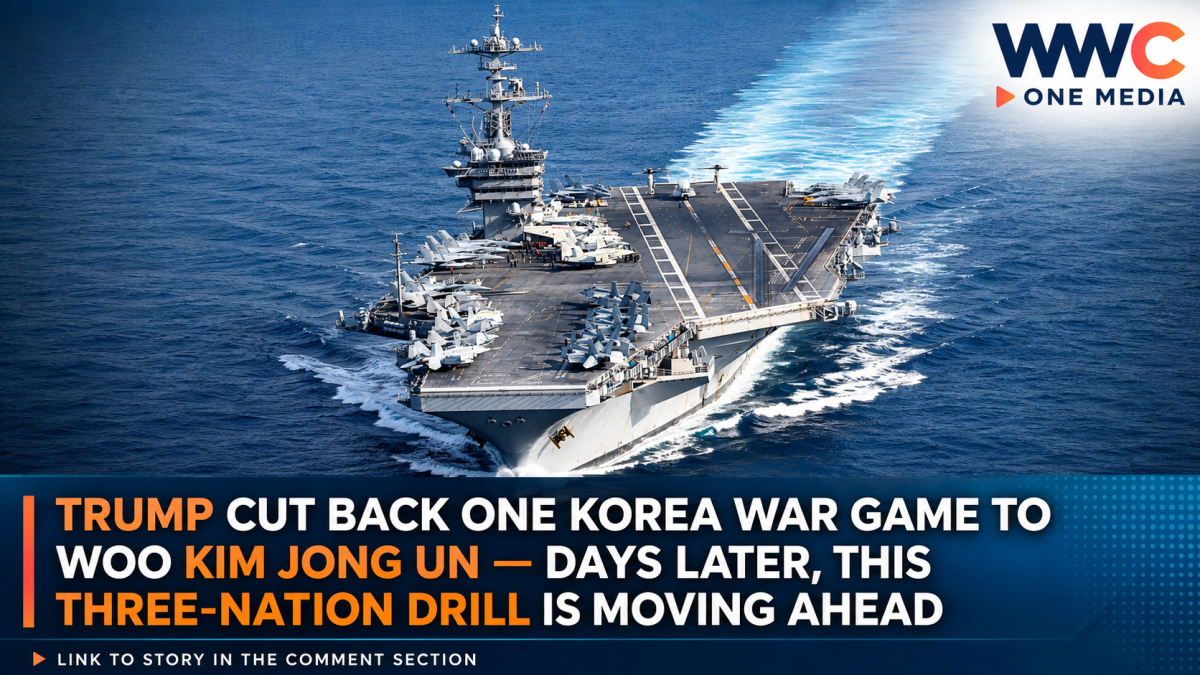
SEOUL — A major military exercise involving the United States, South Korea and Japan is moving ahead near the Korean Peninsula, creating a fresh test for President Donald Trump’s effort to reopen diplomacy with North Korean leader Kim Jong Un.
South Korea’s Joint Chiefs of Staff announced that the three countries will conduct the Freedom Edge 2026 exercise from September 7 to 11 in international waters east and south of Jeju Island.
Seoul describes the annual exercise as defensive and says it is designed to strengthen the three countries’ ability to respond to North Korea’s expanding nuclear and missile capabilities while protecting regional security.
But the timing could make this year’s exercise far more politically significant than a routine military drill.
Just days earlier, Washington and Seoul dramatically shortened their separate Ulchi Freedom Shield exercise after Trump ordered the Pentagon to “substantially” reduce joint military drills with South Korea.
The exercise had originally been scheduled for August 17 to 27 but ended on August 21, cutting its duration from 11 days to five. Field training was also reduced. Trump had argued that large-scale exercises were expensive and could send what he considered an unnecessarily hostile signal to Pyongyang while he seeks renewed dialogue with Kim.
That conciliatory move, however, has so far produced little visible improvement in relations.
North Korea has continued accusing Washington of pursuing hostile policies and has rejected the idea that simply reducing military exercises fundamentally changes the security relationship.
Pyongyang also launched about 10 short-range ballistic missiles toward the sea shortly before the latest Freedom Edge announcement, according to AP, after criticizing U.S.-South Korean military activities.
Freedom Edge Is Becoming More Sophisticated
Freedom Edge began in 2024 following commitments made by the United States, South Korea and Japan after their leaders met at Camp David in 2023.
Unlike a conventional single-service exercise, Freedom Edge is designed as a multi-domain operation, combining naval and air capabilities while strengthening cooperation in areas such as ballistic-missile defense, anti-submarine warfare and surveillance.
This year, the three countries are planning additional capabilities.
U.S. Pacific Command said the 2026 exercise would include greater real-time information sharing and synchronized coordination among the participating forces.
Training is also expected to include expanded air-defense scenarios, maritime interdiction operations and medical evacuation exercises, according to Yonhap. South Korean military officials said the overall scale should remain roughly comparable with previous Freedom Edge exercises.
The exercise has previously been conducted three times — twice in 2024 and once in September 2025.
North Korea Sees the Drills Very Differently
Washington, Seoul and Tokyo characterize Freedom Edge as defensive.
Pyongyang does not.
North Korea has repeatedly condemned the trilateral exercises as evidence of growing military cooperation against it and has portrayed similar U.S.-led exercises as preparations for an invasion.
North Korean authorities have also argued that the trilateral security partnership serves broader U.S. strategic goals involving China and Russia, adding another geopolitical layer to what the allies describe primarily as a response to North Korea’s nuclear and missile programs.
The confrontation intensified again this week when North Korea’s Foreign Ministry criticized a proposed U.S. sale of AIM-9X Sidewinder air-to-air missiles and related equipment to South Korea.
According to Yonhap, Seoul requested 103 AIM-9X Sidewinder Block II missiles along with 10 guidance units and additional equipment.
Pyongyang said the proposed arms transfer demonstrated continuing U.S. hostility and warned that it would respond with powerful countermeasures.
Trump’s Diplomatic Opening Faces a Difficult Test
The situation puts Trump in an increasingly complicated position.
On one side, he has signaled that he wants to revive personal diplomacy with Kim Jong Un and has already demonstrated a willingness to reduce some U.S.-South Korean exercises.
On the other, Washington remains committed to extensive military cooperation with Seoul and Tokyo as North Korea continues developing nuclear weapons, ballistic missiles and closer military ties with Russia.
Freedom Edge therefore represents more than another military exercise.
It highlights the difficult balance between deterrence and diplomacy that has shaped Washington’s North Korea policy for decades.
Trump previously met Kim several times during his first presidency, including summits in Singapore and Hanoi, but those negotiations ultimately failed to produce an agreement capable of dismantling North Korea’s nuclear arsenal.
Since then, Pyongyang has strengthened both its weapons programs and its relationship with Moscow, potentially giving Kim greater leverage in any future negotiations. AP reported that North Korea continues to insist that Washington abandon its demand for denuclearization as a condition for renewed diplomacy.
Meanwhile, the military relationship among Washington, Seoul and Tokyo has continued to deepen.
That means the September exercise could become an important signal in several directions at once: reassurance to South Korea and Japan, deterrence toward North Korea, and a demonstration that Trump’s diplomatic outreach does not automatically mean abandoning U.S. regional security commitments.
Whether Pyongyang responds with another weapons test, stronger rhetoric or something more significant could ultimately determine whether Freedom Edge becomes simply another annual military exercise — or the next major obstacle in Trump’s attempt to bring Kim Jong Un back to the negotiating table.




Leave a Reply