
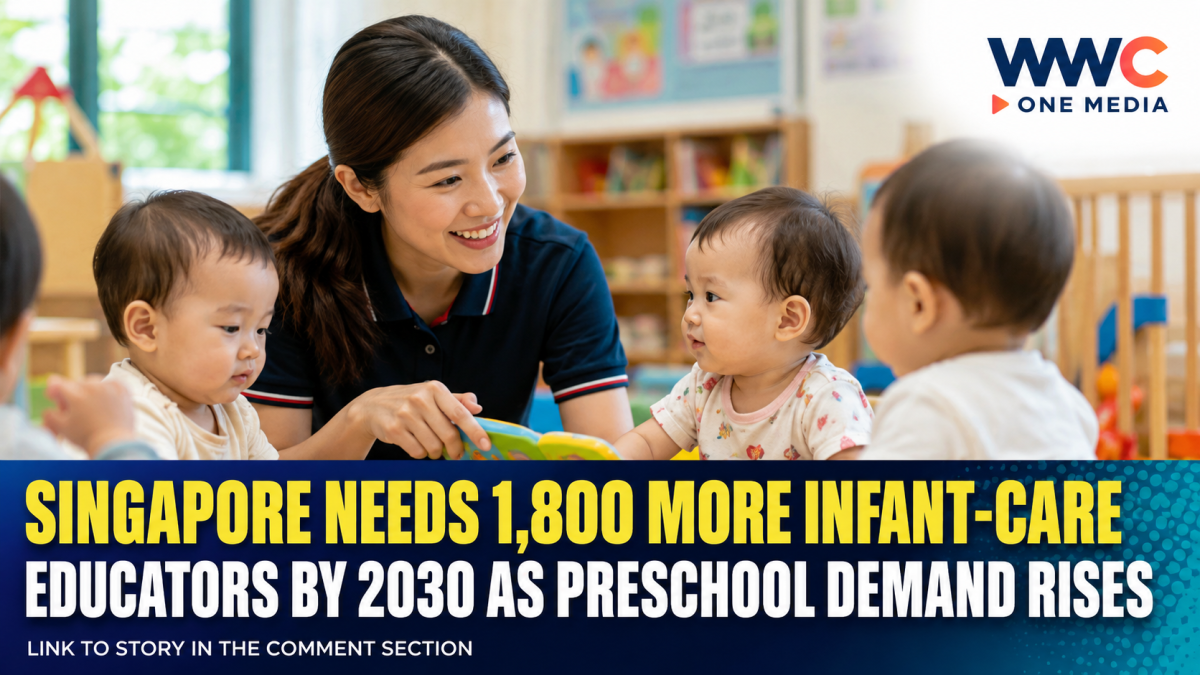
SINGAPORE — Singapore is preparing for a major expansion of infant care, but there is one critical challenge standing in the way: finding enough trained educators to care for the country’s youngest children.
The early childhood sector is aiming to recruit 1,800 additional infant-care educators by 2030, as demand for infant-care places is expected to grow alongside the Government’s plans to make preschool significantly more affordable for families.
The Early Childhood Development Agency (ECDA) announced the manpower target on Aug. 28, just days after Prime Minister Lawrence Wong unveiled major preschool affordability measures during the 2026 National Day Rally.
The push comes as Singapore prepares to progressively reduce fees at government-supported preschools.
By 2030, full-day childcare fees are targeted to fall to S$150 a month, while full-day infant-care fees are expected to drop to S$300 a month, before means-testing. The new rates will be introduced progressively from 2028. Lower-income families will continue to receive additional support and pay even less.
Why 1,800 more educators are needed
Infant care requires more intensive staffing than care for older preschool children.
Under ECDA’s current minimum staffing requirements, children aged 18 months and below require a ratio of one qualified programme staff member for every five infants.
That makes expanding infant-care capacity particularly dependent on having enough trained educators.
ECDA said more than 2,000 preschool educators already hold qualifications that allow them to work in infant care, but only about 4 per cent were working as infant educators as of August 2026. Most were instead working with older preschool children.
The agency is therefore looking at ways to encourage qualified educators to move into infant care, while also helping existing preschool workers obtain the necessary certification.
Bigger hiring push begins in September
From September, ECDA will expand its Manpower Hiring Grant, designed to help preschool operators recruit and train both local and foreign educators toward early-childhood certification.
Under the place-and-train model, employers hire candidates first, with trainees subsequently undertaking part-time training.
For eligible trainees, the grant can cover up to 70 per cent of training stipends and 50 per cent of course fees. ECDA also plans to increase training stipends across several trainee categories, with additional support for infant-care qualifications.
The funding scheme will also be extended for another three years, through Dec. 31, 2030.
ECDA said it will explore overseas partnerships as another way of broadening the pool of potential candidates.
The timing is crucial
The recruitment drive comes as Singapore prepares to dramatically expand access to more affordable preschool care.
Government data and policy announcements show that the Government-supported preschool network currently serves about 80 per cent of preschoolers. Prime Minister Wong said the network needs to expand further so that more families can benefit from lower fees.
A new grant will also be introduced to help eligible preschool operators join the Government-supported network.
ECDA said this could allow a broader range of operators, including smaller providers, to receive government support while continuing to offer families different preschool choices. Details of the new grant are expected later in 2026.
What this means for parents
For Singaporean families, the changes could eventually make infant care substantially more affordable.
The Government has said the future S$300 monthly infant-care fee will apply to every Singaporean child, regardless of household income, before means-testing. Lower-income families will continue to receive additional subsidies.
The Government also plans to eventually extend full childcare and infant-care subsidies to Singapore Citizen children regardless of whether the main subsidy applicant is working. More details on implementation are expected in early 2027.
But cheaper care alone will not solve the capacity problem.
The Government’s own policy documents acknowledge that expanding affordable preschool access must go hand in hand with expanding the infant-care workforce and the number of infant-care places.
The bigger issue: making infant care sustainable
The challenge is not simply recruiting 1,800 people.
Infant-care educators require specialised knowledge and skills because they work with children at a particularly early stage of development. ECDA has stressed the importance of having a well-trained workforce capable of responding to infants’ developmental and caregiving needs.
The wider preschool sector has also been working on job redesign and workforce support. In April 2026, ECDA launched a sector-wide job-redesign initiative aimed at improving educators’ well-being and professional growth, including ideas such as using technology to reduce administrative work and strengthening non-contact time for lesson planning and engagement with parents.
That means Singapore’s preschool affordability push is becoming a two-sided equation:
Lower fees could increase demand — but the country must have enough trained educators and places to meet that demand.
And that is why the target of 1,800 additional infant-care educators by 2030 could prove just as important as the headline-grabbing promise of S$300 infant-care fees.
For parents, the real test will be whether Singapore can make infant care not only cheaper, but also accessible, adequately staffed and sustainable as demand grows.




Leave a Reply