
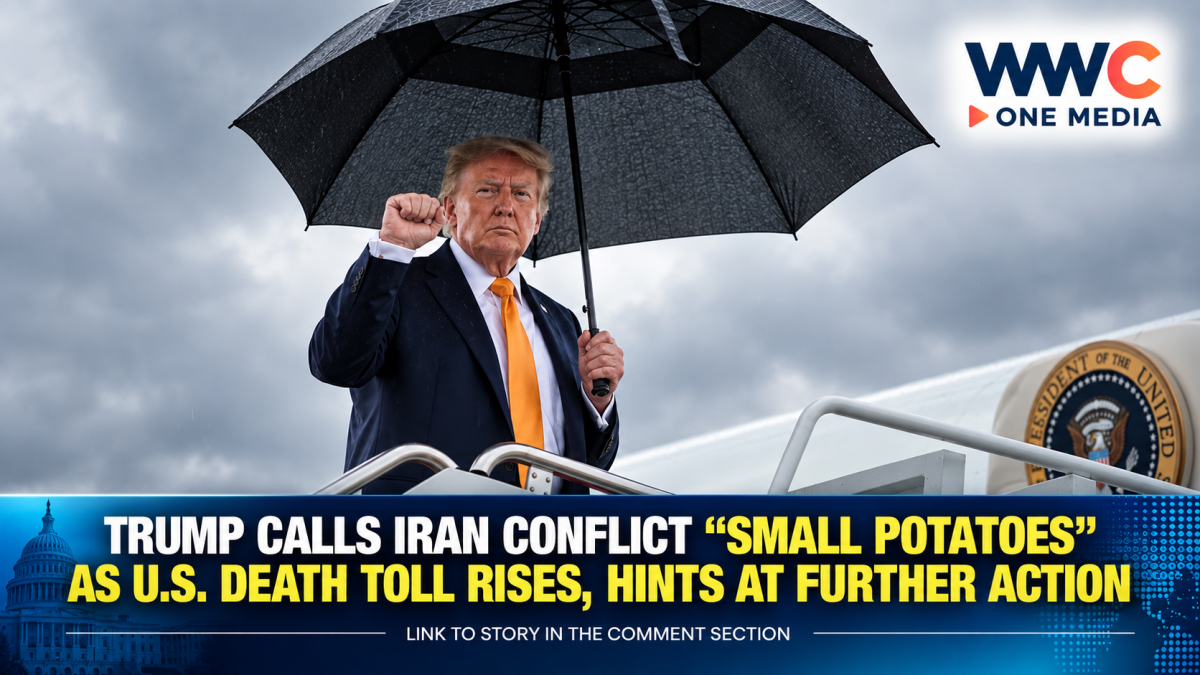
WASHINGTON — President Donald Trump has dismissed the scale of the ongoing U.S.-Iran conflict, calling it “small potatoes” while defending his administration’s description of the fighting as a limited military conflict rather than a conventional war.
Trump made the remark Friday as he defended Vice President JD Vance, who has argued that the United States is not technically at war with Iran. The comments come as the conflict enters another tense phase, with U.S. forces carrying out military operations against Iranian targets and Iran retaliating against American interests and regional allies.
The president’s characterization has drawn attention because the conflict has already produced significant casualties and created wider regional and economic consequences.
Trump: “Small potatoes” for the United States
Speaking to reporters, Trump said the confrontation with Iran was “small potatoes for us”, portraying the military challenge as manageable for the United States.
His comments were made in the context of a broader debate within his administration over whether the confrontation should be described as a “war.”
Vance has maintained that the United States is engaged in a military conflict, rather than formally being at war with Iran. Trump backed that framing while emphasizing that the United States has the military capability to deal with the situation.
The terminology matters politically and legally, particularly as the fighting continues and questions grow over how long the confrontation could last.
U.S. casualties add weight to the debate
Trump’s remarks come as the conflict has already taken a toll on U.S. forces.
AP reported that 18 U.S. service members had been killed, with hundreds more injured, as of Friday.
The casualties have added pressure to the administration’s effort to characterize the conflict as limited.
The fighting has also extended beyond direct U.S.-Iran exchanges.
Iran has launched attacks toward U.S. allies in the Gulf, including Kuwait and Bahrain, following U.S. strikes in Iran, according to AP reporting.
That has raised concerns that the confrontation could continue expanding across the region.
Strait of Hormuz remains a major flashpoint
The conflict also carries global economic implications because of the Strait of Hormuz, one of the world’s most strategically important energy routes.
U.S. forces recently struck Iranian rocket launchers near the Strait in the first reported U.S. military action there in weeks, highlighting the strategic importance of the waterway and the risks surrounding commercial shipping.
Any prolonged disruption in the region could affect energy markets and international trade.
The economic consequences have already been a concern during the conflict, with previous reporting warning that prolonged fighting could push up energy and other commodity prices.
Trump signals Iran’s nuclear sites remain in focus
Despite describing the broader confrontation as manageable, Trump has not ruled out additional military action.
He said the United States could potentially strike Pickaxe Mountain, a deeply buried Iranian nuclear facility, “quite soon,” according to recent reports.
That creates a striking contrast in Trump’s messaging.
On one hand, the president is minimizing the scale of the conflict.
On the other, he continues to threaten additional strikes against strategically important Iranian facilities.
The possibility of another attack could further complicate efforts to prevent the conflict from expanding.
A conflict that refuses to stay contained
The latest developments illustrate the difficult balance facing the Trump administration.
Washington is attempting to project military dominance while avoiding the perception that the United States is being drawn into an open-ended war.
Iran, meanwhile, has demonstrated its willingness to retaliate beyond its own territory, targeting U.S. partners in the Gulf.
The conflict has already lasted months, and AP reporting has noted that Trump’s earlier expectations of a relatively quick resolution have not materialized.
That makes Trump’s “small potatoes” description particularly striking.
For the administration, it may be a message of confidence.
For U.S. troops, regional allies and civilians caught in the fighting, however, the consequences are anything but small.
And with the president now warning that another strike on Iran’s nuclear infrastructure could come soon, the next move may determine whether the confrontation remains limited—or enters an even more dangerous phase.

Leave a Reply