
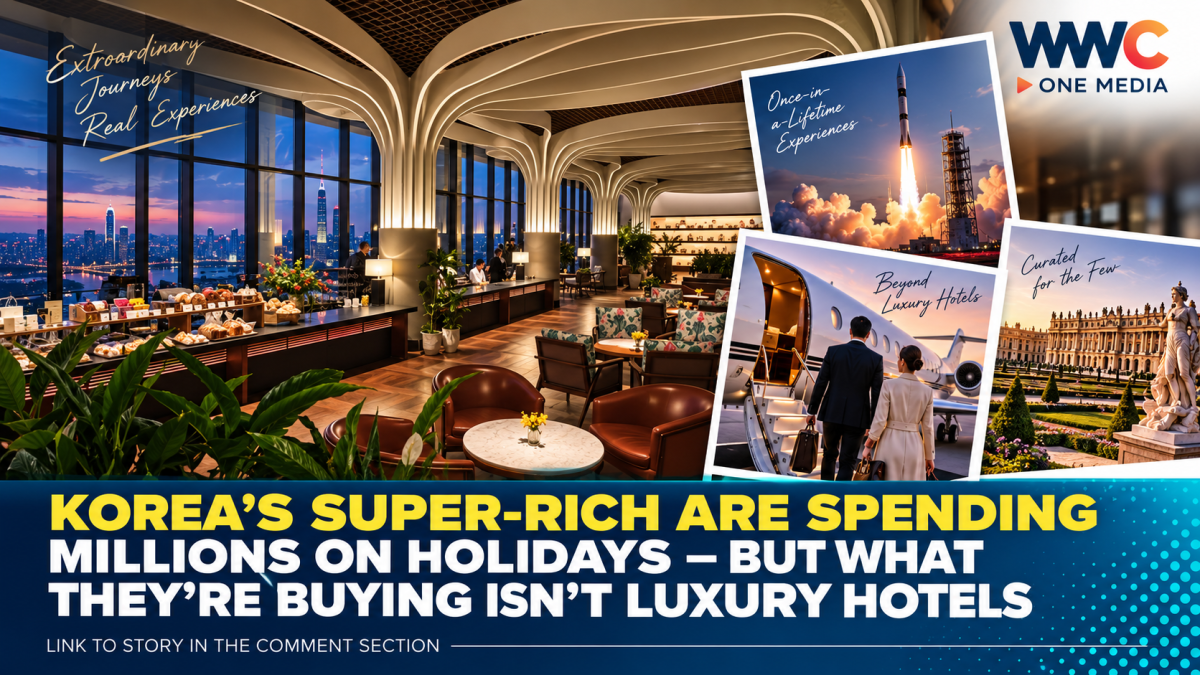
A rocket launch from Kazakhstan. A private jet circling the world. A night inside the grounds of Versailles. A luxury train journey through South America.
For South Korea’s ultra-wealthy travelers, the new definition of luxury appears to be changing.
The latest premium travel offerings in Korea suggest that affluent consumers are increasingly paying not simply for better hotels or business-class seats, but for rare experiences, exclusivity and access that ordinary travelers cannot easily replicate.
One striking example is a seven-day Kazakhstan itinerary built around the Baikonur Cosmodrome, the historic space-launch facility.
The package costs about 28 million won ($20,600) per person and includes a chance to watch a rocket launch from a designated viewing location, along with visits connected to Baikonur’s space program. Korea Economic Daily independently reported the same price and itinerary details.
And that’s only the beginning.
$20,000 to watch a rocket launch
The Baikonur package is being sold by Modetour and is built around the experience of witnessing a rocket launch rather than simply sightseeing.
Travelers are scheduled to stay in a yurt on the Kazakh steppe at a safe distance from the launch area.
The itinerary also includes the Gagarin launch pad, aerospace-related facilities and museums, as well as more traditional tourist stops.
The package includes business-class transportation, meals, private transportation and substantial travel insurance, according to Korea Herald’s report.
The attraction is obvious: this isn’t an experience someone can simply add to a conventional holiday itinerary.
The destination is the experience itself.
Then there is the $240,000 private-jet journey
For travelers operating at an even higher level of wealth, the price tag jumps dramatically.
Hana Tour’s high-end Zeus World brand offers a 20-day Four Seasons Private Jet journey starting at approximately 340 million won, or around $240,000, according to Korean business reporting.
The specially configured aircraft can carry up to 48 passengers.
Travelers receive a level of service designed to resemble a luxury hotel in the sky, with dedicated journey managers, a concierge, physician and executive chef accompanying the trip.
The itinerary includes destinations across several regions, with luxury accommodation and curated experiences built into the journey.
Four Seasons itself lists its 2026 Private Jet experiences at prices reaching $199,000 per person, depending on the itinerary and occupancy, confirming that this category of travel is a genuine global luxury-tourism product rather than simply a Korean marketing phenomenon.
Korea’s department stores are entering the luxury-travel business
Perhaps the biggest indication that this is becoming a broader consumer trend is where these products are being sold.
South Korea’s major department stores — traditionally associated with luxury fashion, jewelry and high-end consumer goods — are increasingly moving into premium travel.
Shinsegae launched VIA SHINSEGAE in 2025, becoming the first Korean department store to directly plan and operate its own travel products, according to Yonhap and Shinsegae’s own announcement.
Rather than competing with ordinary package tours, VIA SHINSEGAE focuses on experiences involving culture, wellness, exploration, motorsports, gastronomy and other highly specialized interests.
And the business appears to be gaining traction.
VIA SHINSEGAE’s numbers reveal where the money is going
According to recent Korean reporting, VIP customers accounted for about 65% of VIA SHINSEGAE’s sales during its first year, while sales increased more than 14-fold year over year in the first half of 2026.
One of its headline-grabbing offerings was a South American luxury itinerary costing more than 50 million won per person.
It reportedly sold out within two days.
Another offering involving pianist Yunchan Lim’s recital in Nagoya reportedly filled its limited 20-person capacity rapidly despite costing around 4.6 million won per person.
That tells an important story about today’s luxury traveler:
The appeal isn’t necessarily the most expensive room. It’s getting access to something difficult to reproduce.
Even a $30 million-won Versailles experience is becoming part of the market
Hyundai Department Store is also targeting the same audience through its premium curation platform, The Hyundai Hi.
Among its offerings is a private Versailles-themed trip priced at about 30.4 million won for two people, excluding flights, according to Maeil Business Newspaper.
Other offerings include luxury rail travel and highly curated European itineraries.
Hyundai has also introduced one-on-one concierge consultations at selected stores, effectively bringing the luxury-travel sales experience into the department-store environment.
The strategy is straightforward:
If wealthy customers already trust a department store to select their luxury goods, why not let it select their luxury experiences too?
This isn’t just about showing off
The shift also reflects a broader change in what affluent consumers consider valuable.
Korea Economic Daily reported that travel companies are increasingly moving away from the traditional question of “Where do you want to go?” toward “What do you want to experience?”
That distinction matters.
A conventional luxury holiday can be purchased by many people with sufficient money.
But watching a specific rocket launch from a controlled viewing area, securing rare access to a major cultural event, traveling with a specialist or joining an extremely limited expedition is different.
Scarcity becomes the luxury.
The numbers show that high prices aren’t necessarily killing demand
Recent reporting indicates that demand for premium travel remains surprisingly strong.
Korea Economic Daily reported that VIA SHINSEGAE has maintained an average booking rate above 80% since its launch, while another report highlighted growing demand for packages costing tens of millions of won.
Meanwhile, Korean travel companies are expanding their luxury portfolios rather than retreating from them.
The offerings now span private jets, luxury cruises, exclusive trains, customized tours, cultural events and specialized expeditions.
Why are Korean companies chasing wealthy travelers?
There is a straightforward business reason.
Ultra-premium travel products have dramatically higher transaction values than conventional package tours.
Korea Economic Daily reported that travel companies are targeting affluent middle-aged and older consumers with significant purchasing power. The newspaper also cited travel-industry experience showing strong inquiry volumes when high-priced cruise products are marketed.
For department stores, the attraction is even greater.
Luxury travel can strengthen relationships with existing VIP customers while giving those customers another way to spend through the retailer’s ecosystem.
Shinsegae, for example, allows qualifying travel purchases to contribute to department-store VIP performance, helping turn travel into another part of the luxury-retail relationship.
The luxury market is changing — from possessions to experiences
The larger trend may be more important than any single $20,000 or $240,000 package.
For decades, luxury consumption was heavily associated with what people owned:
- designer handbags
- luxury watches
- expensive cars
- jewelry
- premium homes
Now, an increasingly important part of luxury consumption is what people can experience.
A private expedition.
A once-in-a-lifetime performance.
A rare hotel.
A rocket launch.
A private aircraft.
An itinerary built around a person’s specific interests.
That is precisely the market Korea’s department stores and travel companies are beginning to pursue.
And the next luxury battlefield may be even more exclusive
The interesting part is that this market is still evolving.
As affluent travelers become accustomed to business-class flights, five-star hotels and conventional luxury tours, simply making something more expensive may no longer be enough.
The next competitive advantage could be access.
Who can get inside?
Who can go somewhere before everyone else?
Who can meet the expert?
Who can witness the event from a restricted location?
Who can experience something that cannot simply be booked online?
That may explain why a $20,000 rocket-launch trip can compete for attention alongside a $240,000 private-jet journey.
They are selling different products — but the underlying promise is remarkably similar:
You aren’t just buying a vacation. You’re buying an experience few other people can have.
And for Korea’s ultra-rich, that may be becoming the ultimate luxury.
WWC ONE MEDIA M.J.E




Leave a Reply