
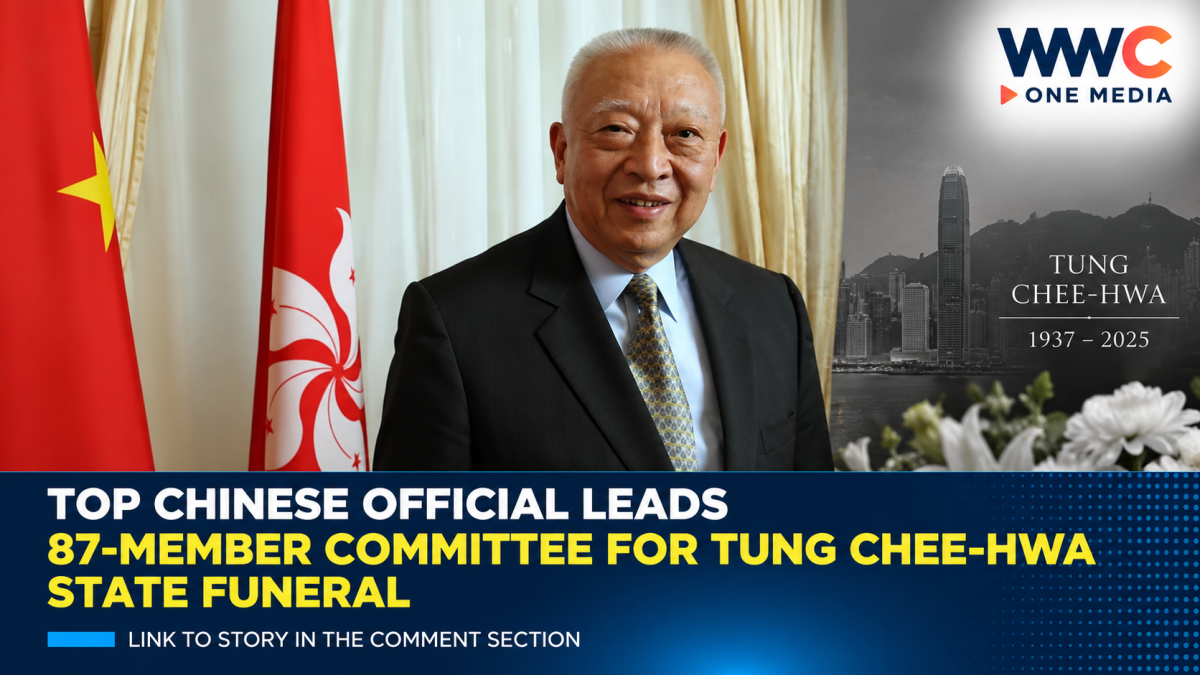
A senior Chinese official has been appointed to lead an 87-member committee overseeing the state funeral arrangements for Tung Chee-hwa, Hong Kong’s first chief executive following the city’s return to Chinese sovereignty in 1997.
Tung died peacefully in hospital on September 8 at the age of 89, with members of his family by his side. His death brought tributes from Hong Kong and mainland Chinese officials, reflecting his longstanding role in the city’s political and economic affairs.
The committee will coordinate arrangements for the state funeral, which is scheduled to take place in Hong Kong on September 20.
The decision to hold a state funeral reflects Tung’s status as the first chief executive of the Hong Kong Special Administrative Region. He served from 1997 until his resignation in 2005, becoming a prominent figure in the early years of Hong Kong’s administration under Chinese sovereignty.
After leaving office, Tung remained active in national and Hong Kong affairs. He served as a vice-chairman of the Chinese People’s Political Consultative Conference and continued to participate in discussions involving the city’s development and its relationship with mainland China.
Tung was born into a prominent Hong Kong shipping family and later took over his family’s business. His political career brought him into the city’s administration before he was selected to become Hong Kong’s first chief executive after the 1997 handover.
His time in office coincided with several major challenges, including the Asian financial crisis, the SARS outbreak and a period of significant public dissatisfaction. His administration also faced widespread opposition over proposed national security legislation in 2003.
Despite the controversies surrounding his tenure, Tung remained an influential figure after leaving government. In later years, he continued to advocate policies concerning Hong Kong’s economic development, housing and closer cooperation with mainland China.
The state funeral is expected to bring together senior Hong Kong and mainland Chinese officials, former government leaders and representatives from different sectors of the city.
The formation of the 87-member committee marks the beginning of the formal preparations for the ceremony and provides a central structure for coordinating the funeral arrangements for one of the most significant political figures in Hong Kong’s post-handover history.


Leave a Reply