
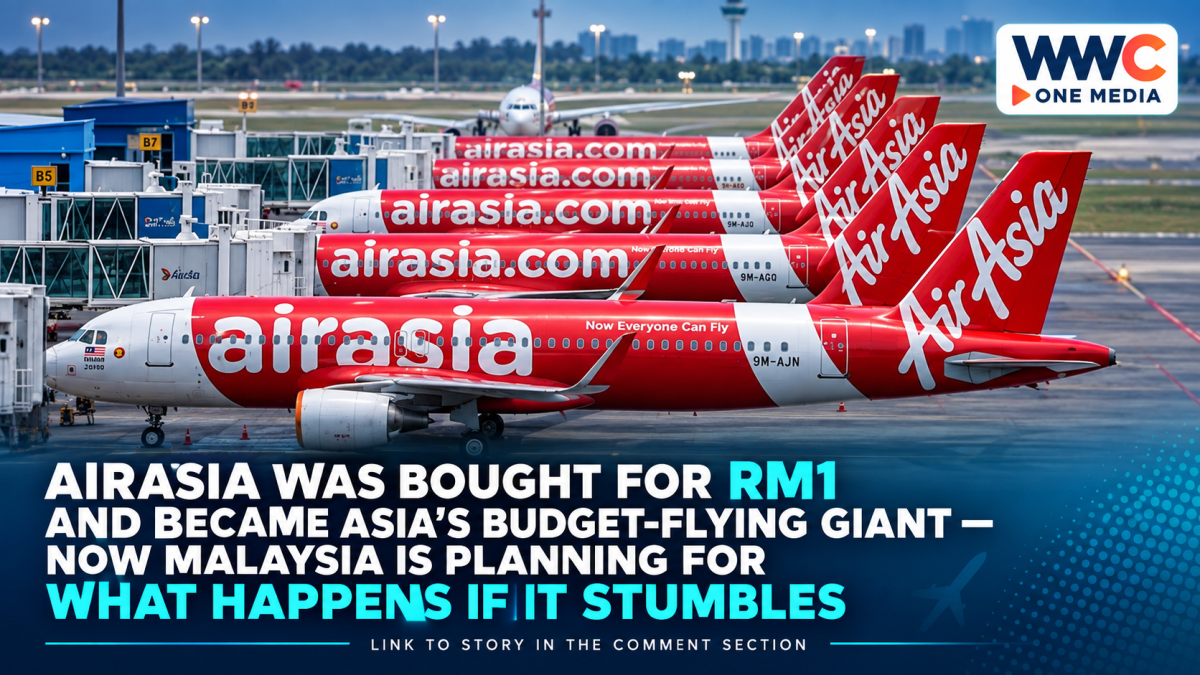
KUALA LUMPUR — AirAsia began as a struggling Malaysian airline that Tony Fernandes and Kamarudin Meranun bought for just RM1 in 2001. It went on to help transform air travel across Southeast Asia, carrying hundreds of millions of passengers and making international flights affordable to a generation of travelers.
Now, more than two decades later, the company that helped rewrite Asian aviation is confronting one of the most serious financial tests in its history.
Malaysia’s government has asked Malaysia Airlines and Batik Air whether they would have enough aircraft and capacity to take over some AirAsia domestic routes and passengers if necessary, Reuters reported, citing people familiar with the discussions.
The discussions are contingency planning.
They do not mean the government has decided AirAsia will fail, that another airline will take it over, or that flights are about to stop. Reuters explicitly reported that no transfer of AirAsia’s operations has been decided, while AirAsia says it remains focused on business continuity and sees strong underlying passenger demand.
Still, the fact that authorities are planning for such a scenario shows how much is at stake.
AirAsia says it controls roughly 40% of Malaysia’s overall aviation market and around 60% of domestic flying. A major disruption would therefore be much more than a corporate problem.
It could become a national connectivity problem.
The airline that cost RM1
AirAsia existed before Tony Fernandes.
The carrier was established in 1993 and began operations in 1996 as a conventional airline.
But the business struggled.
By 2001, it had accumulated about RM40 million in debt. In September that year, Fernandes and Kamarudin’s Tune Air acquired the airline for the symbolic price of RM1 while taking on its liabilities.
That RM1 deal eventually became one of Southeast Asia’s most famous aviation turnaround stories.
The new owners rebuilt AirAsia around a low-cost model: cheap fares, high aircraft utilization, a simpler fleet, direct online sales and an aggressive expansion strategy.
AirAsia relaunched as a budget carrier in 2002.
Phuket followed in 2003.
Indonesia and the Kuala Lumpur-Jakarta route arrived in 2004.
The company listed on Bursa Malaysia that same year and placed major orders for Airbus A320 aircraft as it scaled.
The formula was simple enough to describe.
Keep aircraft flying.
Keep costs low.
Fill seats.
And make money from volumes and ancillary services even while base fares remain affordable.
But executing that formula across several countries would turn out to be far more complicated.
AirAsia helped make flying ordinary
By 2008, AirAsia had carried 50 million passengers.
Two years later, it passed 100 million.
In 2018, the group marked its 500 millionth passenger.
Its impact extended beyond its own balance sheet.
Budget aviation made weekend trips between Southeast Asian capitals accessible to customers who previously might have traveled by bus, ferry or not traveled internationally at all.
AirAsia expanded operations in Thailand, Indonesia, the Philippines and eventually Cambodia, while long-haul affiliate AirAsia X attempted to apply the low-cost model to much longer journeys.
By 2025, the enlarged AirAsia airline businesses carried about 68.6 million passengers, according to the group’s pro-forma financial presentation.
That scale explains why Malaysian authorities cannot treat AirAsia like an ordinary distressed company.
If a small airline withdraws several routes, competitors may eventually fill the gap.
If a carrier controlling most domestic Malaysian capacity suddenly shrinks sharply, replacing those seats requires aircraft—not simply permission to fly the routes.
The first warning came from long-haul flying
AirAsia’s vulnerability to fuel prices appeared early.
AirAsia X launched flights to London and Paris as part of its long-haul expansion, but both European services were suspended in 2012, with high fuel costs and weak demand among the reasons cited.
Low-cost airlines are particularly exposed to fuel shocks because their business model depends on keeping ticket prices attractive to price-sensitive customers.
A premium airline may have a larger business-class cabin and more pricing flexibility.
A budget airline cannot simply double ticket prices without risking the demand proposition on which the business was built.
That tension would become much more important years later.
AirAsia was already showing strain before COVID
By 2018, higher oil prices were squeezing the group.
CNA’s review of AirAsia disclosures shows the carrier’s average fuel price rising from about US$69 a barrel in the fourth quarter of 2017 to US$92 a year later.
AirAsia estimated that the increase added RM703 million to its 2018 fuel bill compared with the previous year.
Weak Southeast Asian currencies against the dollar added another problem because aviation expenses including fuel, aircraft leases and financing are often dollar-linked.
In 2019, the group reported a net loss of roughly RM283 million.
Then came COVID-19.
COVID broke the aviation machine
Few companies were hit harder by the pandemic than airlines.
Borders closed.
Aircraft stopped flying.
International tourism disappeared.
AirAsia operated only around 29% of its 2019 capacity in 2020. Revenue collapsed 74% to RM3.1 billion and the group reported a RM5.9-billion net loss.
AirAsia Japan shut down.
Aircraft were grounded for months.
And debts accumulated while planes generated little or no revenue.
AirAsia X entered Malaysia’s PN17 financially distressed classification in October 2021, while Capital A—the corporate entity then housing AirAsia’s aviation and other businesses—followed in January 2022.
PN17 does not automatically mean bankruptcy.
It is Bursa Malaysia’s classification for listed companies under serious financial stress, requiring them to implement a regularization plan if they want to retain their listing.
AirAsia X subsequently completed a major restructuring.
But surviving COVID created another problem.
The airline now had to restart.
Grounded aircraft became expensive aircraft
When borders reopened, travelers came back surprisingly quickly.
Aircraft did not.
Planes parked for extended periods needed inspections and maintenance before they could safely return to commercial service.
Capital A disclosed in 2023 that it was paying costs associated with 204 aircraft while only around 143 were flying on average at that point.
For a low-cost airline, that is a painful mismatch.
Aircraft leasing and ownership obligations continue whether the aircraft generates revenue or sits on the ground.
The post-pandemic recovery therefore had a strange shape:
Passenger demand was improving.
But restoring enough aircraft to serve that demand was expensive.
Then AirAsia reorganized almost everything
AirAsia spent years simplifying a corporate structure that had grown increasingly complicated.
In January 2026, Capital A completed the disposal of its airline businesses—AirAsia Berhad and AirAsia Aviation Group Limited—to AirAsia X Berhad.
The transaction effectively brought AirAsia’s short-haul and long-haul airlines together under a single aviation platform.
AirAsia X later became AirAsia Group Berhad.
The transaction included AirAsia X assuming RM3.8 billion previously owed by Capital A to AirAsia Berhad.
Meanwhile, Capital A became a separate, primarily non-airline company centered on businesses including engineering, logistics, travel technology, food and brand licensing.
That distinction matters because headlines still frequently use “AirAsia,” “AirAsia X” and “Capital A” as though they were interchangeable.
They are no longer the same corporate story.
Capital A successfully completed its regularization plan and officially exited PN17 in May 2026 after the aviation disposal and a roughly RM5.5-billion capital reduction.
The aviation group, however, was about to face an entirely new crisis.
Just months after consolidation, fuel exploded
The renewed Middle East conflict sent jet-fuel prices sharply higher in March 2026.
AirAsia said jet fuel moved above US$200 per barrel at points in late March, adding roughly RM200 million to the March fuel bill of its Malaysian operations alone.
That is a brutal shock for a company whose competitive identity is built around affordable fares.
AirAsia responded quickly.
Fuel surcharges were introduced.
Ticket prices were adjusted.
Weak routes were reduced or suspended.
Capacity was cut.
The group says it managed to recover roughly 70% of the second-quarter fuel-price increase through higher fares and lower non-fuel costs.
But 70% still leaves a substantial amount unabsorbed.
Twenty-one routes were temporarily suspended
During April and May, AirAsia temporarily suspended 21 routes and reduced second-quarter capacity by roughly 10%.
Thai AirAsia cut capacity sharply during May and June.
Thai AirAsia X reduced frequencies to several international destinations.
Indonesia AirAsia suspended Melbourne-Bali and Adelaide-Bali services as fuel costs remained elevated.
Later, Indonesia AirAsia stopped its direct Jakarta-Singapore service and suspended direct Singapore-Bali flights, redirecting passengers through connecting options including Kuala Lumpur.
AirAsia described the moves as deliberate capacity management rather than a retreat from Southeast Asia.
It says the objective is to fly aircraft only where ticket revenue can adequately cover the cost.
That distinction is important.
For a low-cost airline, flying more seats is not automatically good business.
If every additional passenger seat loses money because fuel has become too expensive, shrinking can actually preserve cash.
The second-quarter numbers showed how serious the pressure became
AirAsia Group reported RM5.1 billion in second-quarter revenue, essentially flat year on year despite an 11% reduction in capacity.
Revenue per available seat kilometer increased 11%, reflecting fare increases and fuel surcharges.
But fuel costs surged.
The group said its average jet-fuel price reached US$183 a barrel during the quarter.
AirAsia reported a RM830.5-million net loss for the three months ended June.
About RM331 million of that came from foreign-exchange losses. Excluding the forex hit, the net loss would still have been approximately RM499.6 million.
The pain was uneven.
Short-haul operations in Malaysia and Cambodia remained profitable, while AirAsia said greater pressure was concentrated in Thailand, Indonesia and the Philippines, as well as long-haul Malaysian operations.
That is another reason describing the entire AirAsia network as financially broken would be inaccurate.
Some important parts of the business remain profitable.
But the balance sheet is the number everyone is watching
At June 30, AirAsia had RM18.4 billion in current liabilities and approximately RM954 million in cash and bank balances, according to Reuters.
“Current liabilities” does not mean all RM18.4 billion must be paid immediately tomorrow.
Accounting standards generally classify obligations expected to be settled within the operating cycle or within 12 months, alongside certain other liabilities.
Still, the gap between current obligations and available cash explains why refinancing has become so important.
Reuters also reported, citing people familiar with the matter, that AirAsia owed airport operator Malaysia Airports Holdings Berhad at least RM500 million for items including landing and parking fees.
AirAsia did not confirm that amount, while the airport operator declined to discuss specific commercial arrangements.
So the RM500-million figure should be attributed to Reuters’ sources rather than presented as an amount formally acknowledged by AirAsia.
AirAsia wants more than $1 billion in financing
AirAsia says it is pursuing up to US$1 billion in international debt-market financing plus RM700 million in Malaysian credit facilities.
The airline has pushed back on the idea that this money is simply emergency cash needed to keep flying.
It says the primary purpose is to refinance and restructure older, more expensive debt, particularly obligations accumulated during the pandemic.
AirAsia says it already raised about US$300 million in March 2026 to extend maturities and reduce principal obligations.
Its strategy is to replace multiple higher-cost facilities with longer-term financing carrying better terms.
That could lower interest expense and give the airline more breathing room.
But Reuters reported that two people familiar with the situation estimated AirAsia might require at least US$3 billion in fresh capital to fully address its financial position.
AirAsia disputes that implication and says its announced financing targets are sufficient for its requirements.
So there are two clearly different views:
Reuters’ sources say the funding need could be much larger.
AirAsia says its current plan is adequate.
Neither should be presented as undisputed fact.
AirAsia is returning 25 older aircraft
The company is also cutting the fixed costs attached to aircraft it no longer considers economically attractive.
AirAsia says it plans to return 25 older aircraft to lessors during 2026, reducing lease obligations and removing less fuel-efficient planes from its cost base.
At the same time, it is preparing for newer aircraft scheduled from 2028 onward, including the Airbus A220 and A321XLR.
That sounds contradictory—return aircraft now while ordering more later—but the strategy reflects a difference between survival and growth.
Right now, AirAsia wants fewer aircraft draining cash on weak routes.
Later, it wants newer aircraft capable of producing better fuel economics and operating more efficiently.
Capacity has been cut by as much as 25%
AirAsia says its third-quarter capacity adjustment of roughly 20% to 25% is partly seasonal and strategic rather than evidence that demand has disappeared.
The airline argues the third quarter is traditionally one of the weaker periods for regional travel and says it intends to increase capacity again for the stronger fourth-quarter travel period.
The airline has also shifted aircraft types between routes.
Widebody A330s have been replaced with narrower aircraft on selected services where smaller planes make more economic sense.
Some routes—including Kuala Lumpur-Sydney and Kuala Lumpur-Delhi—have been temporarily suspended.
The principle is straightforward:
stop chasing passenger volume if those passengers do not produce adequate margins.
That is a major philosophical shift for an airline whose spectacular expansion was built partly on scale.
Yet passengers have not disappeared
The irony is that AirAsia’s current problem is not fundamentally a lack of travelers.
In the first quarter of 2026, the consolidated AirAsia airlines carried about 18.9 million passengers, 9% more than a year earlier.
Its load factor reached 85%, while capacity had recovered to about 98% of pre-pandemic levels before the worst of the latest fuel shock hit.
AirAsia repeatedly says underlying travel demand remains strong.
That separates this crisis from COVID.
During the pandemic, customers disappeared because borders closed.
In 2026, many customers still want to fly.
The problem is whether the airline can carry them cheaply enough to preserve the low fares that made AirAsia successful while still covering fuel, leases, debt, airport costs and foreign-exchange exposure.
Why Malaysia is quietly planning for the worst
That is where the Malaysian government’s conversations with rival airlines come in.
Reuters says authorities have asked Malaysia Airlines and Batik Air about their ability to absorb AirAsia domestic capacity if needed.
Malaysia Airlines and Batik Air reportedly told officials that taking over a large amount of AirAsia traffic would be much easier if aircraft leases were also available.
That makes logistical sense.
Routes themselves do not carry passengers.
Aircraft do.
Batik Air said it could bring in aircraft quickly to help absorb domestic market share if required. Malaysia Airlines declined to comment publicly on the Reuters report.
Again, those discussions are scenario planning—not confirmation that AirAsia operations will be transferred.
The government has a reason to prepare anyway.
With roughly 60% of Malaysia’s domestic aviation market attributed to AirAsia, even temporary capacity reductions could affect fares, tourism, airport traffic and connectivity between Malaysian cities.
A sudden AirAsia retreat could also raise fares
There is another consequence that goes beyond canceled routes.
Competition is one reason airfares stay low.
AirAsia’s aggressive pricing helped force established carriers throughout Southeast Asia to compete with budget fares.
If a large amount of AirAsia capacity disappeared and replacement capacity did not arrive immediately, fewer available seats could put upward pressure on ticket prices.
That is particularly significant for domestic Malaysian travelers who have built travel habits around low-cost aviation.
The irony is striking.
AirAsia became powerful partly because it made flying cheap.
Its scale is now so large that a major contraction could make flying more expensive.
The crisis also exposes a weakness shared by budget airlines
AirAsia is not alone.
Reuters reported in August that Southeast Asian low-cost carriers were facing unusually intense pressure from the latest fuel shock, with airlines including Cebu Pacific and Scoot also recording losses as fuel and currency costs climbed.
Low-cost carriers operate on thin margins by design.
That works brilliantly when aircraft are full, fuel is manageable and costs are tightly controlled.
It becomes much harder when jet fuel suddenly doubles, currencies weaken and passengers resist large fare increases.
Full-service airlines are not immune.
But they often have more premium traffic and corporate customers capable of absorbing higher fares.
Budget carriers built their market precisely around people who watch prices closely.
That makes the fuel-price pass-through problem harder.
AirAsia has survived crises before
There is another side to the story.
This is not the first time AirAsia has appeared financially vulnerable.
It survived the Asian aviation downturns of earlier decades.
It endured the QZ8501 tragedy.
It abandoned an unsuccessful first attempt at long-haul Europe.
It survived COVID.
Its airline businesses were restructured.
Capital A completed its own regularization and exited PN17 in May.
And the enlarged airline group entered 2026 with a far cleaner operating logic than the collection of overlapping corporate structures that preceded it.
AirAsia argues that consolidation now lets it move aircraft more efficiently across markets and choose the most profitable aircraft type for each route.
The question is whether those improvements arrived quickly enough to withstand a historic fuel shock and the debt still left behind by the pandemic.
The RM1 story has reached its hardest sequel
The AirAsia story has always been irresistible because of where it began.
A debt-laden airline.
RM1.
A few aircraft.
Then Phuket.
Jakarta.
Bangkok.
Singapore.
The Philippines.
China.
India.
Europe.
Hundreds of millions of passengers.
And one of Asia’s most recognizable aviation brands.
But the same model that powered its success carries vulnerabilities.
High aircraft utilization means aircraft must remain productive.
Low fares mean cost increases cannot always be passed directly to passengers.
Regional expansion creates exposure to multiple currencies.
And enormous scale means relatively small changes in fuel price can turn into enormous absolute costs.
AirAsia says it is attacking those problems with higher fares, fuel surcharges, route cuts, aircraft returns, refinancing and tighter cost control.
Malaysia’s government, meanwhile, is preparing for scenarios in which those measures may not be enough.
That does not mean AirAsia is disappearing.
It means the airline has become important enough that governments cannot afford to be surprised if its financial pressure worsens.
In 2001, the question was whether anyone could turn a RM1 airline into a regional giant.
AirAsia answered that.
In 2026, the question is whether that giant can refinance the debt, survive another fuel shock and still keep the fares low enough to remain AirAsia.




Leave a Reply