
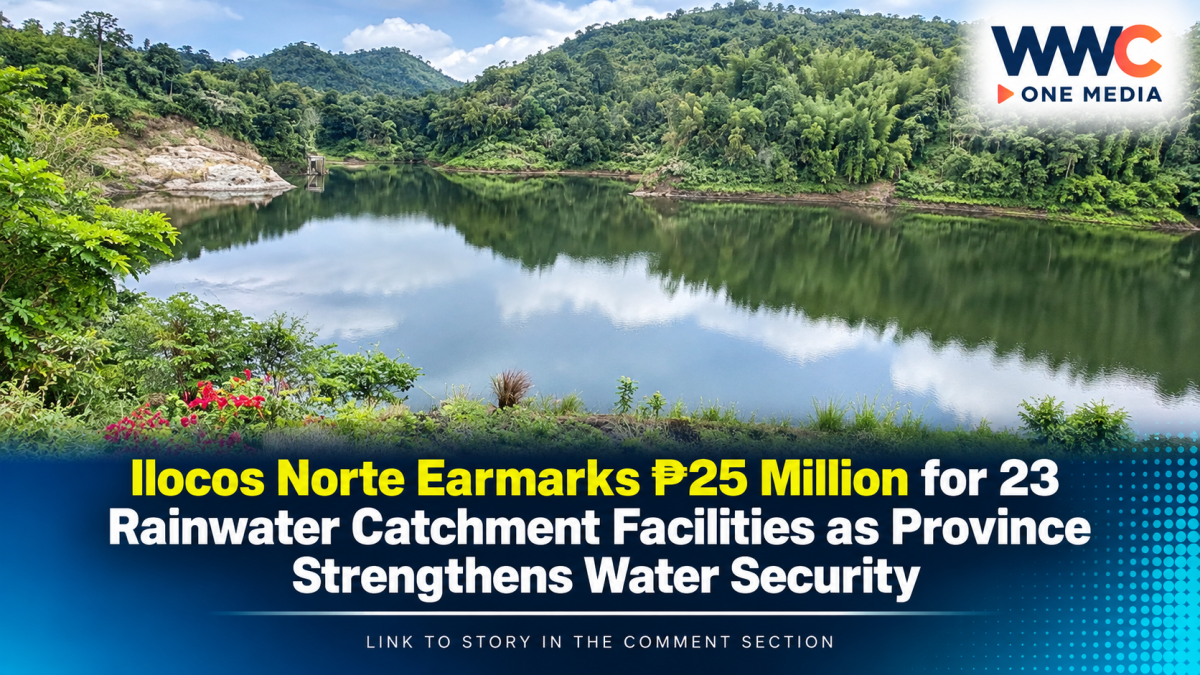
ILOCOS NORTE, Philippines — Ilocos Norte is set to invest ₱25 million in 23 rainwater catchment facilities, expanding efforts to capture and store rainwater for communities while strengthening the province’s water-management capacity.
The planned facilities are intended to make better use of rainfall by collecting water that would otherwise flow away, potentially providing an additional source for community and agricultural needs during periods when water supplies come under pressure.
The initiative comes as water security remains an important concern for Northern Luzon, where communities and agricultural areas can experience very different conditions between the rainy and dry seasons.
Turning Heavy Rain Into a Water Resource
Rainwater harvesting allows communities to collect precipitation from roofs and other suitable surfaces and channel it into storage facilities for later use.
For provinces such as Ilocos Norte, the approach can complement existing water and irrigation systems rather than replace them. The province has extensive agricultural areas, making reliable water availability particularly important to farmers and rural communities.
The project also reflects a broader shift toward localized water-management measures that can help communities retain water closer to where it falls.
Why the Investment Matters
The ₱25-million allocation for 23 facilities works out to an average of roughly ₱1.09 million per facility, although actual project costs can vary depending on the size, location and design of each installation.
Beyond water storage, rainwater catchment systems can also help reduce runoff during heavy rainfall when properly designed and maintained.
Ilocos Norte has previously incorporated rainwater harvesting into sustainable infrastructure. The province’s Capitol complex, for example, was designed with a rainwater harvesting facility, irrigation infrastructure and water cisterns as part of its environmental features.
Part of a Bigger Water Challenge
The need for additional water-management infrastructure is particularly significant in an agricultural province. Irrigation projects in the Ilocos region have also been developed to improve agricultural water access, including the Ilocos Norte–Ilocos Sur–Abra Irrigation Project, which has been designed to serve thousands of hectares of farmland.
Rainwater catchment facilities can provide another layer of resilience by storing water locally instead of relying exclusively on larger irrigation or distribution systems.
However, the effectiveness of the 23 facilities will ultimately depend on factors such as where they are built, how much water each can store, maintenance arrangements and how the collected water will be used.
From Rainfall to Long-Term Resilience
The Ilocos Norte project highlights a simple but increasingly important idea: rainfall can be treated not only as a source of flooding or runoff, but also as a resource that can be captured and managed.
With 23 facilities planned under the ₱25-million program, the next focus will be implementation — including project completion, actual storage capacity and whether the systems deliver a dependable additional water source for communities.
For Ilocos Norte, the bigger test will not simply be how much rain can be collected, but how effectively that water can be stored, managed and put to use when communities need it most.
WWC ONE MEDIA G.A




Leave a Reply