
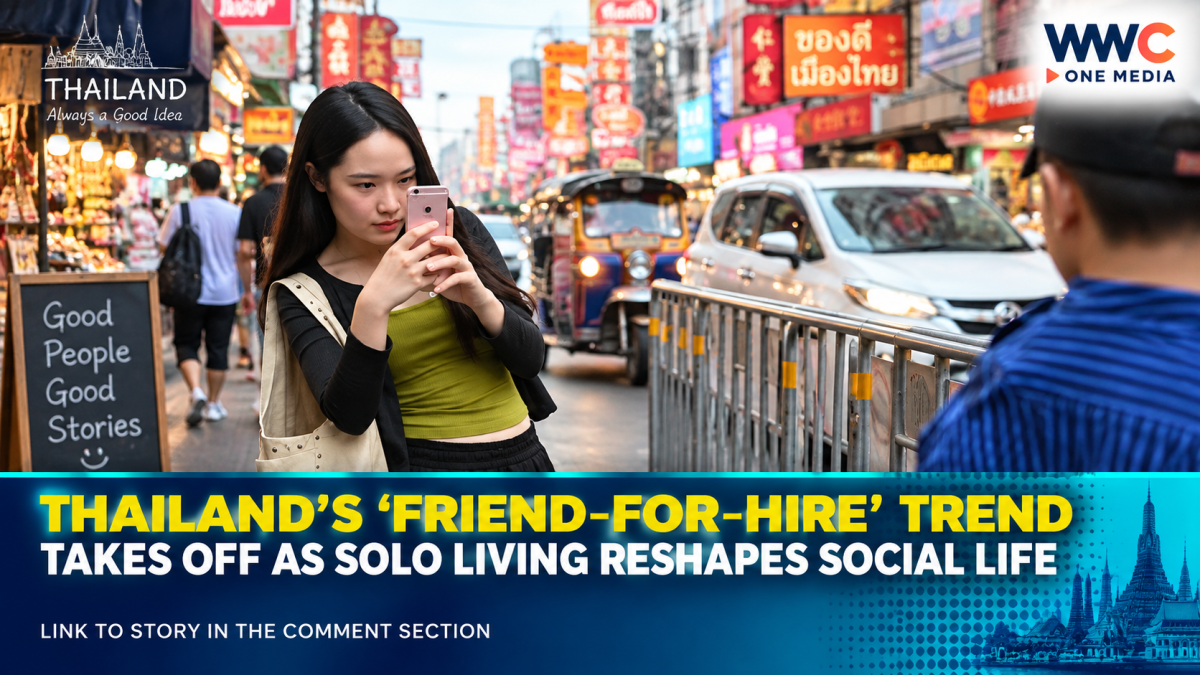
BANGKOK — In Thailand, friendship is becoming an unexpected part of the gig economy.
A growing number of people are now paying for companions to join them on trips, take photographs, go shopping, exercise, visit cafés or simply provide company—reflecting wider changes in Thai lifestyles and the country’s increasingly large population of people living alone.
The emerging “friend-for-hire” industry does not necessarily revolve around romance or loneliness.
For many customers, it is simply about convenience: finding someone available to accompany them when friends or family members cannot.
It is not quite friendship—and that’s the point
The concept is relatively simple.
Customers book someone to accompany them for a specific activity and pay by the hour or according to the arrangement.
That could mean anything from a trip around Bangkok to a photography session, gym workout, café visit or shopping excursion.
One provider featured in the reporting charges 1,000 baht per hour, with typical bookings lasting two to three hours.
The service is therefore less about forming a permanent friendship and more about providing on-demand companionship.
Thailand’s solo households are growing
One of the strongest factors behind the trend is Thailand’s changing household structure.
According to data cited from Euromonitor International, single-person households accounted for 29.5% of Thai households in 2025, compared with a global average of 21.9%.
That shift is creating an expanding market for products and services designed around independent living.
The phenomenon extends beyond companionship.
Businesses are increasingly adapting to consumers who live alone, including services connected with solo travel and dining.
Sometimes people just need someone to take the photo
One Bangkok customer, university student and content creator Ainthuon Rattanawaraporn, said she initially tried the service out of curiosity.
She later found a practical advantage: friends were sometimes unavailable to accompany her on trips, while she was not always comfortable traveling alone.
There was another benefit—having someone whose job was specifically to take photographs.
Instead of feeling guilty about asking friends to repeatedly take photos, she could tell a paid companion exactly what kind of pictures she wanted.
That illustrates why the trend should not automatically be interpreted as evidence of widespread social isolation.
For some customers, it is simply outsourcing a social or practical task.
Social media is helping fuel the business
Social platforms are also playing an important role.
Providers can promote their services directly through social media, while customers can examine reviews, photographs and profiles before deciding whom to hire.
One young entrepreneur, Thanaporn Charoenchuea, launched a service called “Snap Like a Bestie.”
According to the reporting, she served more than 50 clients within roughly two months.
Her service combines photography with companionship, particularly for clients who want to appear more relaxed and natural in front of the camera.
The service is expanding beyond photography
Another provider, Penkawin Wangniwetkul, known as Ice, has taken the concept further.
Her clients have hired her for activities including:
- Running
- Gym workouts
- Aerobics
- Shopping
- Spa visits
- Café hopping
- Indoor rock climbing
She has also accompanied customers on other outings.
The service essentially allows customers to choose the type of social experience they want—and the person they want to experience it with.
Even travelers are hiring companions
The concept is also appearing outside Bangkok.
One customer visiting Chiang Mai hired a companion after finding the service through TikTok reviews.
The arrangement allowed her to explore cafés while her traveling companion pursued another activity.
That highlights another possible market for the industry: travelers who want company for only part of a trip rather than traveling with someone throughout the entire journey.
Safety is becoming a major issue
But turning companionship into a commercial service also creates risks.
Providers interviewed in the reporting said they screen customers before accepting bookings.
Some only meet clients in public locations, while others reject requests that could put them in uncomfortable or potentially dangerous situations.
One provider specifically declined invitations involving male clients and late-night entertainment venues.
That caution is important because the relationship between customer and companion is fundamentally different from ordinary friendship.
The customer is paying for a service, and expectations therefore need to be clearly defined.
Experts say boundaries matter
Sociologist Narupon Duangwises of the Princess Maha Chakri Sirindhorn Anthropology Centre has pointed to the potential emotional benefits of interaction with hired companions for people who have difficulty forming friendships through everyday life.
But there is also an important distinction.
Unlike conventional friendships—which develop organically—customers can select companions based on appearance, personality or specific requirements.
That makes clear rules and boundaries particularly important for protecting both sides from harassment, inappropriate behavior and potential violence.
A new kind of gig economy
The rise of friend-for-hire services offers a glimpse into how Thailand’s changing demographics could create entirely new forms of work.
The business combines several trends at once:
More people living alone + changing lifestyles + social-media-driven experiences + flexible gig work = demand for on-demand companionship.
But the trend also raises larger questions about modern urban life.
As people become increasingly independent, mobile and digitally connected, traditional social networks may not always fit the way they live.
Sometimes people want complete independence.
Other times, they simply want someone to share a few hours with.
The bigger picture
Thailand’s friend-for-hire phenomenon is therefore about more than paying someone to accompany you to the gym or take your holiday photographs.
It reflects a broader transformation in how people work, travel, socialize and build relationships.
And perhaps the most surprising part is that customers are not necessarily looking for a replacement best friend.
Sometimes they just need someone who is available right now.
As Thailand’s solo-living population grows, the question is whether “friend-for-hire” will remain a niche curiosity—or become a permanent new category in the country’s service economy.




Leave a Reply