
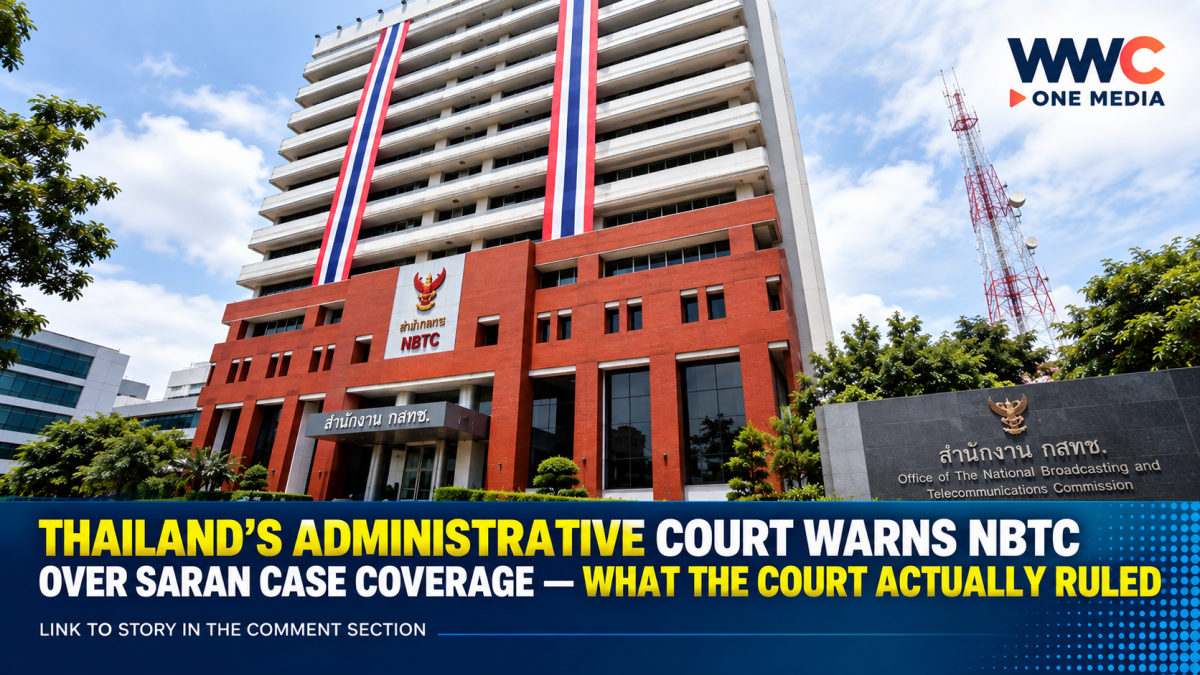
BANGKOK — Thailand’s Administrative Court has warned the National Broadcasting and Telecommunications Commission (NBTC) after finding that parts of an official NBTC news release about a court case involving its chairman, Dr. Saran Boonbaichaiyapruk, could give the public a misleading impression about what the court had actually decided.
The dispute centers on a Supreme Administrative Court order that allowed Saran’s lawsuit to proceed over a selection committee decision concerning his qualifications and status as an NBTC commissioner.
But the court stressed a crucial point: accepting the lawsuit is not the same as ruling in Saran’s favor.
The Administrative Court said some passages published by the NBTC as statements by the Supreme Administrative Court were actually arguments contained in Saran’s appeal and were not findings or reasoning issued by the court itself.
What triggered the warning?
On September 3, the NBTC issued a news release concerning Supreme Administrative Court Order No. 952/2569, dated August 31, 2026.
The order reversed an earlier decision by the lower Administrative Court and allowed Saran’s lawsuit to be accepted for consideration.
Saran is challenging a July 21 decision by the NBTC selection committee concerning his qualifications or prohibited characteristics as an NBTC commissioner.
The NBTC’s subsequent public statement included several passages introduced in a way that suggested they represented the Supreme Administrative Court’s reasoning.
That became the central problem.
On September 4, the Administrative Court issued its own clarification saying that the passages in question were claims made by the plaintiff in his appeal, rather than conclusions reached by the Supreme Administrative Court.
The court said presenting selected passages without the complete context could cause the public to misunderstand the court’s decision and reasoning.
The court has not decided the main dispute
This is the most important distinction in the story.
The Supreme Administrative Court’s order means that Saran’s lawsuit can proceed.
It does not mean the court has already determined that the NBTC selection committee acted unlawfully.
It also does not amount to a final judicial ruling confirming that Saran will remain in office.
The Administrative Court’s clarification specifically emphasized that the passages cited by the NBTC were not the court’s determination of the disputed issues.
In other words, the legal battle has moved forward — but it has not been won by either side.
Why Saran went to court
The dispute stems from a decision by the committee responsible for selecting NBTC commissioners.
The committee ruled in July that Saran had a qualification or prohibited-characteristic issue that affected his status, a decision that could lead to his removal from the commission.
Saran challenged that decision in the Administrative Court.
The lower court initially refused to accept his case. He appealed.
The Supreme Administrative Court subsequently overturned that procedural decision and ordered that the lawsuit be accepted for consideration.
That ruling opened another legal front in the continuing crisis surrounding Thailand’s telecommunications and broadcasting regulator.
A political and regulatory crisis is already surrounding the NBTC
The controversy comes after months of turmoil at the NBTC.
Saran’s position has been under sustained scrutiny, while disagreements among commissioners have contributed to repeated disruptions of board meetings and delays in dealing with regulatory matters.
Thai media have reported repeated conflicts surrounding the chairmanship and the authority of the commission, while the government has also been involved in the dispute over Saran’s status.
The latest court development therefore carries consequences beyond one individual.
The NBTC is Thailand’s key regulator for broadcasting, telecommunications and related spectrum matters. Prolonged uncertainty at the top of the agency can affect decision-making on major regulatory issues.
Government says accepting the lawsuit does not stop the removal process
Deputy Prime Minister for Legal Affairs Pakorn Nilprapunt has said that the Supreme Administrative Court’s decision to accept Saran’s lawsuit does not automatically halt the process concerning his removal.
According to reporting on Pakorn’s comments, the government maintains that it acted under the relevant constitutional and NBTC-law provisions.
Pakorn also stressed that the court had not issued an order protecting Saran from the consequences of the selection committee’s decision.
That means the legal dispute now has two distinct questions:
Can Saran challenge the selection committee’s decision?
The Supreme Administrative Court has said his case can proceed.
Has the court ruled that Saran’s removal is unlawful?
No. That substantive question remains unresolved.
Administrative Court warns against misleading presentation of rulings
The court’s warning goes beyond a simple disagreement over wording.
The Administrative Court said that taking only portions of a court order and publishing them in a manner that could cause misunderstanding about the court’s ruling and reasoning violates the law, and it said it would take action concerning the matter.
That makes the episode significant for Thailand’s broader debate about how government agencies communicate court decisions to the public.
A court order can contain references to arguments submitted by litigants. Those arguments are not automatically judicial findings.
Confusing the two can fundamentally change the meaning of a legal decision.
Why the distinction matters
Imagine a court document saying:
A plaintiff argues that a government decision caused serious harm.
That does not mean the court has found that the government decision caused serious harm.
The distinction between “the plaintiff argues” and “the court finds” is fundamental to judicial reporting.
In this case, the Administrative Court says some of the NBTC’s published wording blurred that distinction.
For news organizations and government agencies alike, the episode is a reminder that court decisions should be reported with the full procedural and legal context.
Saran welcomes the court’s decision
Saran has separately acknowledged the Supreme Administrative Court’s decision to accept his case and has called for the NBTC to put its internal conflict aside and return to its regulatory responsibilities.
His supporters view the court’s decision as an opportunity for the underlying dispute over his status to receive judicial scrutiny.
But the Administrative Court’s latest clarification makes clear that the acceptance of the lawsuit should not be portrayed as a final victory for Saran.
The court has yet to decide the substance of his challenge.
What happens next?
The lawsuit will now proceed through the Administrative Court system.
The court will ultimately have to consider the legal issues surrounding the selection committee’s July decision and Saran’s challenge to it.
Meanwhile, the NBTC and the government face pressure to manage the regulator’s continuing institutional problems while the legal dispute remains unresolved.
The latest confrontation has therefore produced an unusual situation:
Saran has secured the right to have his lawsuit heard — but the court has not yet ruled that he is right.
And the NBTC, meanwhile, is facing criticism not over the court’s decision itself, but over how that decision was presented to the public.
That distinction could become just as important as the underlying case.

Leave a Reply