
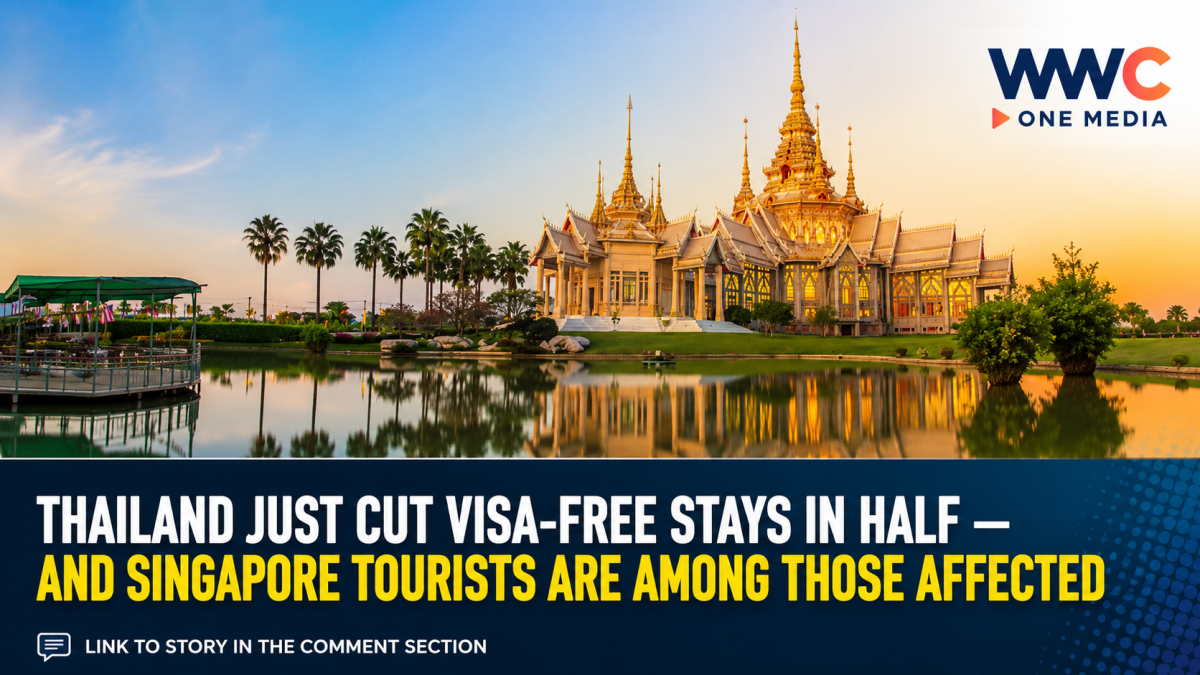
Thailand has tightened its visa-exemption rules, cutting the maximum visa-free stay for tourists from 60 days to 30 days for citizens of 60 countries and territories, including Singapore, the United States, India, the United Kingdom, Australia and much of the European Union.
The change marks a significant rollback of Thailand’s expanded 60-day visa-exemption policy, which was introduced in 2024 as part of efforts to encourage international tourism.
The latest rules were published by Thailand’s Interior Ministry in the Royal Gazette on August 31 and took effect on September 1, according to Thai media reports citing the official notification.
Singaporeans among those affected
Singapore passport holders remain eligible to enter Thailand without a visa for tourism, but the maximum stay under the new 30-day exemption is now shorter than the previous 60-day allowance.
The same 30-day limit applies to passport holders from a broad group of countries, including the Philippines, Malaysia, Indonesia, India, China-related policy references in earlier reporting, the United States, Canada, Japan, Australia, New Zealand and 27 European Union member states. The final Interior Ministry list contains 60 countries and territories.
The official list includes:
Australia, Austria, Bahrain, Belgium, Bulgaria, Bhutan, Brunei, Canada, Croatia, Cyprus, Czech Republic, Denmark, Estonia, Fiji, Finland, France, Georgia, Germany, Greece, Hungary, Iceland, Indonesia, India, Ireland, Israel, Italy, Japan, Jordan, Kuwait, Kyrgyz Republic, Latvia, Liechtenstein, Lithuania, Luxembourg, Malta, Malaysia, Maldives, Netherlands, New Zealand, Norway, Oman, Philippines, Poland, Portugal, Qatar, Romania, Saudi Arabia, Singapore, Slovakia, Slovenia, South Africa, Spain, Sweden, Switzerland, Taiwan, Türkiye, Ukraine, United Arab Emirates, United Kingdom and United States.
Why is Thailand tightening the rules?
Thai authorities say the changes are intended to prevent misuse of visa privileges while balancing tourism, economic interests, national security and international relations.
Thailand’s government previously said the 60-day exemption could create loopholes that allowed some foreign nationals to stay longer than necessary for tourism or use the system for activities outside its intended purpose. Authorities have also raised concerns about foreigners becoming involved in illegal activities or operating businesses without the required permits.
The policy review follows a series of measures aimed at tightening immigration controls and improving screening of foreign visitors.
Thailand’s government has also said it intends to strengthen the Thailand Digital Arrival Card system and improve information-sharing between agencies to better assess travelers and monitor the use of immigration privileges.
A major change from Thailand’s 2024 tourism push
The latest move reverses a key part of Thailand’s previous strategy to make the country more attractive to long-stay international visitors.
In 2024, Thailand expanded visa-free access to more than 90 countries and territories and allowed eligible travelers to stay for up to 60 days. The policy was designed to support tourism and economic activity following the pandemic. Reuters reported in May that Thailand’s Cabinet had approved the rollback after authorities cited security, reciprocity and concerns about misuse of the exemption system.
The government has now moved toward a more country-specific system, following its stated principle of “one country, one entitlement.”
Not everyone is losing days
The changes are not simply a blanket reduction for every nationality.
While citizens of the 60 countries on the new 30-day list face a shorter visa-free stay, Thailand has created different arrangements for certain nationalities.
According to CNA, travelers from Peru, Brazil and South Korea will receive visa-free stays of up to 90 days, compared with 60 days previously.
Thailand’s broader policy revision also introduced different visa-exemption categories, including shorter stays for selected countries, reflecting the government’s decision to tailor privileges according to individual countries rather than maintain one broad 60-day scheme.
What about travelers already in Thailand?
Travelers who entered Thailand under the previous rules before the new measures took effect are not automatically required to leave simply because the policy has changed.
Thailand’s government previously stated that foreigners who entered under the existing scheme before the new notification became effective could remain until the expiration of their permitted stay.
For travelers planning a new trip, however, the relevant rule is the one in force when they enter Thailand.
Land-border travelers face another restriction
There is another important change that could affect frequent travelers.
Under the new rules, visa-exempt travelers entering Thailand through land-border immigration checkpoints are generally limited to two visa-exempt entries per calendar year.
However, the restriction does not apply to nationals of Malaysia, Brunei Darussalam, Indonesia or Singapore. The Interior Ministry notification also allows other nationalities designated by the Interior Minister to receive an exception.
That exemption is particularly relevant for Singaporeans and other travelers who regularly cross Thailand’s land borders.
Thailand’s tourism industry faces a delicate balancing act
The timing of the policy change is significant.
Thailand remains heavily dependent on international tourism, but visitor numbers have faced pressure this year. CNA reported that Thailand had received approximately 20.9 million foreign tourists since the beginning of 2026, about 3% lower than the same period in 2025.
Reuters had earlier reported that Thailand’s tourism authorities were also dealing with weaker arrivals, with the country’s state planning agency forecasting around 32 million foreign visitors for 2026, below the roughly 33 million recorded the previous year.
That creates a difficult policy balance: Thailand wants to keep attracting legitimate tourists while making it harder for visitors to exploit visa-free entry for purposes unrelated to tourism.
What travelers should do now
For anyone planning a Thailand trip, the safest approach is to check the visa rules applicable to their specific passport and intended method of entry before traveling.
For Singaporean tourists, the key takeaway is straightforward: visa-free entry remains available, but the standard tourist exemption is now capped at 30 days under the new Interior Ministry notification.
Travelers intending to stay longer should investigate the appropriate visa or extension options rather than assume that the former 60-day visa-free allowance still applies.
And for frequent border runners, the land-entry rules deserve particular attention because Thailand has introduced additional restrictions for many nationalities.
Thailand’s message is increasingly clear: the country remains open to international tourism, but the era of broadly generous visa-free stays is being replaced by a more controlled and country-specific system.
For travelers, the question is no longer simply whether Thailand is visa-free — it is how long you can legally stay, how you enter, and which rules apply to your passport.
WWC ONE MEDIA MJE

Leave a Reply