
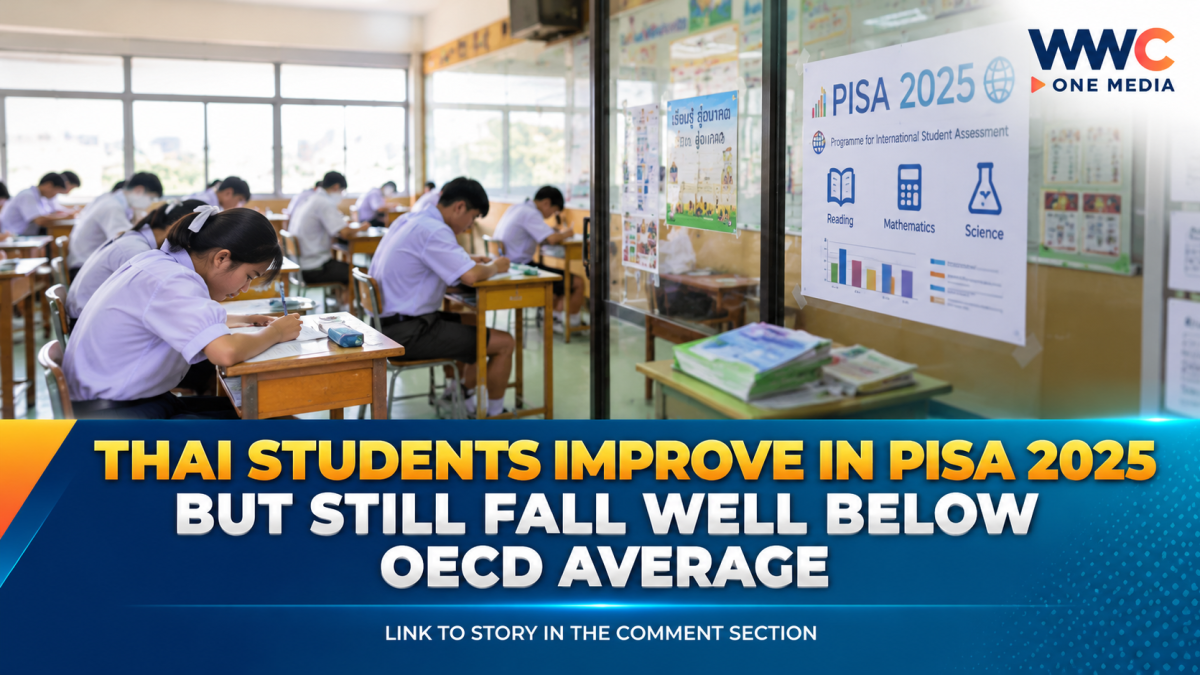
BANGKOK — Thai students have improved their performance since the last round of international PISA testing, but the country’s 15-year-olds still scored well below the OECD average in science, mathematics and reading.
The latest results have once again put Thailand’s education system under the spotlight.
PISA 2025, the OECD’s global assessment of 15-year-old students, found that Thailand recorded gains in all three core subjects compared with 2022.
But the improvement was not enough to close the gap with wealthier and higher-performing education systems.
Thai students scored an average of:
- 432 points in science
- 407 points in mathematics
- 392 points in reading
The OECD averages were:
- 482 points in science
- 463 points in mathematics
- 461 points in reading
Thailand also scored below the OECD average in computational problem-solving.
The results present a mixed picture.
Thailand is improving.
But it is still significantly behind.
Thai students bounce back from PISA 2022
There is some encouraging news in the latest results.
Thailand’s average performance in mathematics, reading and science increased compared with PISA 2022.
According to the OECD, the gains reversed part of the losses recorded in previous years.
Science showed a particularly strong improvement between 2022 and 2025, rising by 23 points.
However, Thailand has not yet fully recovered from its longer-term decline.
The OECD said that despite recent improvements:
- Science and reading results remained below their 2015 levels.
- Science also remained below its 2018 level.
That means the latest improvement is a recovery rather than evidence that Thailand has solved its deeper education challenges.
The numbers show a significant gap
The gap between Thailand and the OECD average remains substantial.
Reading remains Thailand’s weakest core area relative to the OECD average.
A gap of 69 PISA points is particularly significant because reading is closely connected to learning across nearly every other subject.
Students who struggle to understand, analyse and evaluate written information may also face difficulties in science, mathematics and problem-solving.
The latest OECD results therefore raise questions not only about examination performance but also about how well students are developing the foundational skills needed for higher education and the modern workforce.
More than four in 10 Thai students are low performers in science
The latest results also highlight the scale of the challenge.
In science, 41% of students in Thailand were classified as low performers.
The OECD average was 25.7%.
At the other end of the scale, only 0.8% of Thai students were top performers, reaching PISA Levels 5 or 6.
The OECD average was 7.2%.
The numbers reveal a difficult problem for Thailand’s education system.
It is not simply about producing more elite students.
A large proportion of students are still struggling to reach higher levels of foundational proficiency.
And at the same time, Thailand has relatively few students performing at the very top internationally.
Thailand’s reading score is a major concern
Thai students recorded an average reading score of 392.
That was well below the OECD average of 461.
Reading performance is increasingly important in a world where students are expected to process enormous amounts of information online.
Modern literacy involves more than simply reading words.
Students increasingly need to:
- Understand complex texts
- Identify reliable information
- Evaluate claims
- Compare sources
- Detect misinformation
- Summarise information
- Think critically
The OECD’s wider PISA 2025 report found that reading performance across participating education systems has fallen sharply over recent years.
The OECD average for reading in 2025 was the lowest recorded so far, reflecting a broader global challenge.
But Thailand’s score remains significantly below even that weakened international benchmark.
Mathematics remains another major challenge
Thai students scored an average of 407 points in mathematics.
The OECD average was 463.
The result is an improvement over Thailand’s PISA 2022 performance, when the country scored 394 in mathematics.
But the gap remains wide.
Mathematics is particularly important because it measures more than the ability to memorise formulas.
PISA examines whether students can apply mathematical knowledge to real-world situations.
This includes the ability to:
- Interpret data
- Solve unfamiliar problems
- Understand relationships
- Use mathematical reasoning
- Apply knowledge in practical situations
These are also skills increasingly demanded by modern economies.
Thailand’s education problem is not new
The latest PISA results follow years of warnings about weaknesses in Thailand’s education system.
UNICEF Thailand said earlier this year that Thai children were falling behind and that education reform was urgently needed to equip young people with future-ready skills.
It pointed to the country’s weak PISA 2022 performance and the large number of students who had failed to reach baseline proficiency in key subjects.
The OECD has also previously identified broader challenges involving:
- Educational inequality
- Student engagement
- Teacher shortages
- Skills mismatches
- Differences between schools
- Weak connections between education and future employment
These problems cannot be solved simply by changing one examination or introducing a new curriculum.
They involve the entire education system.
Thailand’s students are using AI more than the OECD average
One of the most interesting findings from PISA 2025 concerns artificial intelligence.
Thai students reported relatively high use of AI chatbots for schoolwork.
According to the OECD:
- 51% of Thai students used AI chatbots to help them learn at least once a week.
- The OECD average was 46%.
- 41% used AI for preliminary research on new topics.
- 42% used AI to summarise texts they had to read.
- 41% used AI to draft writing assignments.
Only 4% of Thai students said they never or almost never used AI chatbots for the schoolwork tasks examined.
The OECD average was 14%.
That creates both an opportunity and a challenge.
AI can potentially help students:
- Explore difficult topics
- Receive personalised explanations
- Conduct research
- Practise skills
- Generate ideas
But heavy reliance on AI can also create problems if students use it to avoid thinking, reading and problem-solving independently.
Smartphones may also be part of the discussion
PISA 2025 also showed that Thailand had relatively limited school-level restrictions on smartphone use.
Only 8% of Thai students attended schools with a smartphone ban in 2025.
The OECD average was 49%.
This does not automatically mean smartphones are the reason for Thailand’s lower scores.
Education performance is influenced by many factors.
But the growing debate over digital distraction is likely to become increasingly important.
The wider PISA findings have raised concerns that excessive screen use, social media and poorly managed technology use can affect students’ ability to focus and engage deeply with learning.
The challenge for Thailand may therefore be finding the right balance.
Technology should support learning — not replace learning.
The results come as global scores also decline
Thailand is not alone in facing education challenges.
PISA 2025 recorded the lowest OECD-average performance so far in science, reading and mathematics.
Reading has declined significantly since its peak around 2012.
Science has gradually weakened over the past decade.
Mathematics fell especially sharply after 2018.
That means Thailand’s problem exists within a wider global education crisis.
But this also creates an important distinction.
The OECD average is falling — and Thailand is still below it.
So while global performance has weakened, Thailand still faces the challenge of catching up.
Singapore and East Asia remain among the world’s top performers
The latest PISA results once again showed the strength of several East Asian education systems.
Singapore and B-S-J-Z China were the two highest-performing systems across science, mathematics and reading.
Other strong performers included:
- Japan
- South Korea
- Chinese Taipei
- Macao
- Estonia
- The United Kingdom
These systems continue to demonstrate that high international performance remains possible despite the broader global decline.
For Thailand, the comparison is particularly relevant.
The country is competing for investment and economic growth in the same region as some of the world’s strongest education systems.
A country’s future workforce increasingly determines its ability to compete in:
- Artificial intelligence
- Technology
- Advanced manufacturing
- Digital services
- Science
- Engineering
- Research
That means education performance is not just a classroom issue.
It is also an economic issue.
More than 540,000 Thai students were represented
The OECD said that 8,547 students from 273 schools in Thailand completed the PISA 2025 assessment.
The sample represented approximately 542,700 15-year-old students.
PISA does not simply measure how much information students can memorise.
The assessment is designed to examine how well students can apply knowledge, solve problems, think critically and communicate effectively.
That makes the results particularly relevant in an era when technology and AI can provide information instantly.
The question is increasingly not:
Can students find information?
But:
Can they understand it, question it and use it effectively?
Can Thailand close the gap?
Thailand’s improvement since 2022 suggests progress is possible.
But closing the gap with the OECD average will likely require deeper reforms.
Areas likely to remain central to the discussion include:
Improving foundational skills
Students need stronger reading, mathematics and science skills from an early age.
Supporting teachers
Teacher quality, training and workloads remain critical to student outcomes.
Reducing inequality
Students in different regions and socio-economic groups do not always have equal access to educational resources.
Improving student engagement
Students need to understand how learning connects to their future lives and careers.
Using technology effectively
AI and digital tools need to support critical thinking rather than replace it.
Preparing students for future jobs
Schools need to develop problem-solving, communication, adaptability and digital skills alongside traditional academic knowledge.
The OECD has previously highlighted concerns that some Thai students do not strongly connect their education with life outside school or their future careers.
The latest results are better — but the warning remains
The most important takeaway from PISA 2025 is that Thailand has reason for cautious optimism.
The country improved in all three core subjects compared with 2022.
That is significant.
But the improvement should not hide the larger problem.
Thai students remain well below the OECD average in:
- Science
- Mathematics
- Reading
The largest gap is in reading.
Thailand also has a high proportion of low-performing students and a relatively small proportion of top performers.
The bottom line
Thailand’s PISA 2025 results show progress — but not enough progress.
Thai students are doing better than they did in 2022.
Science, mathematics and reading scores have all improved.
But Thailand still scored:
- 50 points below the OECD average in science
- 56 points below in mathematics
- 69 points below in reading
The results underline a difficult reality for Thailand.
The country is moving forward, but the education systems it is trying to catch are still ahead.
And with artificial intelligence, automation and advanced technology rapidly changing the global economy, the pressure to close that gap may only become greater.
Thailand’s education challenge is no longer simply about helping students pass exams.
It is about ensuring the next generation has the skills to compete in a world that is changing faster than ever.
WWC ONE MEDIA J.M.D




Leave a Reply