
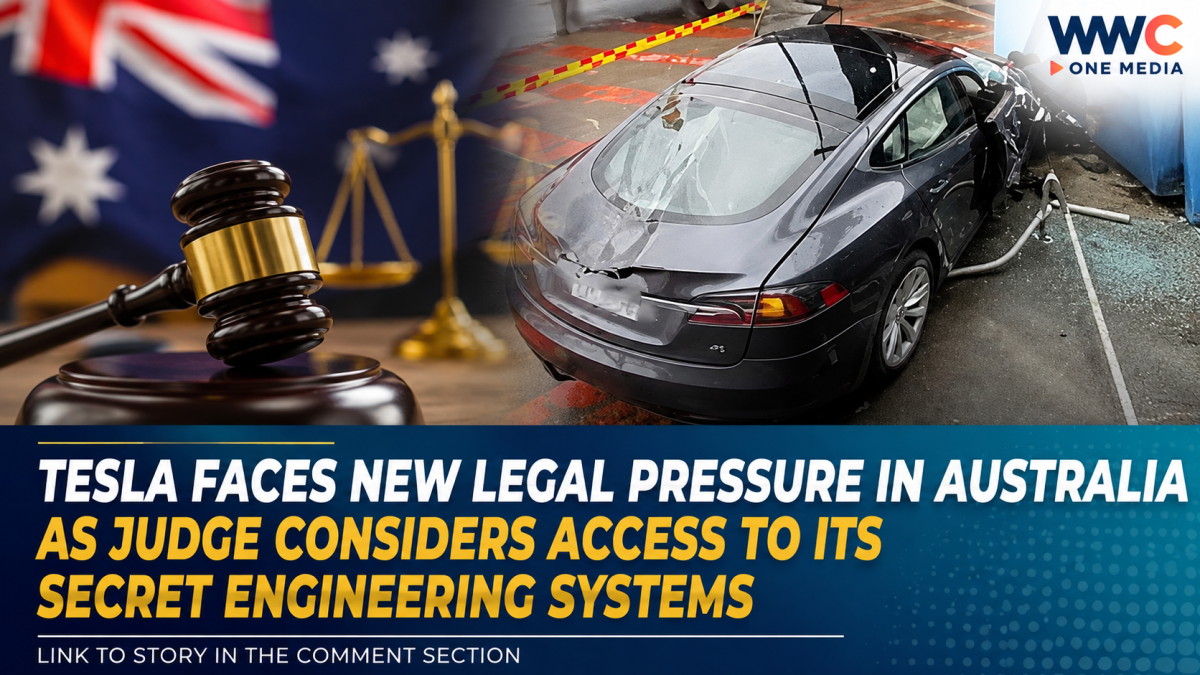
SYDNEY — Tesla is facing another major legal hurdle in Australia after a Federal Court judge suggested that an independent expert could be given access to the company’s internal engineering systems as part of a class-action lawsuit involving thousands of Tesla owners.
The proposal by Federal Court Judge Tom Thawley could change the way the long-running case handles the discovery of technical evidence, potentially allowing an independent expert to examine Tesla’s engineering platforms directly rather than relying solely on documents supplied by the electric-car maker.
The class action, filed in February 2025, involves allegations concerning Tesla Model 3 and Model Y vehicles. Plaintiffs claim the vehicles can experience so-called “phantom braking,” while also alleging that Tesla overstated battery-range performance and the capabilities of its driver-assistance and self-driving technology. These remain allegations that have not been proven in court.
Judge considers direct access to Tesla’s systems
The latest development came after lawyers representing approximately 10,000 Tesla owners argued that documents already provided by the company did not contain enough technical information to properly prepare their case.
Judge Thawley suggested that appointing an independent expert, agreed upon by the parties or selected by the court, could help resolve the dispute.
The judge indicated that an expert with appropriate authority to examine Tesla’s engineering systems could potentially avoid a prolonged fight over which documents should be produced.
Tesla, however, has raised concerns about the confidentiality of its internal systems.
The company has maintained that it has provided thousands of documents in good faith. Tesla has also argued that much of its engineering information is stored in continuously updated software platforms rather than traditional documents that can simply be retrieved as historical records.
What is “phantom braking”?
At the heart of the lawsuit is a phenomenon commonly referred to as phantom braking—a sudden braking event that drivers say can occur when the vehicle apparently detects a hazard that is not actually present.
Australian media previously reported accounts from Tesla owners who said their vehicles unexpectedly slowed or braked while travelling at highway speeds.
ABC News reported in 2025 that approximately 10,000 Australian Tesla drivers had registered interest in the class action, with allegations also involving battery range and representations about Autopilot and autonomous-driving capabilities.
The case concerns vehicles including Model 3 and Model Y models and allegations surrounding Tesla Vision, battery-range representations and the operation of driver-assistance features.
Importantly, the lawsuit does not establish that every Tesla vehicle has a defect or that the allegations have been proven. The claims will ultimately have to be tested through the Australian court process.
Tesla’s discovery battle
The latest court development follows months of disagreement over the amount and type of information Tesla should provide.
In May, Judge Thawley criticized the pace of the discovery process after plaintiffs’ lawyers complained that Tesla had produced only around 2,000 documents after months of proceedings.
Tesla’s lawyers, meanwhile, said the company had reviewed roughly 100,000 documents and still had tens of thousands more to examine, citing the scale of the material and confidentiality considerations.
That dispute has now led to the possibility of a different approach: instead of continuing a lengthy document-by-document battle, an independent technical expert could potentially examine Tesla’s underlying engineering platforms and identify information relevant to the case.
What happens next?
No final order granting such access has been made at this stage.
Both sides are expected to consider the judge’s proposal. The plaintiffs’ lawyers have indicated that they see value in the independent-expert approach, while Tesla’s representatives have said they will consider it and have emphasized the confidential nature of the company’s systems.
The case is scheduled to return to court on November 12, 2026.
For Tesla owners and the broader electric-vehicle industry, the next stage could be significant. If the court ultimately grants an independent expert meaningful access to Tesla’s engineering systems, the move could provide plaintiffs with a much deeper look at the technical evidence behind their allegations.
But for now, the court has not ruled that Tesla’s vehicles are defective, nor has it ordered the company to open its engineering systems. The legal battle remains ongoing.

Leave a Reply