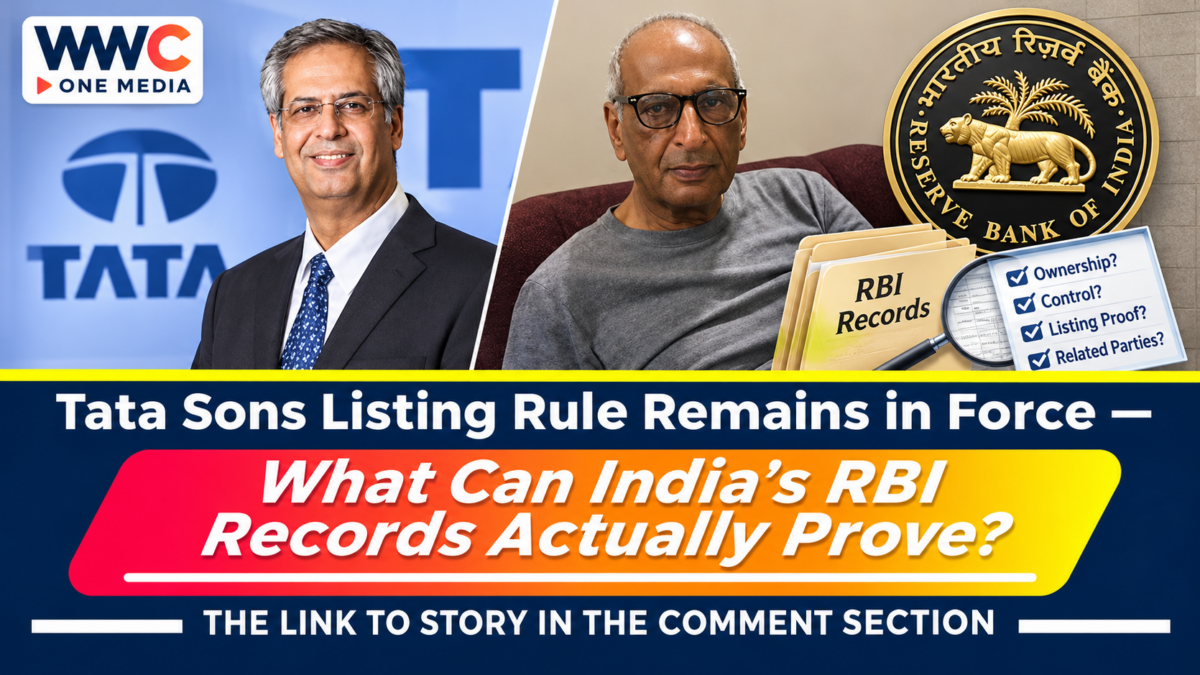
MUMBAI, India — India’s Reserve Bank continues to identify Tata Sons Private Limited as an upper-layer non-banking financial company in its published 2026–27 regulatory list. As debate over a Tata Sons listing intensifies on Nov. 17, 2026, the central bank’s standing governance directions require upper-layer institutions to list within three years of identification, although the latest reported correspondence has not been independently published in the official records reviewed.
The verified issue is broader than one letter: Tata Sons is a privately held investment company at the centre of a major conglomerate, while India’s supervisory framework attaches obligations to its size and regulatory classification. A binding rule, a reported reminder and a completed public offering are three different things.
Tata Sons listing: What the RBI’s rules require
Paragraph 43 of the Reserve Bank’s governance directions, updated June 24, 2026, requires upper-layer non-banking financial companies to be listed within three years of identification. The rule also provides for disclosure requirements modelled on those for listed companies before shares actually begin trading.
An upper-layer NBFC is not necessarily an ordinary deposit-taking bank. It is part of a risk-based supervisory classification for non-bank financial institutions. The listing provision forms part of a wider package dealing with governance, board competence and regulatory reporting.
Tata Sons was explicitly named as a core investment company in the RBI’s first published upper-layer list on Sept. 30, 2022. It appeared again in the central bank’s Aug. 6, 2026 list, alongside Tata Capital Limited, which the RBI identified separately as an investment and credit company.
These records establish that the group parent remains included in the supervisory framework. They do not provide an IPO prospectus, proposed offer size, stock-market valuation or guaranteed first trading date.
The 2026 classification contains an important footnote
The RBI’s Aug. 6 list included a qualification concerning Tata Sons: its inclusion was without prejudice to the outcome of a deregistration application that was still being examined when the notice was issued.
That makes the document more informative than a simple list of names. It shows that a regulatory question was open at that particular date, while the company was still being identified in the upper layer.
Subsequent descriptions of the application’s outcome and of a Nov. 16 letter have appeared publicly, but the actual RBI decision on the application and the reported letter were not available as first-party documents for this review. Neither an exemption refusal nor the precise terms of the alleged new communication is independently asserted here.
Analysis: An official list and an official rule are sufficient to explain the general listing obligation. They are not sufficient to resolve every company-specific procedural issue without the relevant decision and any applicable relief or directions.
Why Tata Sons is unlike an ordinary IPO candidate
Tata Sons describes itself as the principal investment holding company and promoter of Tata companies. Its corporate site says philanthropic trusts hold 66% of its equity capital, while operating companies have their own boards and decision-making structures.
This matters because a public listing of the parent would not be the same event as a new share sale by every Tata operating company. It would involve ownership and disclosure at the holding-company level, where the trusts and minority shareholders exercise their respective rights.
The group’s own descriptions of its charitable shareholders and operating-company independence help explain the questions raised in WWC’s earlier coverage of Tata Trusts and the group’s governance debate. Those earlier controversies are context, not evidence that any shareholder has violated an RBI rule.
Nor does a regulatory listing requirement alone disclose whether existing shareholders would sell shares, how many shares would enter public hands or how proceeds would be used. Those would be matters for actual transaction documents if a listing proceeds.
How governance and public disclosure connect
The RBI’s upper-layer governance chapter addresses the qualifications of board members and reporting where an independent director leaves before completing a normal term. Its broader directions also call for an internal governance policy and oversight of important risks.
The listing clause adds an external transparency dimension: before shares trade, affected institutions are expected to put comparable disclosure arrangements in place under a board-approved policy.
Analysis: For investors, stronger disclosure can make a complicated holding structure easier to examine. It does not erase disputes over control, guarantee an attractive valuation or prove that the market will reward a listing.
WWC has previously explored the debate about Tata Sons board authority. The legal validity of disputed decisions should be assessed through the company’s governing instruments and any actual regulatory or court findings, rather than inferred from competing statements alone.
What shareholders and investors should watch
The RBI’s June 2026 framework amendment set an asset-size threshold of ₹1,00,000 crore for upper-layer identification based on the latest audited balance sheet. The Aug. 6 list subsequently identified Tata Sons under that revised approach.
A company’s inclusion and its duty to comply with governance requirements should not be confused with the valuation of a possible IPO. A holding company can have exposures to many operating businesses, but those investments carry different financial risks and governance arrangements.
That separation also matters when discussing governance questions around Air India investment. A discussion about an operating company’s financing is not itself evidence of the terms of a future Tata Sons offering.
Analysis: A serious assessment of a potential listing would need financial statements, shareholder agreements, an offer document and a clear explanation of how new public shareholders would participate. None of those should be replaced with speculative IPO-price predictions.
What happens next
The next decisive documents would be an officially accessible RBI communication resolving the company-specific listing position, a formal Tata Sons filing describing a proposed offering, or another disclosed regulatory development. Any timetable should be checked against those records rather than assumed from media reports.
For now, the narrow conclusion is firm: the RBI’s published regulations contain a listing requirement for upper-layer NBFCs, and Tata Sons appears in its current upper-layer list. The specific Nov. 16 letter remains unverified as a primary document, and no completed listing is established by the records reviewed.
FAQ
Is Tata Sons currently listed on a stock exchange?
No public listing of Tata Sons was established in the official materials reviewed. The company continues to identify itself as a privately held investment holding company.
Why does the RBI require certain NBFCs to list?
The listing rule is part of enhanced oversight for upper-layer non-bank financial companies. It accompanies governance and disclosure requirements.
When was Tata Sons first classified as an upper-layer NBFC?
It was included in the RBI’s Sept. 30, 2022 published list as a core investment company.
Does the reported Nov. 16 letter announce an IPO date?
No IPO date has been verified from an official document. The reported letter itself was not independently retrieved as a primary record.
Does Tata Trusts own the entire company?
No. Tata’s official corporate description says philanthropic trusts collectively hold 66% of Tata Sons’ equity, not 100%.