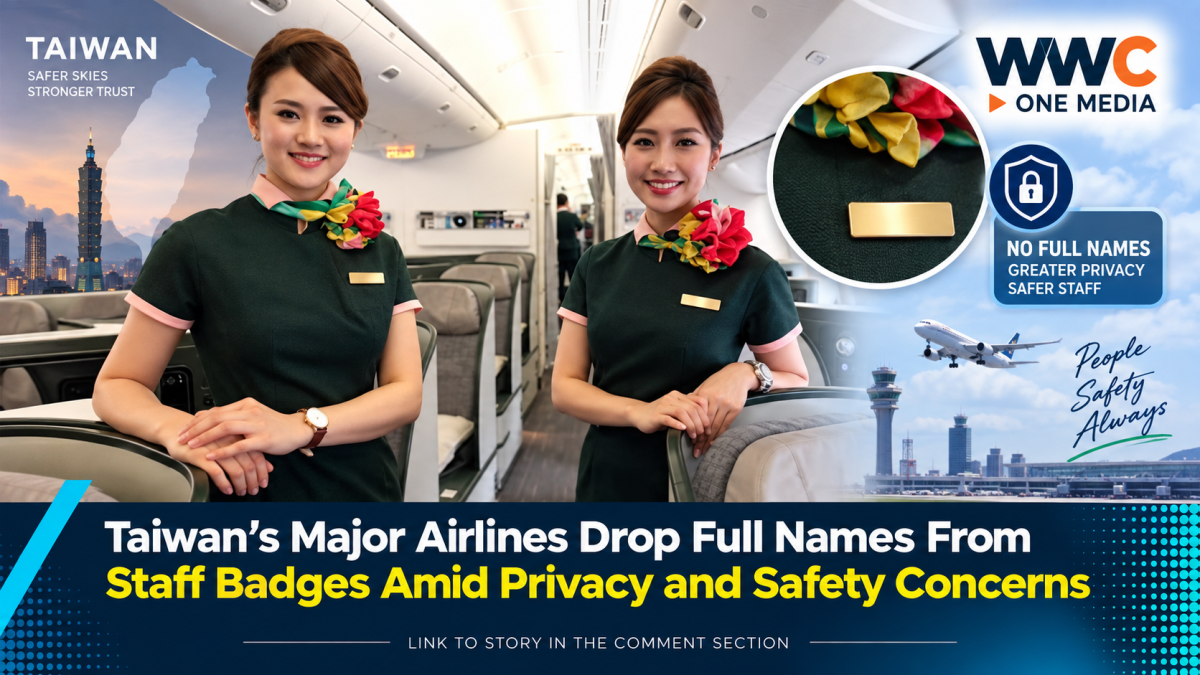
TAIPEI — Taiwan’s three major international airlines are changing the way frontline employees identify themselves at work, moving away from displaying their full Mandarin names on staff badges amid growing concerns over harassment, online exposure and personal safety.
China Airlines, EVA Air and STARLUX Airlines have agreed to revise their employee badge policies following a campaign led by the Taoyuan Flight Attendants Union and other aviation labor groups.
The move follows concerns that displaying a worker’s complete name can make it easier for customers to identify, photograph and search for employees online—potentially exposing them to unwanted contact, public shaming, stalking or other forms of harassment.
Why Taiwan’s Airlines Are Changing Name Badges
The campaign gained momentum after aviation unions highlighted concerns over the privacy of frontline workers.
According to reporting cited by Taiwan News, nearly 40% of surveyed workers said they had experienced harassment associated with name badges, while more than 98% supported removing employees’ full names from badges.
Unions argued that a name badge intended to identify an employee can also become a tool for locating personal information when combined with social media and other publicly available data.
The concerns extend beyond airlines.
Taiwanese unions have pointed to similar privacy issues affecting workers in industries such as postal services, banking, restaurants and rail transportation, where employees regularly interact directly with the public.
China Airlines Will Use Surnames and Abbreviated Names
China Airlines announced on Aug. 26 that it would change the identification format used by frontline personnel.
Instead of displaying a complete Mandarin name, badges will show a Mandarin and English surname, together with either an abbreviated English given name or a foreign-language alias.
Replacement badges are scheduled to be issued in stages beginning in March 2027.
The same arrangement will also be adopted by Mandarin Airlines, a China Airlines subsidiary.
The change is intended to preserve the ability to identify employees while limiting the amount of personal information publicly displayed.
EVA Air Is Making a Similar Change
EVA Air has also agreed to revise its badge system.
Under its planned format, employees will display either a Mandarin or English surname alongside an employee identification number, rather than their complete Mandarin name.
The airline said replacement badges are expected to be issued during the first half of 2027.
The approach gives passengers a way to identify the employee handling their service while reducing the amount of information that can be immediately connected to the individual’s identity.
STARLUX Joins the Change
STARLUX Airlines notified its enterprise union on Sept. 2 that it had agreed to revise its badge format as well.
Details were still being finalized, but the airline said the proposed system would use flight attendants’ English aliases together with their Mandarin surnames, without displaying their Mandarin given names.
Replacement badges are expected to be introduced gradually starting next year.
The three airlines’ decisions prompted aviation unions to cancel a planned news conference at Taiwan’s Ministry of Labor, after the carriers agreed to address the badge issue.
Tigerair Taiwan Started the Trend Earlier
The change is not completely new to Taiwan’s aviation industry.
Tigerair Taiwan had already announced earlier in 2026 that it would remove Mandarin surnames from its work badges and instead use English aliases.
That made Tigerair an early example of an airline attempting to balance passenger-facing identification with employee privacy.
The latest decisions by the country’s three major international carriers now expand that approach across a much larger portion of Taiwan’s commercial aviation workforce.
The Privacy Problem Goes Beyond Name Tags
The debate is not simply about whether customers should know an employee’s name.
Unions say the concern is what can happen after a name is photographed or posted online.
A person who knows an employee’s full name may potentially search social-media accounts, identify photographs or attempt to contact the worker outside the workplace.
The unions cited an example involving a postal worker whose name was photographed by a customer and subsequently posted on Threads in connection with comments about the employee’s appearance.
Such incidents have contributed to concerns among frontline workers about harassment and unwanted attention.
Airlines Are Trying to Balance Privacy and Accountability
The revised badge systems do not mean employees will become completely anonymous.
Instead, the airlines are moving toward partial identification, such as surnames, aliases, abbreviated names or employee numbers.
That creates a middle ground between protecting personal information and maintaining accountability in customer-service environments.
For passengers, the employee can still be identified through workplace information. For workers, however, fewer personal details are immediately exposed to strangers.
A Wider Workplace Privacy Debate
Taiwan’s airline badge changes reflect a broader question facing customer-facing industries: how much personal information should employees be required to display simply because they work with the public?
Digital platforms have made it easier for information collected in one setting to follow someone into another.
A name printed on a uniform may once have been primarily useful for customer service. Today, it can potentially become the starting point for finding someone’s online presence.
That has pushed unions and employers to reconsider traditional identification practices.
What Happens Next
The revised policies will not take effect simultaneously.
China Airlines plans phased badge replacements from March 2027, while EVA Air expects its new badges during the first half of 2027. STARLUX is also preparing a gradual rollout beginning next year.
The changes mark a significant shift in how Taiwan’s major airlines approach frontline employee identification.
Rather than putting a worker’s full name on display, the new systems are designed to provide enough information for workplace identification while limiting unnecessary exposure of personal details.
For Taiwan’s flight attendants and other frontline aviation employees, the humble name badge is becoming something more than an identification tool—it is now part of a much larger debate over privacy, digital harassment and workplace safety in the social-media era.