
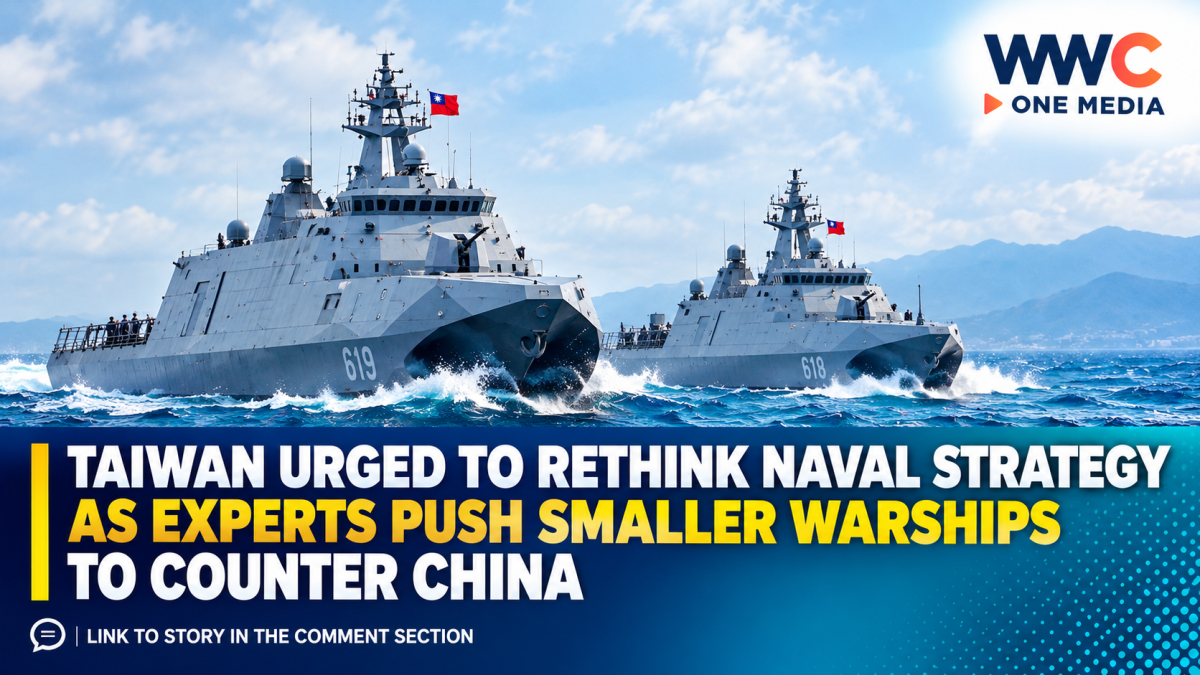
TAIPEI — Taiwan may need to rethink what its navy should look like if it wants to withstand a potential Chinese attack—and defense experts say the answer may not be bigger warships.
Instead, Taiwan should consider building a fleet centered on smaller, stealthier and heavily armed corvettes, supported by drones, missiles, submarines and a stronger network of sensors, according to defense analyst Holmes Liao and former U.S. Director of National Intelligence Dennis Blair.
In an article published by Foreign Affairs, the two authors argued that Taiwan’s naval strategy should place greater emphasis on numerous smaller platforms capable of operating independently while working together against a much larger adversary.
The proposal comes as Taiwan accelerates a broader military modernization effort amid growing pressure from China.
Why smaller ships?
The argument is rooted partly in lessons from the war in Ukraine.
Liao and Blair pointed to Ukraine’s campaign against Russia’s Black Sea Fleet as evidence that a smaller military does not necessarily need to achieve traditional control of the sea to make a powerful naval force vulnerable.
Ukraine has used anti-ship missiles, uncrewed surface vessels, drones and intelligence support to disrupt Russian naval operations.
For Taiwan, the authors argue that a similar concept could make sense in the Taiwan Strait, where geography and the island’s relatively constrained operating space could favor distributed, harder-to-detect forces rather than a small number of expensive major warships.
Their proposal calls for stealthy corvettes weighing roughly 700 to 1,000 tons, equipped with missiles and drones.
The objective would not be to defeat China’s much larger navy ship-for-ship.
Instead, the concept would be to create a network of smaller platforms capable of detecting, tracking and attacking hostile vessels while making it harder for an adversary to eliminate Taiwan’s entire maritime force in a single campaign.
Tuo Chiang-class ships already point in that direction
Taiwan already has a platform that fits much of this concept: the Tuo Chiang-class corvette.
The class uses a low-observable catamaran hull and is designed around speed, maneuverability and missile firepower.
The eighth vessel, ROCS Tan Chiang, entered service in July, and Taiwan expects all 12 ships in the planned class to be delivered and commissioned by the end of 2026.
The ships are capable of carrying Taiwan’s Hsiung Feng family of anti-ship missiles. Taipei Times reported that the Tuo Chiang-class can employ the Hsiung Feng III extended-range supersonic missile against sea and land targets.
That makes the class particularly relevant to the debate over whether Taiwan should invest more heavily in smaller missile vessels instead of concentrating resources on larger ships.
Liao and Blair argue that Taiwan’s domestic shipbuilding industry could produce such vessels relatively quickly and become more efficient as production expands.
They also criticized Taiwan’s plans for larger light frigates, arguing that larger and more expensive ships could become attractive targets in a conflict with China. Importantly, that is the authors’ assessment, not an announcement that Taipei has canceled its frigate program.
Taiwan is already building a drone-heavy defense network
The proposed naval shift would not rely on ships alone.
Taiwan’s military is already moving aggressively toward greater use of unmanned systems.
The Navy recently disclosed plans to acquire 32 domestically developed Albatross II drones and 280 U.S.-made V-BAT vertical-takeoff-and-landing drones between 2026 and 2029.
The program is intended to strengthen maritime surveillance, reconnaissance and target identification.
The Albatross II is designed with modular payloads and can remain airborne for up to 16 hours, while the V-BAT can take off and land vertically and operate in environments affected by GPS interference and communications jamming, according to Taiwan News’ report based on CNA information.
That matters because a distributed fleet of small warships becomes considerably more effective when it can receive information from a distributed network of drones and sensors.
In simple terms, the concept is not merely more small ships.
It is more eyes, more sensors and more weapons spread across more platforms.
Submarines would add another layer
The proposed approach would also complement Taiwan’s submarine program.
Taiwan’s first domestically built submarine, the Hai Kun, has been undergoing sea trials after beginning submerged testing in January.
The submarine program is intended to give Taiwan another way to threaten hostile naval forces beneath the surface.
Liao and Blair argue that submarines and missile-armed corvettes could perform complementary roles: smaller surface vessels could attack targets above the waterline while submarines provide an underwater threat.
The authors also envision drones and missiles as critical components of the broader network.
Taiwan is already practicing this kind of warfare
The concept is not entirely theoretical.
During Taiwan’s 2026 Han Kuang military exercises, the armed forces practiced coastal-defense scenarios involving missile boats, drones and Coast Guard vessels.
President Lai Ching-te observed one of the coastal strike drills, which simulated responses to a potential Chinese amphibious attack. Reuters reported that low-flying attack drones and Anping-class Coast Guard vessels participated in the exercises.
Taiwan’s Anping-class vessels are based on the Tuo Chiang design, reinforcing the island’s broader movement toward fast, maneuverable maritime platforms that can support coastal defense.
Taiwan has also been developing unmanned surface vessels. Its Navy plans to pursue swarm capabilities for attack USVs, while the National Chung-Shan Institute of Science and Technology is producing large numbers of unmanned surface vessels for several military commands.
The bigger problem: China has overwhelming naval numbers
The strategic dilemma facing Taipei is straightforward.
China possesses a vastly larger naval force and significantly greater industrial capacity.
Trying to match that fleet ship-for-ship would require enormous resources—and could leave Taiwan dependent on a relatively small number of expensive assets.
The smaller-vessel concept therefore attempts to change the equation.
Instead of asking whether Taiwan can build a navy as large as China’s, the question becomes whether Taiwan can create enough mobile, distributed and difficult-to-destroy weapons platforms to make an invasion prohibitively costly.
That strategy resembles the broader asymmetric-defense philosophy Taiwan has increasingly emphasized.
But it also carries risks.
Smaller ships have less endurance and protection than major surface combatants, and their effectiveness depends heavily on reliable intelligence, communications, targeting information and missile supplies.
Recent analysis by the U.S. Naval Institute has also highlighted weaknesses in Taiwan’s maritime-domain-awareness architecture, including challenges involving drone readiness and operations in difficult weather and electronic-warfare environments.
A major strategic decision lies ahead
Liao and Blair acknowledge that transforming Taiwan’s navy would be difficult.
Moving away from traditional large warships would require political and military leaders to accept institutional change, investment risks and potentially significant criticism.
Their recommendation therefore should not be mistaken for a confirmed change in Taiwan’s defense policy.
It is a strategic proposal aimed at changing how Taiwan thinks about naval warfare against a much larger opponent.
What is already clear, however, is that several pieces of the proposed strategy are emerging simultaneously: Tuo Chiang-class corvettes, expanding drone fleets, unmanned vessels, submarines and increasingly integrated coastal-defense exercises.
The pieces are already on the board.
The bigger question is whether Taiwan will put them together into a fundamentally different kind of navy—and whether that smaller, more distributed force could provide enough deterrence against China’s vastly larger military.
That decision could shape Taiwan’s maritime defense for years to come.




Leave a Reply