
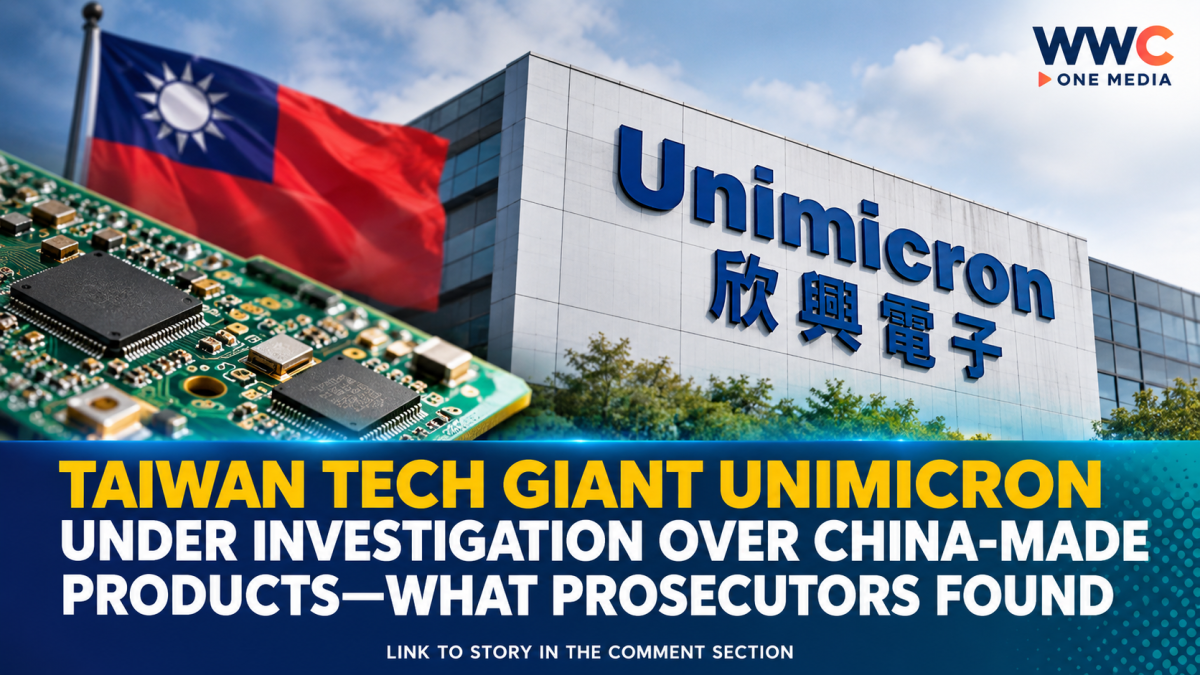
TAIPEI, Taiwan — One of Taiwan’s leading technology manufacturers is facing a growing legal investigation after prosecutors alleged that some printed circuit boards (PCBs) made in China may have been brought to Taiwan and falsely relabeled as locally made.
Unimicron Technology Corp., a major player in the global PCB and advanced semiconductor packaging supply chain, is under investigation by prosecutors in Taoyuan, who are examining allegations involving the country-of-origin labeling of some of the company’s products.
According to prosecutors, the company is suspected of shipping certain PCBs manufactured in China to Taiwan and changing their labels to indicate that they were made in Taiwan. Authorities said the alleged conduct could involve offenses related to forged documents and false product-origin markings.
The case remains under investigation, and the allegations have not been proven in court.
Raids Conducted, Executives Questioned
Investigators searched Unimicron’s headquarters in Taoyuan’s Guishan District and a manufacturing facility in Zhongli as part of the probe.
Taiwanese authorities questioned 14 executives and employees, according to the Taipei Times and CNA reporting. All were later released, with some released without bail and others granted bail ranging from NT$300,000 to NT$15 million.
A PCB division general manager surnamed Wang was released on NT$15 million bail, while a deputy general manager surnamed Wu was released on NT$12 million bail, prosecutors said.
Authorities have stressed that the investigation is continuing as they gather additional evidence and seek to determine the full scope of the alleged activity.
Why the Case Could Draw Global Attention
The investigation comes at a particularly sensitive time for Taiwan’s technology sector, which sits at the center of global supply chains for semiconductors, artificial intelligence hardware and advanced electronics.
PCBs are essential components that connect electronic parts inside everything from consumer electronics to high-performance computing systems. Unimicron is also a major supplier of Ajinomoto Build-up Film (ABF) substrates, a critical technology used in advanced semiconductor packaging for AI, high-performance computing and smartphones.
Industry reporting has highlighted strong demand for ABF substrates as the global AI boom drives increased production of advanced processors and servers. That makes scrutiny of a major supplier such as Unimicron significant for investors and the broader technology supply chain, even as the legal investigation remains unresolved.
Taiwan Cracks Down on Alleged ‘Origin Washing’
The case also shines a spotlight on a wider issue known as “origin washing”—the practice of allegedly changing or misrepresenting a product’s country of origin.
Reuters-based reporting said Taiwan has been increasing scrutiny of goods that may be routed through third countries or territories in ways that could obscure their actual origin, particularly amid heightened global trade tensions and tariffs involving Chinese-made products.
However, prosecutors have not publicly established that the alleged conduct involving Unimicron was connected to tariff avoidance or exports to any particular country. Those broader possibilities should therefore not be presented as facts in connection with this specific case unless confirmed by investigators.
Unimicron Says It Is Cooperating
Unimicron has said it is cooperating with authorities as the investigation proceeds. The company has not been found guilty of any wrongdoing, and prosecutors have said further investigation is needed.
The case now raises major questions about what investigators may uncover—and whether the allegations could have wider implications for Taiwan’s tightly watched technology manufacturing sector.
For now, the most important fact remains clear: this is an ongoing investigation, not a final judgment.
As prosecutors continue gathering evidence, the outcome could determine whether the case remains a corporate compliance issue—or develops into a much larger test of supply-chain transparency in one of the world’s most strategically important technology hubs.
The investigation is far from over—and the next findings could be the most important yet.




Leave a Reply