
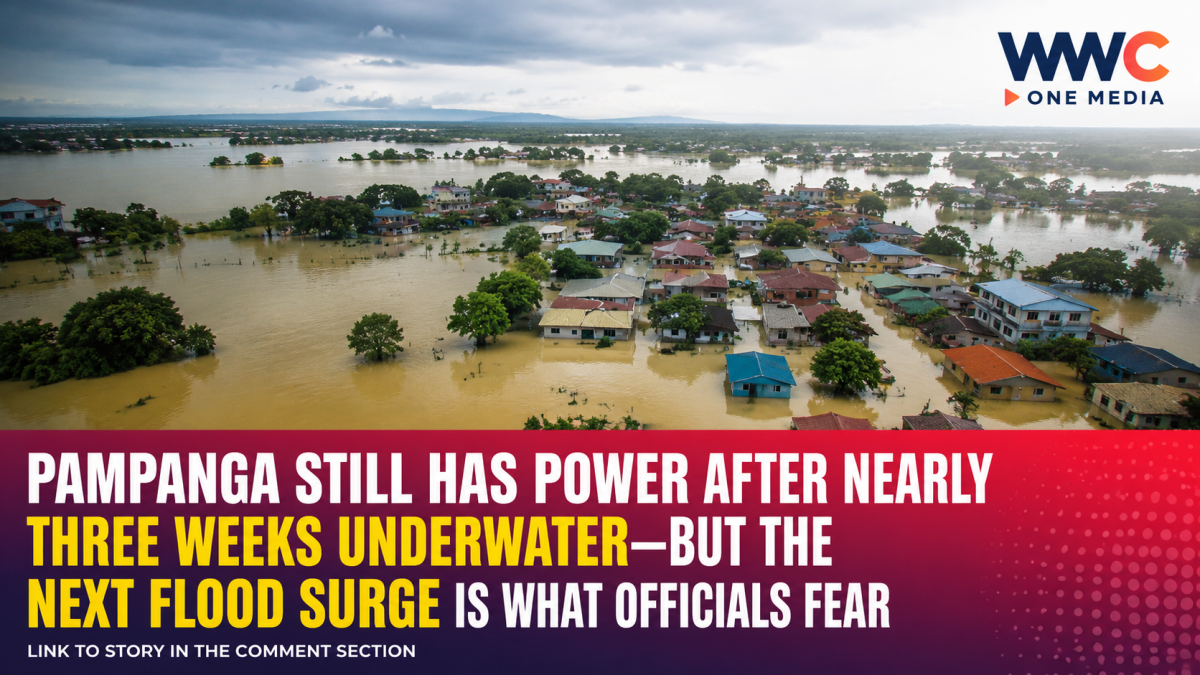
PAMPANGA, Philippines — Even as floodwaters continue to engulf communities across Pampanga after nearly three weeks of relentless rain, electricity remains available in many affected areas—a lifeline officials are trying to preserve as authorities brace for more possible flooding.
Pampanga Governor Lilia “Nanay” Pineda said Sunday that the province’s power supply remains operational despite some communities being submerged in waist-deep floodwaters for weeks due to persistent rains brought by the Southwest Monsoon, or Habagat.
But the governor warned that the situation remains unpredictable, with water flowing into the province not only from local rainfall but also from surrounding upland areas and river systems.
The water can rise suddenly—and that is the danger Pampanga is now facing.
Why Keep the Power On?
Pineda said maintaining essential services such as electricity and water is crucial, particularly for residents who remain in their homes. Cutting utilities could force families to leave even when evacuation may be difficult or dangerous.
However, authorities have stressed that electricity in flooded communities comes with serious risks. The Department of Health in Central Luzon has warned residents to stay away from live wires, electrical outlets and appliances that may have been exposed to water. Flooding also increases the risk of diseases such as leptospirosis.
The governor is coordinating with electric cooperatives and disaster-response agencies as conditions continue to change.
Floodwaters Keep Coming From Beyond Pampanga
Pineda described Pampanga as a natural catch basin, receiving massive volumes of water flowing downstream from mountainous and neighboring areas, including parts of the Zambales mountain range, Sierra Madre, Aurora and Nueva Ecija.
That geography makes the crisis particularly difficult to manage.
On Saturday night, authorities were forced to conduct emergency evacuations after water levels rose suddenly. Pineda said the province is now monitoring far more rivers and communities than during previous flooding events, with coastal and low-lying areas among those affected.
The governor has urged families—especially those with young children and senior citizens—to evacuate before floodwaters become too dangerous.
More Than 1 Million People Affected
The latest reports underscore the scale of the disaster.
Earlier this week, the Pampanga Provincial Disaster Risk Reduction and Management Office reported that flooding had affected more than 315,000 families, or approximately 1.01 million people, even as the number of flooded villages temporarily declined. Thousands of residents remained in evacuation centers, while agriculture and fisheries suffered an estimated ₱1.2 billion in damage and losses. Pampanga has been under a state of calamity since August 12.
Other reports from the past week showed the crisis had at one point left hundreds of barangays underwater, highlighting how quickly conditions can change as rain continues and upstream water flows into the province.
A Long-Term Solution Is Now Becoming the Bigger Question
The flooding crisis has intensified calls for a comprehensive, long-term flood management plan for Central Luzon.
President Ferdinand Marcos Jr. recently acknowledged that the enormous volume of rainfall had overwhelmed existing flood-management systems, while also pointing to the broader challenges posed by climate change and infrastructure limitations. Government plans being discussed include Sabo dams in Nueva Ecija, designed to help slow water and reduce sediment flowing downstream, along with other large-scale flood-control measures.
For Pineda, however, the immediate concern remains the safety of residents as Pampanga continues to absorb water from multiple directions.
Authorities are coordinating with the Armed Forces of the Philippines and the Office of Civil Defense for rescue and response operations, while officials are also discussing safer evacuation procedures amid the continuing threat of heavy rains.
The Bottom Line
Pampanga may still have electricity—but power alone is not the measure of safety.
With communities still underwater, families displaced, and floodwaters capable of rising without warning, the province remains in a race against time. The immediate challenge is keeping people safe. The bigger question is whether a long-term solution can finally stop Pampanga from becoming the basin where Central Luzon’s floodwaters ultimately converge.
And as the Habagat continues, residents are waiting for the water to recede—while hoping the next surge does not come first.




Leave a Reply