
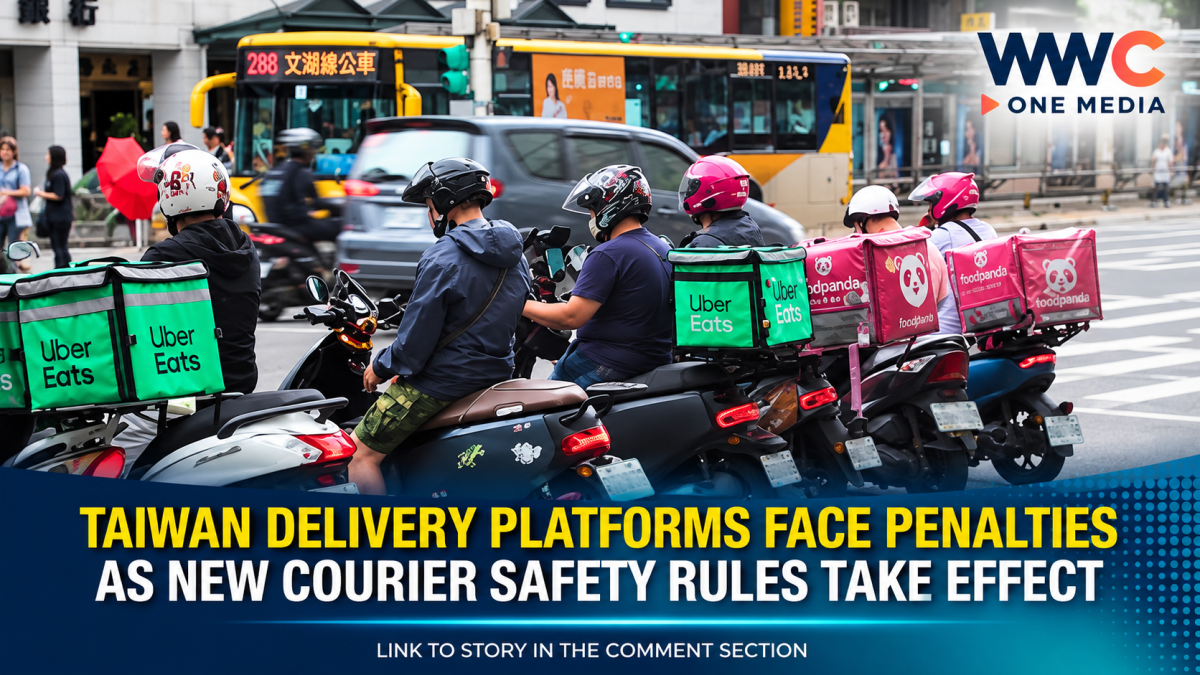
Taiwan’s food-delivery industry is entering a tougher regulatory era, with platforms now facing legal obligations to strengthen courier safety training, insurance, pay protections and workplace safeguards.
The changes stem from Taiwan’s Delivery Workers’ Rights Protection and Delivery Platform Management Act, which was passed by the Legislative Yuan in January and officially took effect on July 21, 2026. The law represents Taiwan’s first dedicated national legal framework for the delivery-platform industry.
At the center of the new rules is a simple principle: delivery platforms cannot treat safety as an afterthought while relying on couriers to navigate increasingly busy roads.
Mandatory safety training puts platforms under the spotlight
Under the new framework, delivery platforms must provide newly registered couriers with prescribed occupational-safety education and training. Platforms must also provide additional safety instruction when a courier commits conduct that has a significant impact on traffic safety before allowing the worker to resume deliveries.
Transportation authorities have also moved toward requiring broader road-safety training and regular refresher courses. The proposed rules would cover safe driving practices and require additional instruction for workers involved in serious traffic-safety violations.
That means platforms are no longer responsible only for connecting customers, restaurants and couriers. Their responsibilities increasingly extend to how delivery work is organized and how safety risks are managed.
Violations can bring significant fines
The law includes administrative penalties for platforms that fail to meet its requirements.
Depending on the violation, platforms can face fines ranging from NT$100,000 to NT$500,000 under provisions concerning delivery-worker protections and platform responsibilities. Other violations carry separate penalty ranges.
The law also provides penalties for failing to report a major occupational accident within the required eight-hour period, with fines of NT$30,000 to NT$300,000.
The message for the industry is becoming increasingly clear: compliance is no longer simply a matter of corporate policy.
The rules go beyond safety training
Safety training is only one part of Taiwan’s new delivery-platform regime.
The law also establishes protections covering courier compensation, insurance, complaints, contract termination and transparency over how delivery payments are calculated. Delivery workers are guaranteed at least NT$45 per completed order, while the law also establishes a minimum tied to 1.25 times the statutory hourly minimum wage when calculated according to time spent completing an order.
The current statutory minimum wage used in the calculation is NT$196 per hour, according to reporting on the rules that came into force in July.
Platforms must also explain how orders are assigned and how compensation is calculated, while establishing procedures for complaints and rules governing suspensions or termination of delivery contracts.
Why this matters for Foodpanda, Uber Eats and the wider gig economy
Taiwan’s delivery sector has grown rapidly over the past decade, but the expansion has also raised concerns over traffic accidents, insurance, compensation and the employment status of platform-based workers.
The new legislation is therefore significant beyond the food-delivery business. It represents a broader attempt to establish clearer responsibilities for companies operating in Taiwan’s gig economy.
Food-delivery platforms have previously faced pressure from labor groups and regulators over courier protections. When the new law was passed in January, both major platforms publicly indicated they would respond to the regulatory changes, while emphasizing the importance of balancing worker protections with the realities of operating delivery services.
A new test for Taiwan’s platform economy
The biggest question now is not whether Taiwan has created new rules—it has. The real test will be how consistently those rules are enforced and whether platforms can adapt without creating unintended consequences for couriers, restaurants or consumers.
For delivery workers, stronger training and safety requirements could mean better preparation for the risks of working on the road.
For platforms, however, the new system brings something equally important: greater legal accountability.
Taiwan’s delivery economy has entered a new phase where speed and convenience are no longer the only measures of success. Worker safety, transparency and corporate responsibility are becoming part of the price of doing business.
And as enforcement develops, the pressure on delivery platforms to prove that their safety systems actually work—not merely that they exist—could become the next major test for the industry.
WWC ONE MEDIA G.A




Leave a Reply