
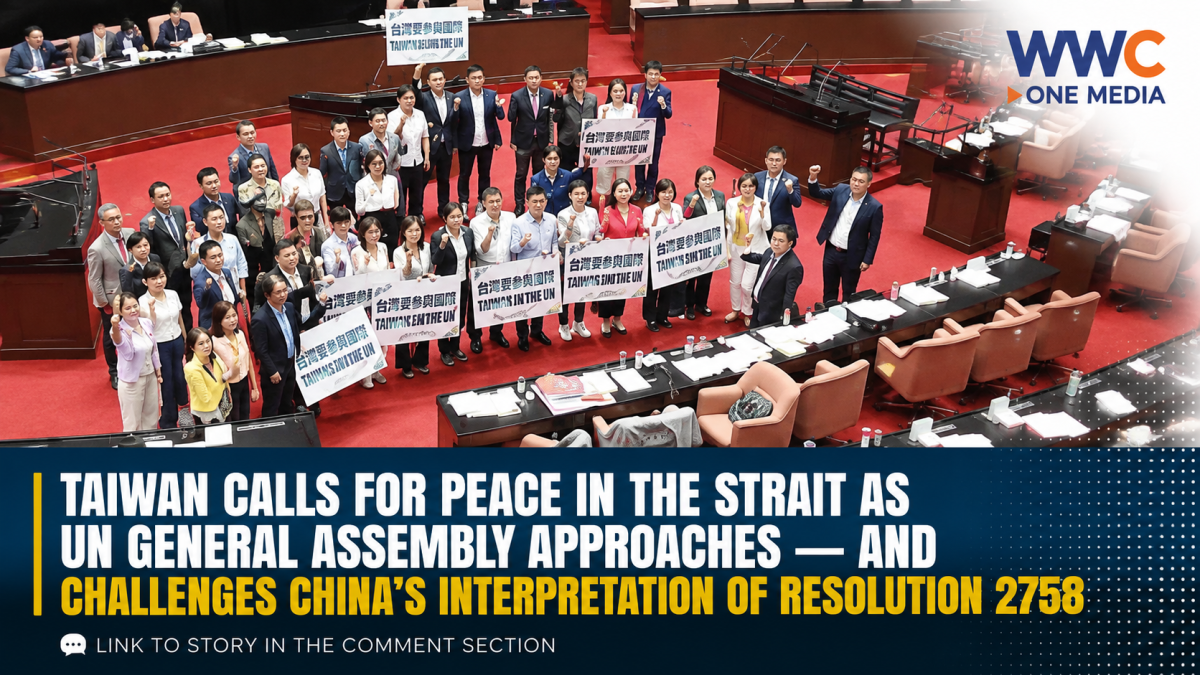
TAIPEI, Taiwan — Taiwan is stepping up its diplomatic campaign ahead of the United Nations General Assembly, calling for peace and stability in the Taiwan Strait while pressing for greater participation in the UN system.
Taiwan’s Ministry of Foreign Affairs on Tuesday outlined three key messages it plans to emphasize as the 81st UN General Assembly approaches: preserving peace across the Taiwan Strait, defending Taiwan’s ability to participate in international organizations, and resolving disputes peacefully in accordance with international law and the UN Charter.
The UN General Assembly’s 81st session officially opens on Sept. 8, with the high-level General Debate scheduled for Sept. 22–28. This year’s theme is “Restoring Trust, Managing Transformation: A United Nations That Delivers for All.”
Taiwan puts the Taiwan Strait at the center of its message
Taiwanese Deputy Foreign Minister Baushuan Ger said the wars in Ukraine and the Middle East, threats to energy and global supply chains, climate change and growing divisions between major powers demonstrate the need for stronger multilateral cooperation.
Against that backdrop, Taiwan argues that maintaining stability in the Taiwan Strait is not simply a cross-strait issue but one with wider implications for regional security, international trade and global supply chains.
Taipei also accused Beijing of increasing pressure through military activity and other forms of coercion, while calling for any disputes to be handled peacefully.
China claims Taiwan as part of its territory and has not ruled out using force to bring the island under its control. Taiwan rejects Beijing’s sovereignty claim and maintains that its future should be decided by its people. Reuters reported this week that Taiwan is also warning that Beijing is tightening its military and maritime activities around the island.
The fight over UN Resolution 2758
One of the most politically sensitive parts of Taiwan’s campaign concerns UN General Assembly Resolution 2758, adopted in 1971.
Taiwan says the resolution does not explicitly mention Taiwan and should not be interpreted as preventing the island from participating in the UN system or other international organizations. Taiwan’s foreign ministry has repeatedly accused Beijing of using the resolution to expand its diplomatic pressure against Taipei.
China disputes that interpretation and regards Resolution 2758 as establishing the UN’s recognition of the People’s Republic of China as the sole legitimate representative of China, including in relation to Taiwan.
That disagreement has become an increasingly important part of the broader diplomatic struggle over Taiwan’s international status.
Taiwan’s government says it wants countries participating in the General Assembly to support its three messages and help create opportunities for Taiwan to contribute to international organizations.
Why the UN campaign matters now
The timing is significant.
The 81st General Assembly comes as the international system faces simultaneous pressure from wars, geopolitical rivalry, climate challenges and disputes over global supply chains. The UN itself says this year’s session is intended to strengthen cooperation and restore confidence in multilateral institutions.
Taiwan is not a UN member, meaning its ability to participate formally in UN proceedings is highly restricted. Beijing’s diplomatic influence has also made Taiwan’s participation in international organizations a recurring source of tension.
At the same time, Taiwan has become increasingly important to the global economy because of its semiconductor industry.
Taiwanese President Lai Ching-te said this week that the island’s chip industry has become a trusted international supplier, while Taiwan announced that its companies are planning an additional US$20 billion in U.S. investments, driven in part by strong AI-related demand. TSMC alone has announced plans for a total of US$265 billion in U.S. investment.
That means any major disruption around the Taiwan Strait could have consequences far beyond East Asia.
Taiwan’s diplomatic push comes as military pressure continues
The diplomatic campaign is unfolding alongside continued military activity around Taiwan.
Taiwan’s defense ministry said on Wednesday that it had tracked one Chinese military aircraft, five naval vessels and three official ships around the island during the previous 24-hour period. Taiwan deployed aircraft, naval vessels and coastal missile systems to monitor the activity.
Taiwan has also proposed a major expansion of defense spending. Lai said the proposed 2027 defense budget would exceed NT$1 trillion (about US$31.47 billion) for the first time, describing the increase as a demonstration of Taiwan’s determination to strengthen its self-defense capabilities. China criticized the move as provocative.
The bigger picture
Taiwan’s UN campaign is therefore about more than gaining a seat or formal recognition.
It is part of a wider effort by Taipei to prevent what it describes as the diplomatic isolation of Taiwan, reinforce the argument that peace in the Taiwan Strait matters to the international community, and expand Taiwan’s participation in global institutions.
For Beijing, however, Taiwan’s international participation remains a sovereignty issue and a major red line.
With the UN General Assembly about to bring world leaders together in New York, the diplomatic battle over Taiwan is likely to become even more visible — even as military, economic and technological tensions continue to rise across the Taiwan Strait.
WWC ONE MEDIA J.M.D


Leave a Reply