
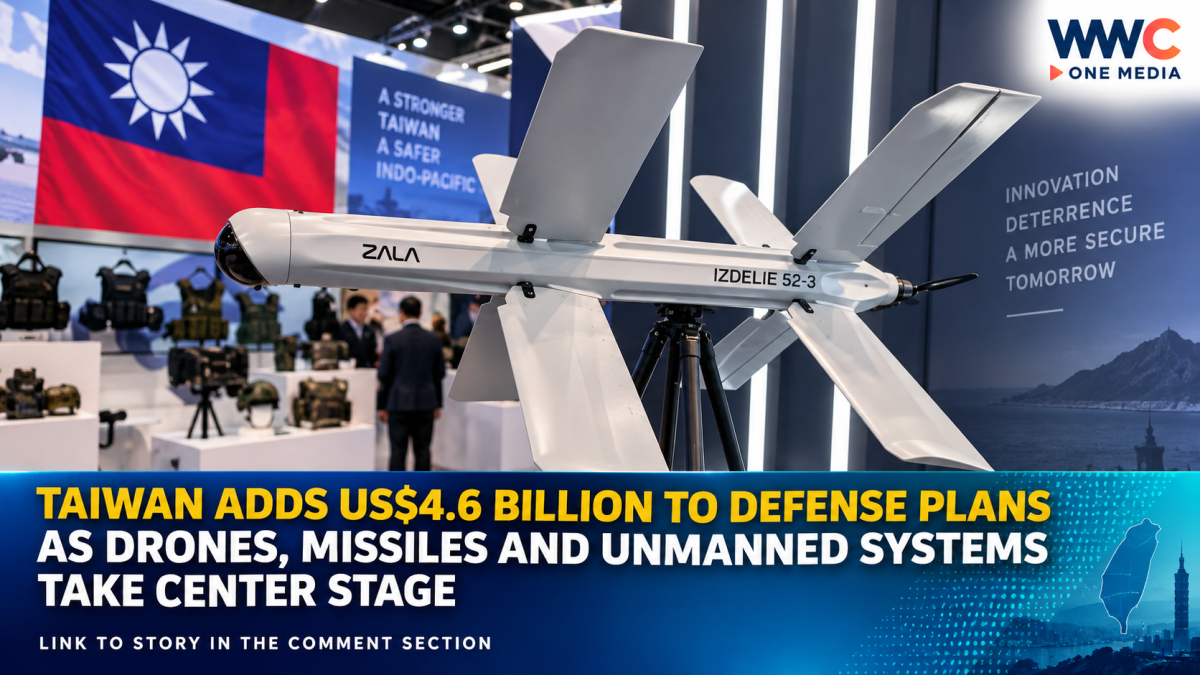
TAIPEI — Taiwan’s government has approved a NT$145.7 billion (about US$4.6 billion) defense allocation as part of a much larger supplementary budget, putting drones, missiles, ammunition and other military capabilities at the center of Taipei’s latest effort to strengthen its defenses.
But there is an important catch: the additional defense spending still needs approval from Taiwan’s Legislative Yuan.
The proposal comes as Taiwan faces sustained military and political pressure from Beijing and as President Lai Ching-te’s government pushes for greater defense self-reliance and expanded use of unmanned systems. Reuters reported that Lai has made defense modernization a central priority as China continues to claim Taiwan as its territory.
A massive supplementary budget
Taiwan’s Cabinet approved a NT$607.6 billion supplementary budget for 2026. Of that amount, NT$145.7 billion is earmarked for defense-related spending.
The defense package breaks down broadly into NT$4.1 billion for personnel, NT$8.2 billion for operations and NT$133.4 billion for military investment.
The proposal includes funding for:
- NT$55.9 billion for three categories of unmanned systems
- NT$13 billion for seven defense projects, including the domestically developed Strong Bow missile system
- NT$7.3 billion to replenish urgently needed ammunition
- NT$900 million for Taiwan’s Tactical Network
- NT$64.5 billion for two classified defense projects
The scale of the proposal is significant enough that the South China Morning Post reported it would push Taiwan’s total defense-related spending for the year above NT$1 trillion, while estimating defense spending at about 3.83% of GDP after the additional funding.
Drones are at the heart of the plan
Perhaps the most eye-catching part of the package is Taiwan’s planned expansion of its unmanned capabilities.
According to Taiwan’s Central News Agency, the government plans to acquire more than 40,000 coastal attack drones, 600 coastal reconnaissance drones and 100 small one-way unmanned surface vessels in 2027.
The government says the additional funding is partly intended to prevent delays in military buildup and allow procurement preparations to move forward.
Lt. Gen. Huang Wen-chi, head of the Ministry of National Defense’s Department of Strategic Planning, said the procurement schedule was a major factor behind the supplementary request.
This reflects a broader shift in Taiwan’s defense strategy toward asymmetric capabilities—systems that can potentially complicate an adversary’s operations without relying exclusively on expensive conventional platforms.
Strong Bow missile also gets funding
The package also includes money for Taiwan’s Chiang Kung, or Strong Bow, medium-altitude anti-tactical ballistic missile system.
Taiwan’s Ministry of National Defense has identified the system as a domestically developed capability. CNA reported that the missile system is designed to intercept ballistic threats, with its reported interception altitude reaching around 70 kilometers.
The inclusion of the system underscores Taiwan’s effort to strengthen not only its drone capabilities but also its ability to defend against missile threats.
Why the money is being added now
The supplementary proposal follows a major political dispute over Taiwan’s previously proposed special defense budget.
The Lai administration had sought an NT$1.25 trillion special defense package covering 23 items. However, opposition lawmakers cut roughly NT$470 billion from that proposal, with some domestically developed systems and other programs left outside the approved package.
Taiwan’s government is now attempting to restore funding for some of those capabilities through the supplementary budget.
The Cabinet has argued that national defense cannot afford a funding gap while the military’s modernization schedule is already underway.
Parliament still has the final say
Despite the headline-grabbing numbers, the money is not yet available for unrestricted spending.
The Cabinet’s supplementary budget request must still go through Taiwan’s legislature.
That creates another potential political battle because the opposition-controlled Legislative Yuan previously reduced the government’s larger defense proposal and has supported a separate law focused on strengthening Taiwan’s domestic unmanned-vehicle industry.
In August, lawmakers approved a six-year NT$240 billion program for drones, equivalent in principle to about NT$40 billion annually, although questions remain over how that program intersects with the government’s latest supplementary request.
Taiwan is also preparing for an even larger defense budget
The latest move is not occurring in isolation.
President Lai said earlier this week that Taiwan’s 2027 defense budget is expected to exceed NT$1 trillion for the first time, reflecting Taipei’s intention to substantially increase military spending and develop domestic defense capabilities.
Reuters reported that Lai has emphasized self-reliance, military industry development, artificial intelligence and unmanned systems as important components of Taiwan’s future defense strategy.
The spending push comes against a backdrop of increasingly frequent Chinese military and coast guard activity around Taiwan.
Taiwan’s Defense Ministry said Friday that it had tracked five Chinese naval vessels and five Chinese official ships around Taiwan during the previous 24-hour period, deploying aircraft, naval assets and coastal missile systems to monitor the activity.
Separately, Reuters reported that China conducted a seabed survey east of Taiwan in August and that Chinese coast guard vessels have continued patrols in waters near the island. Taipei has condemned those activities as maritime pressure and rejected Beijing’s jurisdictional claims.
The bigger picture
Taiwan’s latest defense proposal is therefore about more than simply buying more weapons.
It represents a broader attempt to build a military structure that relies increasingly on domestically produced missiles, large numbers of relatively inexpensive unmanned systems, improved battlefield communications and expanded ammunition reserves.
For Taipei, the goal is to close perceived capability gaps while accelerating a military modernization program that the government says cannot wait for lengthy legislative battles.
For Beijing, however, Taiwan’s growing defense capabilities are likely to remain a politically sensitive issue, given China’s longstanding claim over the island.
The immediate question is no longer whether Taiwan intends to spend more on defense—the direction is already clear. The bigger question is whether lawmakers will approve the latest NT$145.7 billion package, and how quickly the drones and missile systems can actually move from budget documents into Taiwan’s military inventory.


Leave a Reply