
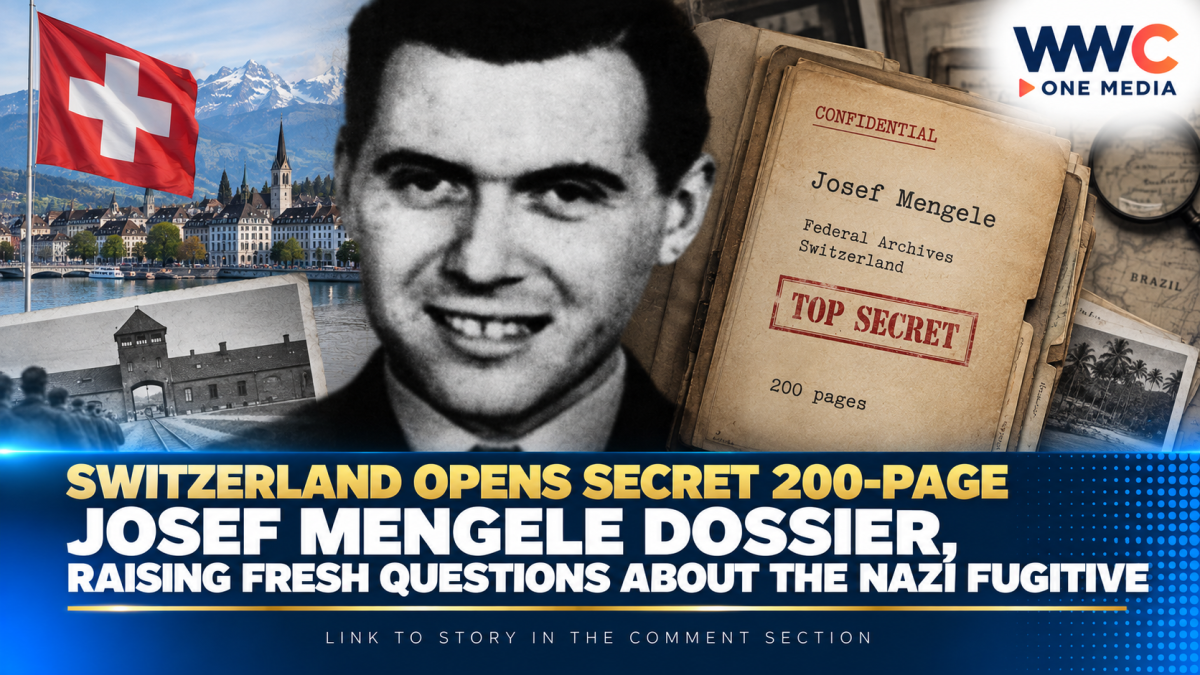
BERN — Switzerland has published a previously restricted 200-page intelligence dossier on Josef Mengele, the notorious Nazi doctor known as the “Angel of Death,” opening a new chapter in the decades-long search for answers about whether one of history’s most wanted war criminals may have passed through the country while on the run.
The newly released file was made public by Switzerland’s Federal Intelligence Service on September 10 after years of restricted access and a legal challenge by a historian. The dossier had originally been sealed under an extended protection period running until the end of 2071.
Mengele became infamous for conducting brutal and deadly medical experiments on prisoners, including children, at the Auschwitz concentration and extermination camp during World War II.
A Secret File Finally Goes Public
The publication of the dossier is significant because historians have long wanted to know whether Swiss authorities possessed information about Mengele’s movements after the collapse of Nazi Germany.
Documents in the file include information provided to Swiss police suggesting that Mengele may have returned to Switzerland after fleeing Germany or may have planned to enter the country using a false identity. The documents do not, however, automatically prove that he successfully lived in Switzerland.
The dossier was originally compiled by the police service of the Swiss federal prosecutor’s office, an organisation that later became part of the intelligence structure now responsible for the records.
It was transferred to the Swiss Federal Archives in 2001.
For decades, public access remained tightly restricted.
Historian’s Legal Challenge Changed Everything
The breakthrough came after historian Gérard Wettstein challenged Swiss authorities over their refusal to release the file.
Switzerland’s intelligence service had most recently denied access in February 2026, arguing that the archive remained protected until 2071.
But during the legal proceedings, authorities discovered that the Mengele dossier had been examined by the Independent Commission of Experts Switzerland–Second World War, commonly known as the Bergier Commission.
That discovery changed the legal situation.
A Swiss Federal Council decision from 2001 called for a more liberal access policy for archives examined by the commission. Swiss authorities announced in May that they would reconsider their position, before formally releasing the file with limited redactions on September 8 and publishing it publicly two days later.
Why Was Mengele So Infamous?
Josef Mengele was an SS doctor at Auschwitz-Birkenau, where he became one of the most notorious figures associated with Nazi medical crimes.
He conducted horrific experiments on prisoners under the guise of scientific research, with particular attention given to twins and children.
An estimated 1.1 million people were murdered at Auschwitz, approximately one million of them Jews.
Mengele survived the war and escaped prosecution, becoming one of the most wanted Nazi fugitives in the world.
Unlike many other senior Nazi figures, he was never captured and never put on trial for his crimes.
How the “Angel of Death” Escaped Europe
After World War II, Mengele managed to evade capture and eventually obtained travel documents under a false identity.
He escaped Europe and spent years living in Latin America, including periods in Argentina, Paraguay and Brazil.
International investigators continued searching for him, but he remained a fugitive until his death in Brazil in 1979.
Mengele drowned while swimming near the Brazilian coast. His identity was initially concealed, and confirmation of his death came only years later.
The newly released Swiss dossier is now expected to receive renewed scrutiny from historians searching for details about the gaps in his escape route.
What Could the Newly Released Files Reveal?
The Swiss intelligence service says some sections of the dossier have been redacted to protect confidential sources and the personal information of third parties.
However, officials said they attempted to keep the redactions to a minimum and that the documents remain broadly understandable.
The decision to publish the entire accessible dossier online — rather than allowing only individual researchers to inspect it under controlled conditions — was driven by what authorities described as exceptionally high public interest and a growing number of access requests.
Historians will now be able to independently examine the documents for potential new information about Mengele’s movements and possible links to Switzerland.
A New Question Over Switzerland’s Wartime and Postwar History
The release could also renew discussion about Switzerland’s role during and after World War II.
Switzerland remained neutral during the conflict but has spent decades examining complex questions involving Nazi-era financial dealings, refugees, intelligence activity and the movements of war criminals.
The Bergier Commission was established to investigate aspects of Switzerland’s relationship with the Nazi era and the Second World War.
The fact that the Mengele dossier was connected to archives examined by the commission ultimately became the key factor that helped unlock access to the previously restricted material.
More Than 80 Years Later, The Search for Answers Continues
The publication of the dossier does not change the fact that Mengele escaped justice.
But it offers historians a rare opportunity to examine intelligence records that were expected to remain inaccessible for another 45 years.
The documents could help answer lingering questions about how one of the world’s most notorious Nazi fugitives avoided capture for more than three decades.
They could also reveal what authorities knew — and when they knew it.
The Bottom Line
Switzerland has opened a secret 200-page dossier on Josef Mengele that had been expected to remain restricted until 2071, following a successful legal challenge and renewed public pressure.
The documents contain information suggesting that the notorious Nazi doctor may have returned to Switzerland or planned to enter the country while using a false identity as he fled international justice.
Whether the newly released records will finally solve long-standing mysteries about Mengele’s escape remains to be seen.
But more than eight decades after the crimes of Auschwitz, a file once locked away from the public is now open — and historians are preparing to search its pages for answers that may have remained hidden for generations.




Leave a Reply