
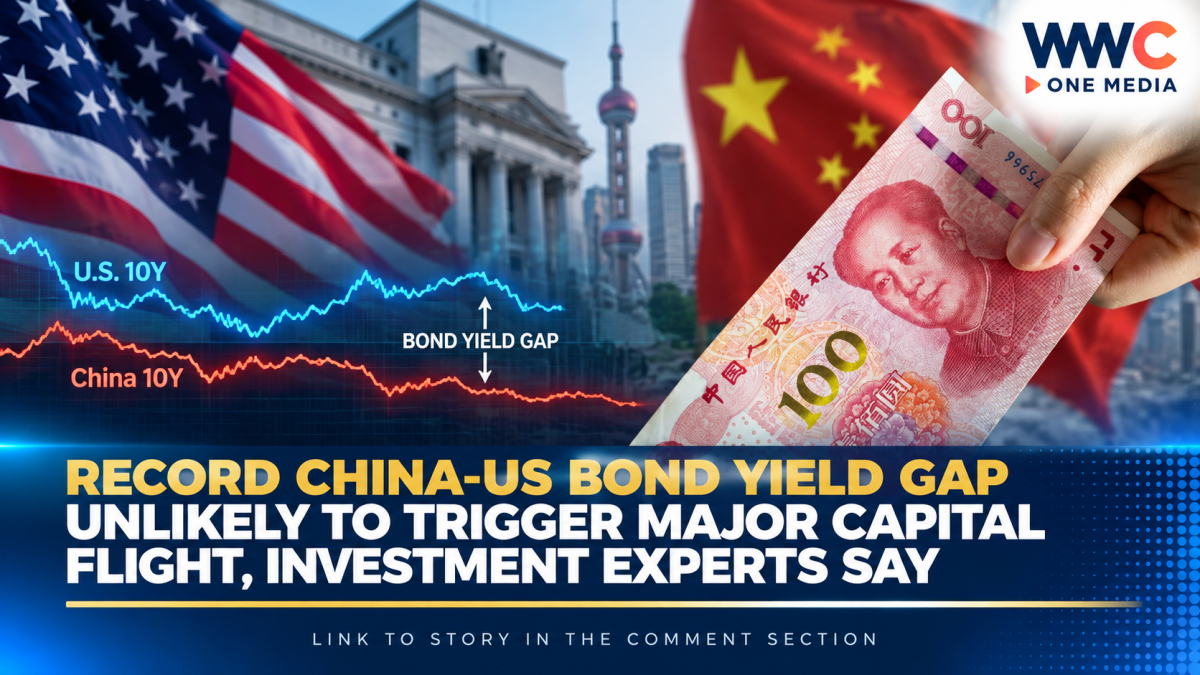
HONG KONG — The record gap between US and Chinese government bond yields is raising fresh concerns about whether investors could move large amounts of money out of China in search of higher returns in the United States.
But investment executives say a dramatic capital exodus remains unlikely.
The gap between benchmark 10-year US Treasury bonds and equivalent Chinese government bonds recently widened to a record 3.17 percentage points. US Treasury yields climbed to 4.85%, while China’s 10-year government bond yield stood at just 1.68%.
Normally, such a huge difference could make US assets more attractive to investors looking for higher returns.
However, experts at Marsh Investment argue that the situation is more complicated.
Why Are US Bond Yields So Much Higher?
The widening gap reflects two very different economic situations.
In China, bond yields have remained low amid weak credit demand, slowing economic growth and deflationary pressures.
In the United States, yields have surged as investors worry about rising government debt, persistent inflation pressures and heavy borrowing by companies — particularly major technology firms investing heavily in artificial intelligence and data centres.
The result is the widest gap ever recorded between the benchmark borrowing costs of the world’s two largest economies.
But Higher US Returns May Not Cause a Mass Exodus
Despite fears that investors could shift money from China to the United States, Marsh Investment executives said capital flight is unlikely to become the dominant force affecting global markets.
Niall O’Sullivan, the firm’s global chief investment officer, pointed instead to larger forces driving the dollar and US interest rates, including global supply-and-demand conditions, America’s expanding national debt and enormous corporate borrowing needs.
In other words, the higher US yield is not automatically a simple invitation for investors to abandon China.
A higher return also comes with questions about risk.
Growing US Debt Is Changing the Calculation
One reason investors may hesitate to move aggressively into US bonds is concern about America’s long-term fiscal position.
US borrowing costs have risen as the market absorbs massive amounts of government and corporate debt.
Investors are increasingly questioning whether growing deficits and debt levels can continue without eventually creating greater financial pressure.
That creates an unusual situation.
US bonds offer significantly higher yields than Chinese bonds, but some investors are also demanding those higher yields because they see greater risks associated with inflation, debt and future government borrowing.
Higher yields do not always mean a better investment — sometimes they are the market’s way of demanding more compensation for risk.
China’s Low Rates Are Creating Another Opportunity
China’s low borrowing costs are also producing an unexpected benefit.
Companies and foreign governments are increasingly borrowing in renminbi because Chinese interest rates are comparatively cheap.
Offshore renminbi borrowing has surged to a record level in 2026, with dim sum and panda bond issuance reaching approximately 1 trillion yuan, or US$149 billion, so far this year.
This could support Beijing’s longer-term goal of increasing the international use of the yuan.
Rather than simply viewing low Chinese bond yields as a weakness, policymakers may also see them as an opportunity to make the renminbi a more attractive funding currency.
China Is Still Watching Capital Flows Closely
That does not mean Beijing is unconcerned.
Chinese authorities have taken steps to monitor and manage money moving overseas, including greater scrutiny of certain offshore investment channels and adjustments to quotas for institutional overseas investment.
China’s financial account has already experienced substantial outflows, making capital movement an important issue for policymakers.
But the scale and complexity of China’s financial system means that interest-rate differences are only one factor influencing where investors put their money.
Currency expectations, government controls, geopolitical risks, economic growth and asset valuations can all play major roles.
Can the Yuan Replace the US Dollar?
The huge yield gap has also revived a much bigger debate: could growing problems in the US bond market eventually weaken the dollar’s dominance?
Investment experts remain cautious.
Replacing the dollar as the world’s leading reserve currency would require far more than higher or lower interest rates.
A competing currency would need deep financial markets, widespread international acceptance, global payment infrastructure and the confidence of governments, banks and investors around the world. Marsh Investment executives said the dollar’s dominant position remains deeply entrenched.
Changing the world’s reserve currency is not like changing banks. It requires rebuilding an enormous global financial system.
Chinese Banks Are Still Finding US Bonds Attractive
Interestingly, the record yield gap has not stopped all Chinese institutions from buying US assets.
Recent reports indicate that Chinese banks have increased purchases of US Treasuries after attracting more dollar deposits, taking advantage of the higher returns available in the American bond market.
This highlights another important point:
Capital flows are not moving in only one direction.
Different investors have different needs.
Some may seek higher returns in US bonds. Others may borrow cheaply in yuan. Some companies may use both currencies as part of broader financing strategies.
What Investors Are Really Watching
The record yield gap is therefore about much more than China versus the United States.
Investors are also watching:
- Rising US government debt
- Inflation and interest-rate expectations
- China’s slowing economy
- The future direction of the yuan
- Global capital flows
- AI-related corporate borrowing
- Dollar dominance
- Renminbi internationalisation
The yield gap could remain important, especially if it continues widening.
But investment experts say it should not automatically be interpreted as a signal that China’s financial markets are about to experience a catastrophic outflow of capital.
The Bottom Line
The record 3.17-percentage-point gap between US and Chinese 10-year bond yields is putting fresh pressure on China’s capital markets, but investment executives do not expect it to trigger a massive capital flight.
US bonds currently offer much higher yields, but those returns also reflect concerns about America’s growing debt, inflation and enormous borrowing needs.
Meanwhile, China’s lower interest rates are helping fuel record borrowing in renminbi, creating opportunities for the country’s efforts to expand the currency’s global role.
The growing China-US yield gap is a powerful sign of how differently the world’s two largest economies are moving — but money does not follow interest rates alone. In today’s uncertain global economy, investors are increasingly weighing returns against risk, debt, currencies and long-term stability.




Leave a Reply