
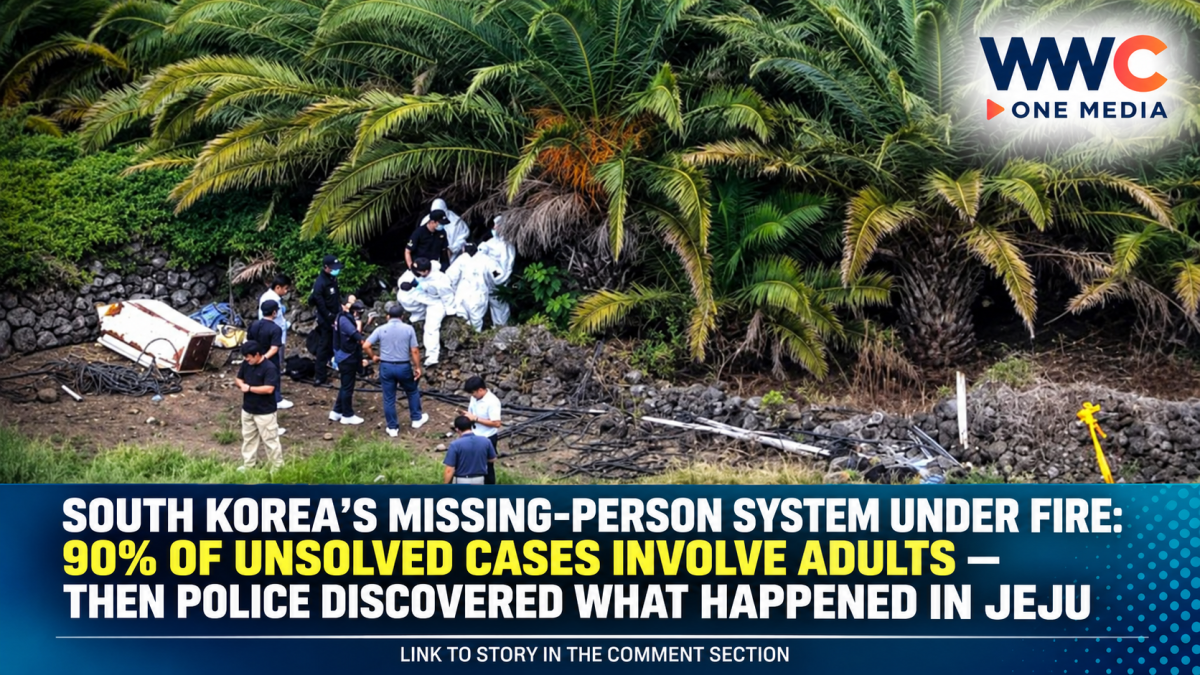
South Korea’s missing-person system is facing mounting scrutiny after new government data showed that more than 90% of unresolved disappearance cases involved adults without dementia or other legally protected conditions.
The figures have emerged as a widening police scandal in Jeju raises fresh questions about whether the country’s current system gives ordinary adults enough protection when they disappear.
According to data from the National Police Agency cited by Rep. Lim Ho-seon of the ruling Democratic Party of Korea, 1,727 missing-person cases remained unresolved from 2022 through July 2026. Of those, 1,596 involved adults without special needs — accounting for more than 90% of the total.
The issue has drawn national attention following the disappearance and death of 37-year-old Jang Mi-ran on Jeju Island.
Jang disappeared after leaving her accommodation in Hallim-eup on May 12. Her boyfriend reported her missing on May 15. Police later discovered that the officer handling the case had allegedly closed the investigation without actually confirming that Jang was safe.
Her body was eventually found on Aug. 24 — 104 days after she disappeared — in a palm farm roughly 1 kilometer from the accommodation where she had been staying. Yonhap reported that the body was later confirmed to be Jang’s.
The handling of the case became even more controversial after investigators found no record of the phone call the officer claimed to have had with Jang.
According to police, the officer had allegedly told people who reported the disappearance that he had contacted Jang and that she did not want her whereabouts disclosed. Phone records, however, did not support that account.
The officer, identified by the surname Bu, was subsequently accused of falsely closing another missing-person case involving a man in his 60s. That man was later found dead.
Police initially focused on roughly 200 cases handled by Bu. A broader review subsequently established that he had handled and closed 298 missing-person cases during his assignment to the Jeju Seobu Police Station’s missing-persons team from March 2025 through July 2026.
The investigation has now uncovered 25 additional cases suspected of being improperly closed.
Police said 10 of those cases involved people whose whereabouts had not been properly verified before the cases were closed. All 10 were eventually found safe. In another 15 cases, police said the individuals’ whereabouts had already been confirmed, but the officer allegedly entered false reasons into the system, including supposed traffic-accident or unnatural deaths, before removing the records.
The scandal widened further when police reported that 63 records had been deleted or omitted from the missing-person case registry. Some involved protected groups, including children and people with disabilities, whose cases are subject to enhanced reporting and search requirements.
Bu reportedly told investigators that he falsified or prematurely closed cases because he felt burdened by the workload involved in keeping missing-person investigations open. Police said investigators found accumulated work pressure and fatigue to be contributing factors, while finding no evidence of a separate financial or personal motive.
The Jeju case has exposed a broader weakness in South Korea’s missing-person alert system.
Nationwide missing-person alerts and other enhanced investigative measures are generally available for children, people with certain disabilities, people with mental disorders and those with dementia. Ordinary adults do not receive the same automatic level of protection under the existing framework.
That distinction is now at the center of the national debate.
The National Police Agency data cited by Lim showed that 11,881 nationwide alerts had been issued since 2022 for children and people in protected categories. Police said 99.6% of those cases resulted in the person being found.
By contrast, the overwhelming majority of unresolved cases involved adults outside those protected categories.
Lim argued that there should be a legal framework allowing authorities to issue emergency alerts for adults when there are clear indications that a missing person may face an imminent threat, such as criminal victimization or suicide risk.
The controversy has already prompted police reforms.
Authorities are reviewing the handling of large numbers of closed missing-person cases and moving toward stronger oversight of case closures. Police have also indicated that non-face-to-face closures should generally be prohibited and that supervisors should review objective evidence before a case can be formally closed.
The Jeju scandal therefore goes beyond one officer or one missing woman.
It has exposed a difficult question for South Korea: when an adult disappears without fitting the categories that trigger enhanced police intervention, how quickly should authorities treat that disappearance as an emergency?
For families searching for missing relatives, the answer could determine whether the crucial first hours of an investigation are used to find someone — or whether a case is simply closed.
WWC ONE. MEDIA M.J.E

Leave a Reply