
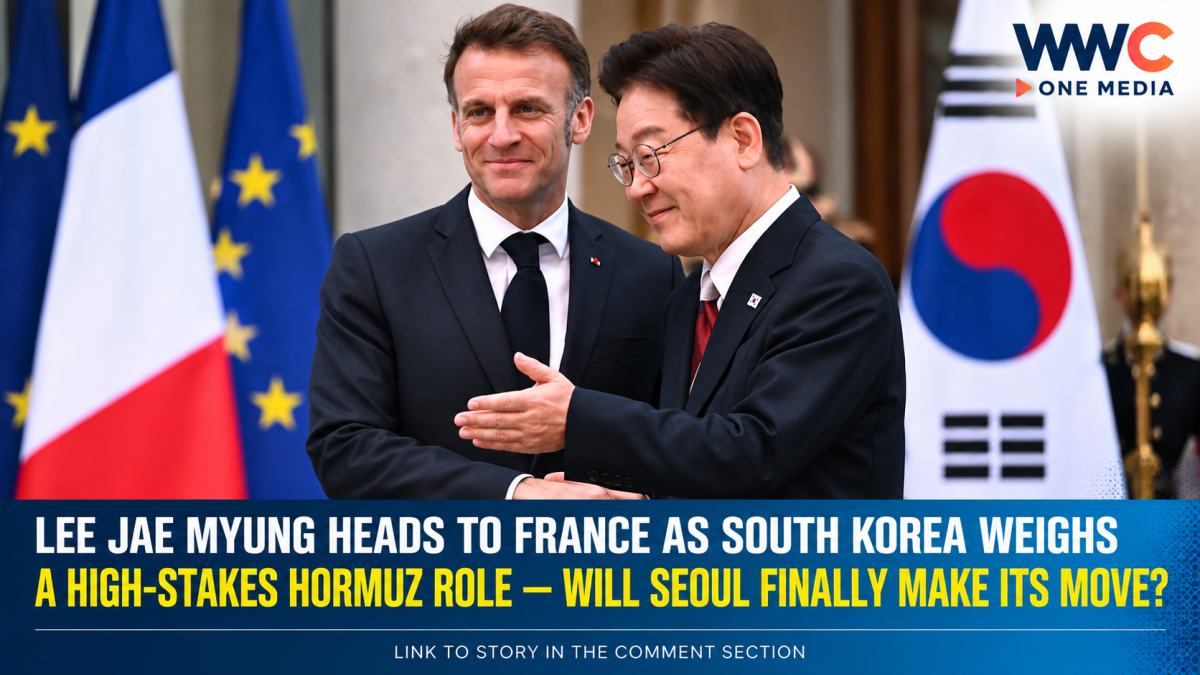
South Korean President Lee Jae Myung has departed for France for a four-day state visit that could become more consequential than a routine diplomatic trip, with talks expected to cover security, nuclear energy, advanced technology—and potentially South Korea’s role in the strategically vital Strait of Hormuz.
Lee left Seoul on Sunday for a visit running through September 9. He is scheduled to co-chair the Lumière Summit with French President Emmanuel Macron on Monday in Saint-Paul-de-Vence before traveling to Paris for formal state-visit activities and bilateral talks.
The timing is significant. South Korea and France are celebrating the 140th anniversary of diplomatic relations, while both governments are seeking to deepen a relationship upgraded to a global strategic partnership during Macron’s visit to South Korea in April.
Hormuz could become the biggest issue on the table
The most closely watched part of Lee’s France trip may not be culture or trade—but the Middle East.
South Korea is currently reviewing whether it could contribute military or nonmilitary assets to international efforts aimed at maintaining freedom of navigation through the Strait of Hormuz, a critical energy corridor.
The presidential office has repeatedly stressed that no deployment decision has been made. Officials say Seoul is examining a range of possibilities while ensuring that any contribution would not undermine South Korea’s military readiness on the Korean Peninsula and would comply with domestic legal procedures.
Reported options have included P-8A Poseidon maritime patrol aircraft, naval logistics support vessels and other capabilities, although these remain possibilities rather than an approved deployment.
The issue could surface during Lee’s talks with Macron because France has been involved in international discussions on restoring safe navigation through the waterway. The Korea Herald reported that French and South Korean officials may discuss the matter during the summit.
Why Hormuz matters so much to Seoul
For South Korea, the issue is not simply about military diplomacy.
The country is heavily dependent on energy supplies moving through the Middle East. South Korean officials have said that roughly 70% of the country’s crude-oil imports are linked to the Strait of Hormuz, making the waterway an important part of Seoul’s economic-security calculations.
Any prolonged disruption could therefore affect South Korea’s energy supply, shipping costs and broader economy.
Reuters reported that the possibility of a South Korean contribution is also unfolding amid pressure from Washington for Seoul to play a role in efforts to secure navigation through the strait.
But the decision is politically sensitive at home. Reuters reported that a Gallup Korea survey found 55% opposed sending a warship, illustrating the domestic challenge Lee could face if the government moves toward an overseas military contribution.
Lee and Macron also have a much bigger economic agenda
The Hormuz question is only one piece of the France visit.
Lee and Macron are expected to discuss expanding cooperation in defense, nuclear energy, artificial intelligence, space, biotechnology and other advanced technologies.
The two countries agreed during Macron’s April visit to strengthen cooperation in defense industries and civilian nuclear power, while also expanding collaboration in AI, semiconductors, quantum technology and space.
Lee is also scheduled to attend a business roundtable involving 20 companies from South Korea and France, giving the visit an important economic dimension.
From K-pop to global cinema: Culture is also part of the strategy
Lee’s visit begins with the Lumière Summit, a gathering focused on the future of the global film and audiovisual industries.
The summit is expected to bring together representatives from dozens of countries and major players from film, audiovisual and gaming industries. Reuters reported that discussions will include challenges created by artificial intelligence, social-media competition, financing pressures and the need to expand audiences globally.
That gives Seoul another opportunity to showcase South Korea’s growing cultural influence while France reinforces its position as a major global center for cinema.
The Korea Herald noted that about 150 participants from more than 30 countries are expected at the gathering, including representatives from film, audiovisual and video-game industries.
A partnership being tested by a changing world
Lee’s France visit therefore comes at an unusually complicated moment.
On one side, Seoul and Paris are trying to expand cooperation in technology, energy, defense and culture.
On the other, the escalating strategic importance of the Middle East is forcing South Korea to consider how far it is willing to go in supporting international efforts to keep one of the world’s most important shipping routes open.
For now, there is no final decision to send South Korean forces to the Strait of Hormuz. Any actual overseas troop deployment would also have to go through South Korea’s domestic legal process, including consultation and approval by the National Assembly.
That means Lee’s meetings with Macron could be closely watched—not because a deployment has already been decided, but because the France summit could help reveal which direction Seoul is ultimately preparing to take.
WWC ONE MEDIA M.J.E




Leave a Reply