
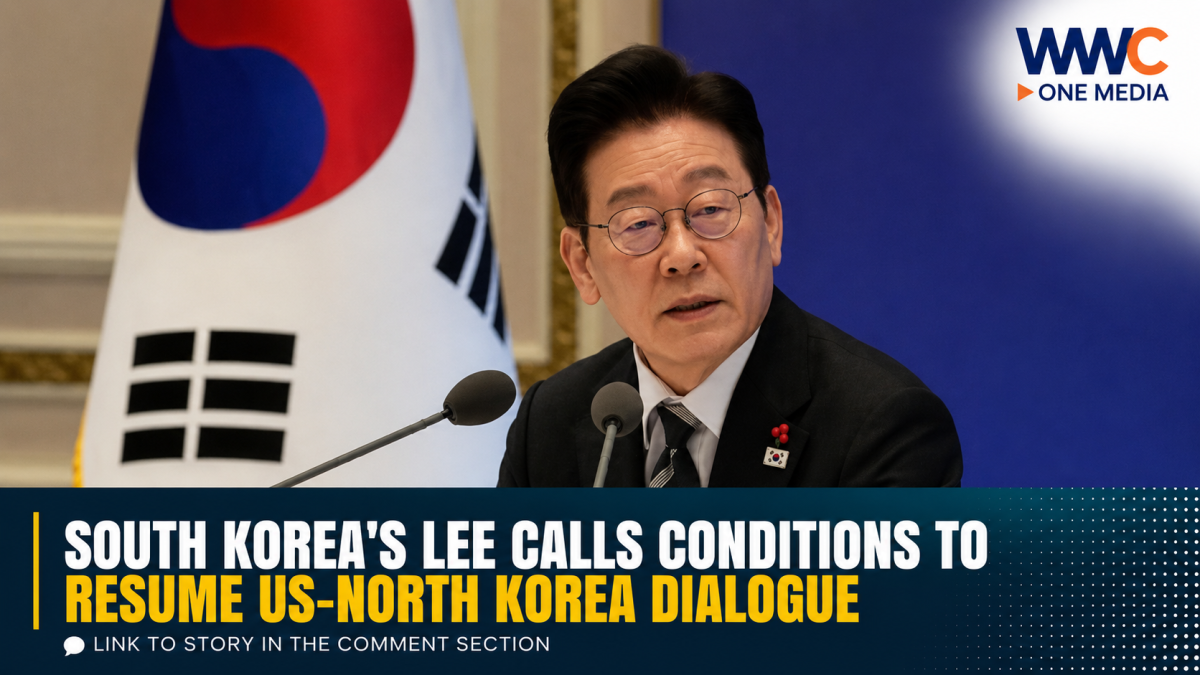
South Korean President Lee Jae Myung is urging efforts to create the conditions for renewed dialogue between the United States and North Korea, arguing that even a small diplomatic opening could help move the Korean Peninsula away from decades of confrontation.
Lee made the appeal on Sept. 2, 2026, as Seoul seeks to capitalize on signs that US President Donald Trump may be interested in reopening direct engagement with North Korean leader Kim Jong Un.
But there is a major obstacle: Pyongyang has not signalled that it is ready to return to negotiations, and North Korea recently reiterated that it considers Washington’s policy hostile.
That makes Lee’s latest push potentially significant—but far from a guaranteed diplomatic breakthrough.
Lee Wants the Armistice Replaced With a Peace System
Speaking to members of the overseas branch of South Korea’s Peaceful Unification Advisory Council in Incheon, Lee said conditions should be created for constructive discussions between Washington and Pyongyang.
He also called for transforming the Korean Peninsula’s existing armistice system into a peace system based on cooperation and prosperity.
The Korean War ended in 1953 with an armistice rather than a formal peace treaty. As a result, the two Koreas remain technically at war.
Lee has repeatedly made establishing a lasting peace arrangement a central element of his administration’s approach to inter-Korean relations.
In his Aug. 15 Liberation Day speech, he proposed that North and South Korea begin discussions aimed at formally ending the war and finding practical ways to address the North’s advancing nuclear capabilities.
Trump May Be Creating an Opening
Lee’s comments come amid renewed speculation about a possible Trump-Kim meeting.
According to South Korea’s National Intelligence Service, lawmakers were told on Sept. 1 that a US-North Korea summit could potentially take place at any time, citing signs of possible dialogue between Washington and Pyongyang. However, there was no confirmation of specific communications between the two governments at that point.
The White House has separately said that US policy toward North Korea has not changed and that Trump remains willing to speak with Kim without preconditions.
Trump and Kim previously met three times—in 2018 and 2019—but those negotiations ultimately failed to produce an agreement on denuclearisation.
Lee now appears to be trying to create diplomatic space for another round of engagement.
Seoul Wants to Help Restart the Conversation
Lee’s message was not simply a call for direct talks between the two Koreas.
Instead, he argued that South Korea should help create the environment needed for Washington and Pyongyang to resume constructive discussions.
Yonhap reported that Lee believes Trump’s recent moves have created at least a small possibility of change on the peninsula. Seoul therefore wants to use that opening to rebuild trust and encourage dialogue.
That represents a delicate diplomatic balancing act.
South Korea remains a treaty ally of the United States and depends heavily on the US military presence for deterrence against North Korea. At the same time, Lee has sought a less confrontational approach toward Pyongyang.
North Korea Is Still Rejecting Washington’s Approach
The biggest question is whether Kim Jong Un is interested.
Just days before Lee’s latest remarks, North Korea said US policy toward Pyongyang remained hostile and vowed to continue strengthening its nuclear capabilities.
A North Korean Foreign Ministry statement carried by state media on Aug. 31 rejected Washington’s continued calls for denuclearisation and criticised US-South Korean and US-Japan military exercises.
That creates a major contradiction.
Washington says it is open to talks without preconditions.
Seoul wants conditions created for constructive dialogue.
Pyongyang says its nuclear weapons are essential to its security and that there has been no change in its policy toward the United States.
For diplomacy to restart, those positions would have to move closer together.
Military Exercises Remain a Sensitive Issue
The future of US-South Korean military exercises is also becoming part of the diplomatic equation.
Trump recently ordered the US military to substantially reduce the scale of joint exercises with South Korea, saying the drills were costly and sent an unnecessarily hostile signal to North Korea.
South Korea’s military had said its Ulchi Freedom Shield exercise was proceeding, although Trump’s announcement raised questions about how the alliance’s future exercises would be structured.
For Pyongyang, such exercises have long been portrayed as preparations for an invasion.
For Washington and Seoul, however, military exercises are considered important for maintaining readiness and alliance coordination.
That disagreement could become one of the most difficult issues if US-North Korea talks resume.
Seoul Faces a Complicated Security Environment
Lee’s push for diplomacy comes as North Korea’s security relationships have also changed.
Pyongyang has deepened its military relationship with Russia, while maintaining important ties with China.
North Korea has also continued developing its nuclear and missile capabilities.
That means the diplomatic landscape is very different from 2018, when Trump and Kim first entered their unprecedented summit process.
Analysts cited by AP have warned that Kim may have less incentive to return to negotiations unless Washington offers significant concessions, particularly given North Korea’s expanded military capabilities and closer ties with Russia.
What Happens Next Could Matter Across Asia
A renewed Trump-Kim meeting would be significant—but a meeting alone would not guarantee progress.
The previous summit process demonstrated how difficult it is to bridge the gap between Washington’s demands over North Korea’s nuclear programme and Pyongyang’s insistence on security guarantees and sanctions relief.
Lee’s strategy is therefore focused on creating the conditions for diplomacy, rather than claiming that negotiations have already restarted.
For South Korea, the stakes extend beyond relations with North Korea.
A reduction in military tensions could improve stability across Northeast Asia, while a failed diplomatic initiative could leave the peninsula facing continued nuclear development, military competition and periodic confrontation.
For now, the door to dialogue appears to be slightly open—but nobody has yet confirmed that Pyongyang is ready to walk through it.
Accuracy Note
Lee’s Sept. 2 statement does not mean US-North Korea negotiations have resumed. He called for conditions to be created for constructive discussions and dialogue. South Korea’s intelligence service has reported possible signs of renewed contact, but Reuters noted there was no confirmation of specific US-North Korean communications.
The White House says Trump remains open to talks with Kim without preconditions, while North Korea has recently maintained that US policy remains hostile and has vowed to strengthen its nuclear capabilities.
WWC ONE MEDIA J.M.D


Leave a Reply