
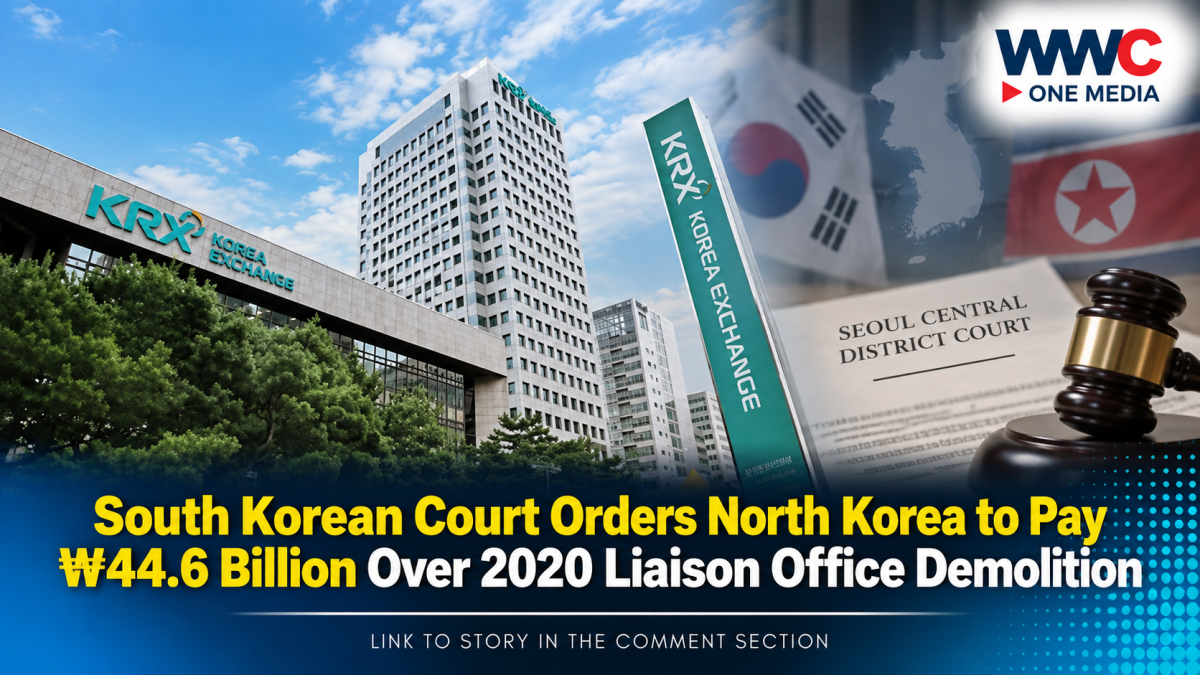
SEOUL, South Korea — A Seoul court has ordered North Korea to pay 44.6 billion won (about US$32.5 million) in damages to the South Korean government over Pyongyang’s 2020 demolition of an inter-Korean liaison office in the North Korean border city of Kaesong.
The Seoul Central District Court issued the ruling on Wednesday, September 16, in a case filed by the South Korean government in June 2023. The judgment marks the first time a South Korean government lawsuit seeking damages directly from North Korea has resulted in a ruling.
Court Backs Seoul’s ₩44.6 Billion Claim
The government had sought compensation for damage to the liaison office and other structures affected by the demolition.
According to Seoul Economic Daily, the claim included approximately ₩10.2 billion for the liaison office itself and ₩34.4 billion for damage to the Kaesong Industrial Complex Comprehensive Support Center and related structures. The court essentially upheld the government’s claim and also ordered delayed interest.
The lawsuit was filed three years after the building was destroyed.
What Happened to the Liaison Office?
The Inter-Korean Joint Liaison Office opened in September 2018 as part of efforts to improve communication between Seoul and Pyongyang following a series of inter-Korean summits.
The office was designed to provide a direct channel for officials from the two Koreas to communicate and discuss bilateral issues.
But relations deteriorated sharply in 2020.
North Korea blew up the four-story building in Kaesong on June 16, 2020, after escalating tensions over South Korean activists sending anti-Pyongyang leaflets across the border. The building had already been largely emptied because of COVID-19 restrictions.
The demolition became one of the most visible symbols of the collapse of the period of inter-Korean engagement that had begun in 2018.
Seoul Took the Dispute to Court
South Korea filed the damages lawsuit in June 2023, seeking compensation of roughly ₩44.7 billion.
At the time, Seoul argued that North Korea’s destruction of the facility constituted an unlawful act that caused substantial financial damage to South Korea. Reuters reported that this was the first time the South Korean government had directly sued North Korea for damages.
The latest ruling now gives Seoul a formal domestic court judgment in its favor.
However, the legal victory does not necessarily mean South Korea will actually receive the money.
Can North Korea Be Forced to Pay?
That is one of the biggest questions surrounding the ruling.
North Korea has no diplomatic relations with South Korea and did not participate in the court proceedings. The case was therefore handled through procedures allowing the court to proceed despite the absence of a North Korean defense.
Experts cited by Korean and international media say enforcing the judgment against North Korea will be extremely difficult because Seoul has no practical mechanism for compelling Pyongyang to make the payment.
The South Korean government said it would review what follow-up measures are available.
Government Calls for Dialogue
Despite the court victory, Seoul’s response has also emphasized the importance of communication.
South Korea’s government said it hopes outstanding inter-Korean issues can ultimately be addressed through dialogue and cooperation, according to SBS.
The ruling comes amid continuing efforts by the administration of President Lee Jae Myung to improve inter-Korean relations, although Pyongyang has not responded to Seoul’s calls for renewed dialogue.
A Legal Victory With a Difficult Next Step
The decision creates an unusual situation: South Korea has won a court judgment against North Korea, but collecting the money remains uncertain.
The ruling nevertheless establishes a formal legal record concerning the destruction of the liaison office and represents a significant development in Seoul’s efforts to address the financial consequences of the 2020 demolition.
Six years after the building was destroyed, the dispute has now moved from the site in Kaesong to a South Korean courtroom.
The court has delivered its verdict. The bigger question is whether Pyongyang will ever pay.
WWC ONE MEDIA G.A


Leave a Reply