
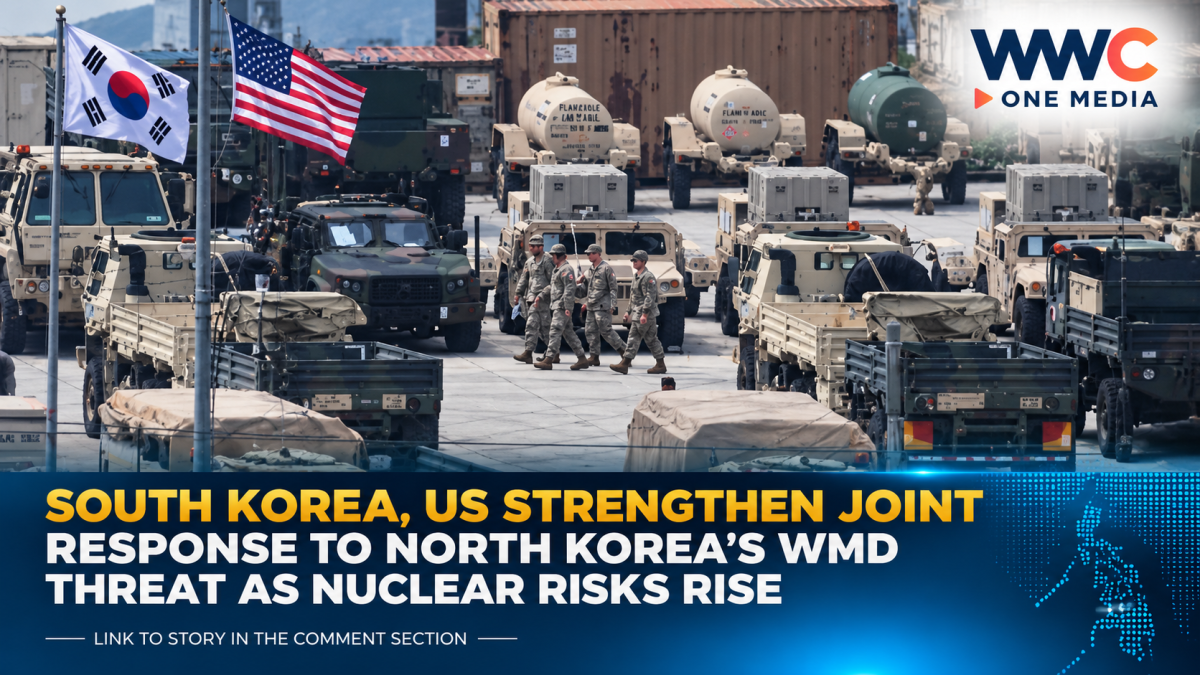
SEOUL — South Korea and the United States are deepening coordination over North Korea’s nuclear and weapons programs, reaffirming their commitment to deterrence and joint planning as Pyongyang continues to expand its nuclear and missile capabilities.
The allies held the sixth U.S.-ROK Nuclear Consultative Group (NCG) meeting in Seoul on June 11, 2026, bringing together senior defense, foreign-affairs and intelligence officials to discuss how the two countries can strengthen their response to North Korea’s evolving nuclear threat.
The meeting comes at a particularly sensitive moment. North Korea has continued developing its nuclear arsenal and missile capabilities while insisting that its nuclear status will not be surrendered.
Allies sharpen nuclear deterrence plans
The NCG was established in 2023 under the Washington Declaration to give South Korea a greater role in discussions with Washington over U.S. extended deterrence.
At the latest meeting, Seoul and Washington reviewed several areas of cooperation, including nuclear crisis consultation, information-sharing, conventional-nuclear integration, exercises and training, strategic messaging and risk reduction.
Both governments agreed to continue developing their combined capabilities to deter and respond to North Korean nuclear threats.
Washington also reaffirmed its commitment to provide extended deterrence to South Korea, including through the full range of U.S. capabilities.
Extended deterrence means that the United States pledges to use its military capabilities to help defend an ally facing a major security threat.
Denuclearization remains the official goal
Despite North Korea’s growing nuclear arsenal, Seoul and Washington reiterated their shared objective of denuclearizing North Korea.
Yonhap reported that the reaffirmation came as Pyongyang has increasingly portrayed itself as a permanent nuclear-armed state and continued efforts to expand its capabilities.
The allies’ position is significant because it shows that expanded deterrence cooperation has not replaced their stated goal of eliminating North Korea’s nuclear weapons.
Instead, the two tracks are proceeding simultaneously: strengthening defenses against the existing threat while maintaining denuclearization as the long-term objective.
Intelligence and information-sharing become more important
A major component of the NCG’s work is improving the flow of information between the two allies.
The June meeting reviewed security and information-sharing arrangements designed to allow Seoul and Washington to better assess North Korea’s nuclear and missile activities.
The two sides also signed U.S.-ROK NCG Security Guidelines, establishing safeguards for sensitive information connected to the group’s activities and consultations.
That cooperation could become increasingly important as North Korea develops more sophisticated missile systems and expands its nuclear capabilities.
A changing security environment
The discussions are taking place as the security landscape surrounding the Korean Peninsula becomes more complicated.
North Korea has strengthened its relationship with Russia, while Pyongyang continues to develop its own military capabilities.
Reuters recently reported that North Korean leader Kim Jong Un praised troops involved in overseas military operations, amid assessments from South Korean and Western officials that thousands of North Korean personnel have been deployed to support Russia’s war in Ukraine.
At the same time, the United States and South Korea have been adjusting their military relationship.
President Donald Trump’s decision to scale back some joint U.S.-South Korean military exercises in August prompted concerns among some lawmakers and analysts about alliance readiness.
The developments make the NCG’s focus on nuclear consultation and planning particularly significant.
North Korea continues to expand its nuclear capability
The urgency is also being reinforced by new evidence about North Korea’s nuclear infrastructure.
The International Atomic Energy Agency has raised concerns about a new uranium-enrichment facility at Yongbyon, alongside increased activity at another suspected enrichment site.
The developments suggest that North Korea continues to expand its ability to produce weapons-grade nuclear material despite international pressure.
That means the challenge facing Seoul and Washington is no longer simply how to respond to individual missile launches.
It is how to manage a more capable nuclear-armed North Korea over the long term.
The alliance faces a delicate balancing act
The latest talks therefore come at a complicated point for the U.S.-ROK alliance.
South Korea wants credible American security guarantees while President Lee Jae Myung has also expressed interest in renewed dialogue with North Korea.
Washington, meanwhile, continues to weigh deterrence against diplomatic engagement with Kim Jong Un.
Analysts have warned that Pyongyang is increasingly confident and has strengthened its relationships with Russia and China, making pressure alone less likely to force an immediate change in North Korea’s nuclear policy.
For Seoul and Washington, the challenge is to maintain credible deterrence without closing the door to diplomacy.
The June NCG meeting demonstrates that, despite changes in the wider alliance and debates over military exercises, nuclear preparedness and coordination remain central to the U.S.-South Korea security relationship.
And with North Korea continuing to expand its nuclear capabilities, the stakes are rising.
The biggest question now is whether stronger U.S.-South Korean coordination can keep pace with a North Korean nuclear program that is moving faster than diplomacy.


Leave a Reply