
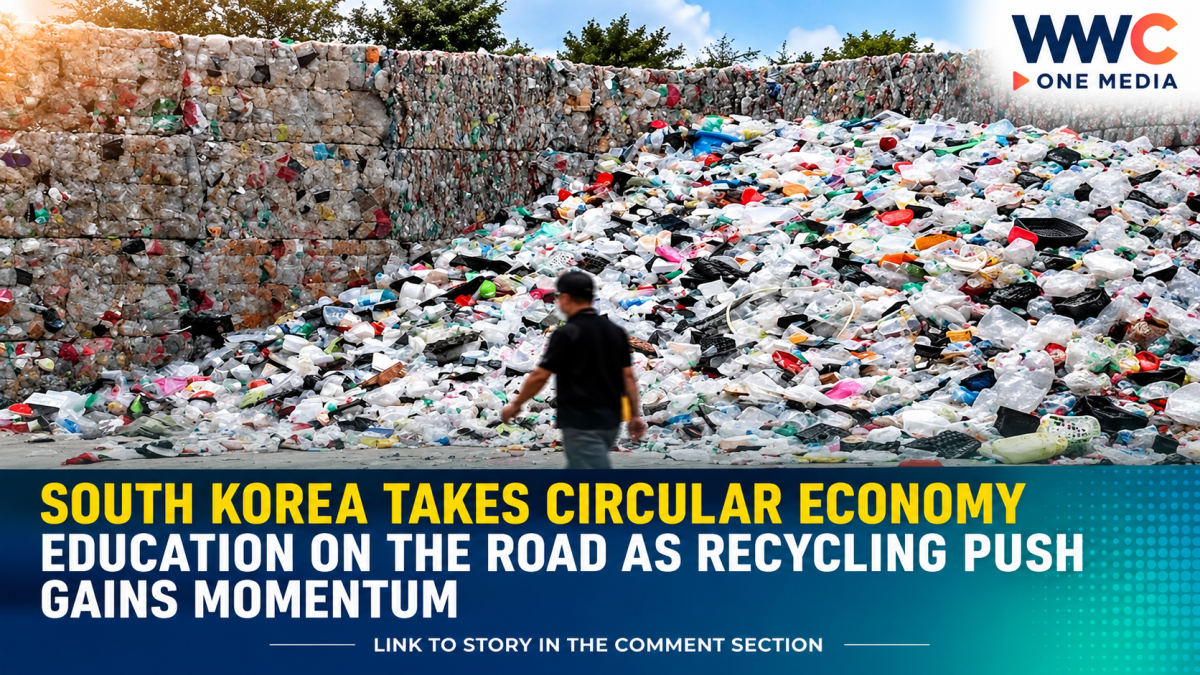
SEOUL — South Korea is taking its circular-economy message directly into local communities, launching a new education program designed to show people what happens to everyday waste — and how discarded materials can remain valuable resources instead of becoming trash.
The Korea Environmental Education Center began the outreach program on Aug. 25 in partnership with Novelis Korea, focusing on resource circulation and the principles of a circular economy. The initiative is scheduled to continue through November with at least 30 on-site classes across Seoul, Gyeonggi Province, Incheon and Yeongju in North Gyeongsang Province.
Rather than treating recycling as simply a matter of putting waste into the correct bin, the program explains what happens after collection — including how plastic, glass bottles, paper cartons and aluminum cans can be collected, processed and returned to productive use.
From used cans to new cans
One of the program’s central examples is the “Can-to-Can” model for aluminum recycling.
In a closed-loop system, used aluminum beverage cans can be processed and turned into material for new cans, keeping the resource in circulation rather than sending it toward disposal or lower-value uses.
The idea is particularly relevant as Korea attempts to strengthen its broader circular-economy system.
Earlier this year, the Korean government announced plans to reduce reliance on newly produced, oil-based plastics and increase the use of recycled materials. The government’s 2030 target includes cutting projected virgin-plastic use by more than 30%, while increasing the mandatory recycled content of PET bottles to 30%.
Why aluminum recycling matters
Aluminum has become an important part of the discussion because it can be recycled repeatedly without losing its fundamental material properties.
Novelis has previously reported that its Yeongju recycling operation has processed more than 2 million tons of aluminum cans, equivalent to about 133.3 billion cans, since the facility began operations in 2012. The company said the recycling effort avoided approximately 20 million tons of carbon emissions.
The company has also said recycling aluminum requires only about 5% of the energy needed to produce primary aluminum from raw materials.
But collection alone does not guarantee that an aluminum can will return to another can.
A March report in The Korea Times noted that while Korea’s aluminum beverage-can collection rate was estimated at around 97%, Novelis put the country’s can-to-can recycling rate at about 37%. Contamination and the quality of collected material remain important challenges.
That gap helps explain why education is becoming an important part of the recycling equation.
Turning environmental lessons into everyday habits
The new outreach program has selected 10 instructors from approximately 120 applicants. The instructors underwent theoretical training and teaching evaluations before being deployed to community classes.
The classes are being delivered at public institutions, lifelong-learning centers and civic organizations, with the goal of making concepts such as resource circulation, closed-loop recycling and the circular economy easier for ordinary citizens to understand and apply in daily life.
Teaching materials jointly developed by the Korea Environmental Education Center and Novelis Korea will also be made available free of charge to nonprofit organizations and public institutions interested in conducting similar educational programs.
Korea’s bigger circular-economy transition
The education campaign comes as South Korea continues building a formal policy framework around the circular economy.
Korea’s Act on the Promotion of Transition to a Circular Economy and Society provides for national circular-economy planning and policies aimed at reducing waste, promoting circular use of resources and strengthening cooperation among government, businesses and citizens.
The government has also been moving toward systems that can classify certain recovered materials as circular resources, allowing valuable materials to return to economic use rather than remaining subject to conventional waste regulations.
That means the latest education initiative is part of a much larger shift: changing the way society thinks about waste from “something to throw away” to “something that may still have economic and environmental value.”
The challenge is what happens after the lesson
The biggest test will ultimately be whether awareness translates into better collection, cleaner recyclables and more materials successfully returning to production.
That is particularly important for aluminum, where high collection does not automatically mean high-quality closed-loop recycling. Industry and environmental groups have continued to call for stronger systems that make it easier to recover materials at sufficient quality for reuse.
For the Korea Environmental Education Center, however, the immediate mission is straightforward: make circular-economy concepts understandable enough that people can act on them.
And if a discarded can can become another can instead of becoming waste, the real lesson may be that recycling doesn’t end when the bin lid closes — that’s where the next stage begins.
Why this story matters
South Korea’s latest initiative highlights a growing reality in the global sustainability debate: recycling infrastructure alone cannot create a circular economy.
Consumers need to understand how materials move through the system, companies need markets for recycled resources, and governments need policies that make circular production economically viable.
The roadshow may involve only dozens of classes, but its underlying message is considerably bigger — the future of recycling depends not only on what people throw away, but on whether society learns to see value in what remains.
Editorial note: The Aug. 25 launch, 30-class schedule, four target areas, 10 instructors, approximately 120 applicants and free educational materials are based on the Sept. 4 Korea Times report. The additional policy and aluminum-recycling context has been independently cross-checked against Korea.net, Korean government legal material and Novelis disclosures.


Leave a Reply