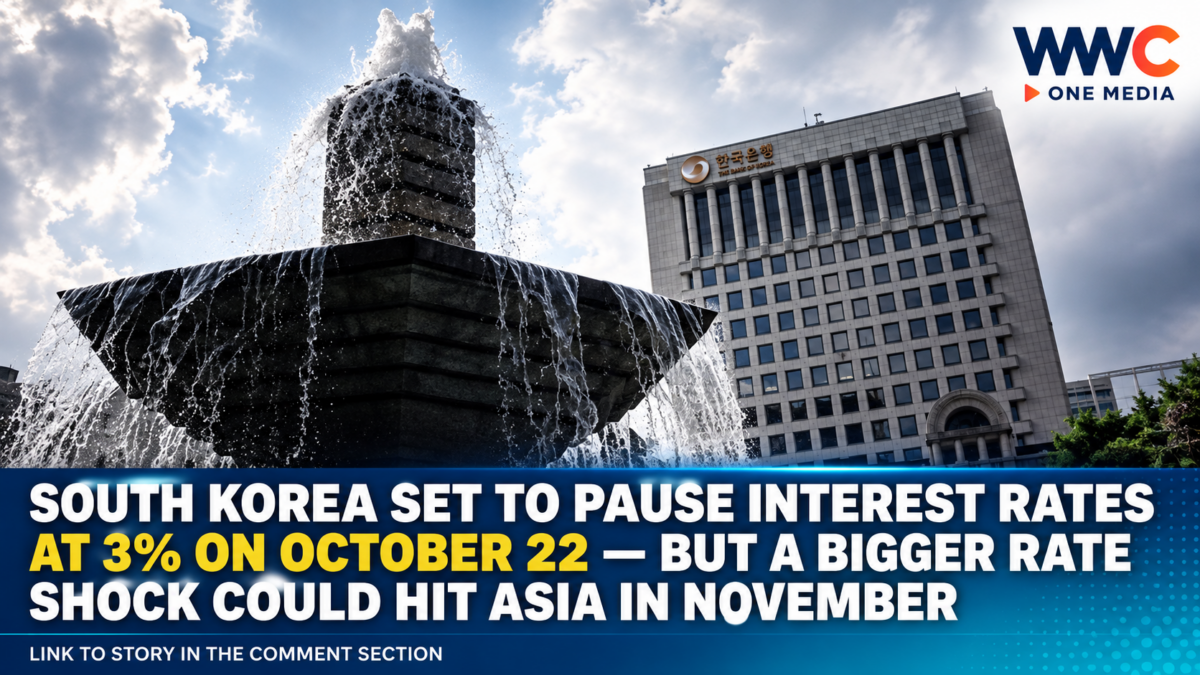
SEOUL, SOUTH KOREA — South Korea’s central bank is expected to temporarily halt its interest rate increases this week, but investors and borrowers may have little reason to celebrate. Economists predict another increase as early as November, raising concerns about mounting borrowing costs, stubborn inflation and growing pressure on Asia’s fourth-largest economy.
According to a Reuters survey conducted from October 14 to 19, all 34 economists polled expect the Bank of Korea (BOK) to maintain its benchmark seven-day repurchase rate at 3.00% during its October 22 monetary policy meeting.
The anticipated pause follows two consecutive interest rate increases as policymakers attempt to control inflation without destabilizing financial markets or undermining economic growth.
However, the pause may be short-lived.
The median forecast from economists suggests that South Korea’s central bank could increase interest rates by another 25 basis points to 3.25% in November, followed by a further increase to 3.50% during the first quarter of 2027.
If those projections materialize, Korean households, businesses and investors could face an extended period of elevated financing costs.
Inflation Is Cooling, but the Fight Is Far From Over
South Korea’s consumer inflation slowed to 2.9% in September from 3.1% in August, suggesting that previous monetary tightening may be starting to ease price pressures.
Nevertheless, inflation remains substantially above the Bank of Korea’s official 2% target.
Elevated energy prices, stronger domestic spending and continued economic expansion are complicating policymakers’ efforts to restore price stability.
The Reuters survey projects annual economic growth of 3.5% in 2026, supported by the country’s powerful semiconductor industry and improving domestic demand.
Inflation, meanwhile, is forecast to average 2.7% this year before easing to 2.2% in 2027.
The central bank must now determine whether higher borrowing costs are necessary to prevent inflation from becoming entrenched.
Semiconductor Boom Creates an Unexpected Challenge
South Korea’s technology sector has emerged as a major source of economic strength, benefiting from demand for advanced semiconductors and artificial intelligence infrastructure.
Companies such as Samsung Electronics and SK Hynix occupy strategically important positions in the global semiconductor supply chain.
Strong chip exports can support industrial output, employment and corporate investment, helping the economy withstand higher interest rates.
However, an increasingly resilient economy also presents complications for monetary policymakers.
As export-driven growth spreads into domestic investment, employment and household spending, inflationary pressure could persist.
That creates a difficult situation for the Bank of Korea: the economy may be strong enough to withstand additional tightening, but higher rates could put greater strain on indebted households and interest-sensitive businesses.
South Korea’s Housing Market May Be the Bigger Problem
Beyond consumer inflation, South Korea’s property market has become a central concern for monetary policymakers.
Housing prices continue to rise despite previous interest rate increases, while household borrowing remains an important financial-stability risk.
Although mortgage borrowing growth has moderated, economists warn that existing monetary tightening may not have been sufficient to cool property demand.
Higher interest rates generally increase financing costs for new borrowers and those with variable-rate loans, potentially slowing housing transactions and discouraging speculative property purchases.
But the consequences are not evenly distributed.
Families carrying substantial mortgage debt may experience greater financial pressure, while prospective homebuyers could face even higher monthly repayments.
A prolonged tightening cycle could therefore protect against excessive property speculation while simultaneously making homeownership more difficult.
KOSPI Volatility Adds Another Risk
South Korea’s stock market is also experiencing significant volatility, adding uncertainty to the central bank’s decision.
Reuters reported that the benchmark KOSPI recently fell to a six-month low, triggering a market circuit breaker amid heightened trading turbulence.
The development highlights the delicate relationship between monetary policy and investor confidence.
Higher interest rates can make borrowing more expensive for companies and reduce the relative attractiveness of equities compared with interest-bearing assets.
However, stock market weakness alone may not persuade policymakers to abandon monetary tightening.
South Korean household wealth is heavily concentrated in property, making housing prices particularly important to consumer confidence and overall financial stability.
Economists nevertheless caution that a sustained equity-market decline could influence how quickly the central bank increases rates.
November Could Become the Decisive Meeting
The Reuters survey suggests that October’s widely expected pause is more likely to represent a temporary assessment period than the end of South Korea’s tightening cycle.
Bank of Korea Governor Shin Hyun Song has indicated that policymakers need time to evaluate the effects of previous increases.
That approach gives the central bank an opportunity to examine inflation, financial markets and economic activity before deciding whether another rate hike is necessary.
Several important developments could influence the November decision:
- Whether inflation continues moving toward the 2% target.
- Whether South Korea’s semiconductor-led growth spreads into broader domestic demand.
- Whether housing prices and household borrowing begin responding to previous rate increases.
- Whether equity-market volatility threatens consumer confidence and investment.
- Whether global energy costs and financial conditions create additional inflationary pressure.
A November increase to 3.25% remains an economists’ forecast, not an official Bank of Korea decision.
Why the Philippines and the Rest of Asia Should Pay Attention
South Korea’s interest rate outlook carries implications beyond its borders.
As one of Asia’s largest industrial and technology economies, South Korea plays an important role in regional manufacturing, semiconductor production, international trade and investment.
A tightening cycle in Seoul could influence regional market sentiment, especially as investors compare monetary policy decisions across major Asian economies.
For the Philippines, South Korea is an important economic partner through electronics supply chains, investment, tourism and trade.
Changes in Korean interest rates could affect financing conditions, currency movements and investment decisions, although the actual impact on the Philippine economy would depend on broader international financial conditions.
The direct implications for Bangko Sentral ng Pilipinas policy should not be overstated. Philippine monetary decisions are primarily driven by domestic inflation, growth, financial conditions and the central bank’s own assessment of risks.
Nevertheless, developments in South Korea offer another indication of how Asian policymakers are confronting the difficult combination of rising prices, resilient economic activity and volatile financial markets.
The Bigger Picture: Asia’s Central Banks Are Walking a Tightrope
South Korea’s monetary policy outlook comes amid continuing uncertainty across global financial markets.
Energy prices, international trade tensions and shifting expectations for major central banks have complicated the outlook for inflation and economic growth.
For South Korea, strong semiconductor demand provides a cushion against economic weakness.
But persistent inflation, elevated property prices and household debt may leave policymakers with limited room to ease financial conditions.
The challenge is finding the right balance between containing inflation and avoiding excessive damage to consumer finances and investment.
The Bottom Line
South Korea appears headed for a temporary interest rate pause on October 22, with economists unanimously forecasting that the Bank of Korea will leave its policy rate at 3.00%.
Yet the November meeting could prove more consequential.
If inflation remains stubborn and housing pressures persist, policymakers may choose to increase rates again despite recent market volatility.
For investors, homeowners, businesses and economies connected to South Korea, the key question is no longer simply whether the central bank will pause this week.
It is whether South Korea’s next interest rate increase will bring inflation under control — or create a new wave of financial pressure across Asia.